Searching for geography curriculum has been a fruitless pursuit for me, so I dabbled in creating my own. We discussed earth being our home, looked at maps, and located places on the globe from our history and literature studies. That was enough, but I wanted to go more in depth.

When I was introduced to A Child’s Geography, Explore His Earth by Ann Voskamp, I thought, “Maybe this is it!”

A giddy, homeschool mom drooling over curriculum is not new, but I’m still excited after starting the lessons, examining the activities, and skimming the suggested reading lists.

The first lesson echoes the first idea I presented to my children. This amazing earth was created by God as a home for us, but Ann goes deeper to explain the enormity and beauty of our world.

Engaging, conversational chapters expand a child’s understanding of atmosphere and climate, continents and earthquakes, maps and oceans, and more. The Scriptures scattered throughout are an integral part of the text.

Each chapter is followed by a clever review. Postcards are used to record the main ideas of the lesson. (template included) Thorough instructions for hands-on activities further enrich the lessons.

My favorite parts are the Reaching Out segments, because they include tangible ways to minister to our neighbors on this spinning sphere. Geography is God’s handwriting on the earth he created, so it is fitting to intertwine his loving purpose while studying. Ann Voskamp does this eloquently and practically. She gives a portion of the proceeds to World Vision.

The only thing I want to change is the ebook format. I wish I’d gotten a print copy, which are now available at Christianbook.com and Timberdoodle.

Written by Renae Deckard, Biblical Principled mother of 3. Find Renae’s reflections about homeschool and family life at Life Nurturing Education. (Originally published at Heart of the Matter Online.)


This is the first dictionary of the American English language. Written by Noah Webster, considered the founding father of American Christian education, this dictionary is an important asset to any homeschool library. I refer to it in our studies daily and Mr. Webster’s definitions have spurred many rabbit trails and offered a lot of insight.

The green pages in the front of the book are a biography of Webster and his contributions to American Christian education. In the introduction of the dictionary itself Mr. Webster offers a lot of useful help, starting with what language is, where it came from and its history. He also includes notes on grammar, orthography and etymology.

I do not believe there has ever been a dictionary so lovingly and painstakingly produced. He learned 20 languages to help him in his pursuit and diligently looked each word up in 20 to 30 other dictionaries of various languages, considering language, use and grammar, making notes and scrutinizing every entry.

The words are defined completely and the list is exhaustive. It’s a huge book at around 2000 pages and it is a facsimile of the original, so the typesetting and format is identical to his original. The definitions give the part of speech, language of origin and examples of the word used in context (many examples come from scripture).

Reasons you may like this book

  • It is thorough (70,000 words completely defined)
  • It gives the original meanings of words as they used them at the time of the Revolutionary War.
  • The scripture examples given
  • The helpful notes at the front of the book
  • It gives great opportunities for word studies within the definition
  • It is done excellently
  • It allows you to use words precisely

Reasons you may not

  • Modern words are not here so you need another dictionary to supplement
  • The size (note it is available on CD-ROM)
  • The wording can be challenging. For younger students you will have to put things in your own words at times
  • Cost is $50+

The American Dictionary of the English Language (1828 Facsimile Edition)
is available in hardback or on a CD-ROM. It is available many places (such as the Foundation for American Christian Education, Amazon and CBD) and is often on sale.

Anna-Marie blogs at http://principledmom.com


History textbooks have a tendency to be boring, but I discovered a series of about American history to treasure. These books do not contain dry lists of dates or a simple retelling of events. Instead, they focus on the causes behind events: people and Providence.

The Mighty Works of God consists of three volumes for the early elementary years. They are not listed by grade-level, but gradually increase in difficulty. This review will focus on the 1st level, which is roughly 1st or 2nd grade.

The first lesson from The Mighty Works of God: Self Government introduces history as the story of God working in the lives of men and nations. For his title page, my son wrote,

“You are the God who works wonders…Psalms 77:14”

He was so inspired considering the works of God in his own life that he composed a song:

God, You are so good to me. God you set me free…

That moment I knew it was a good curriculum choice.

We placed the carefully written song in his notebook along with the variety of colorful pages created from the CD in the Teacher’s Guide Timelines, coloring pages, t-charts, maps, and notes created a meaningful overview my son still enjoys purusing.

The Teacher’s Guide also includes detailed lesson plans and suggestions For Reflection and Reasoning and Cultivation Mastery. Each lesson is one leading idea, so it is simple to implement.

The lessons are derived from original source documents whenever applicable and those sources are shared in The Teacher’s Guide. I still refer to the quotes and research even though we aren’t using this particular curriculum right now.

I requested permission to use some images and samples from the book, and it was graciously given to me. The following list of files (pdf) were sent to me by the author, Ruth J. Smith.

You can get a good understanding of what is covered in the year-long program and a glimpse of the beautiful artwork throughout:

I learned so much using this curriculum. It gave me examples of how to use leading ideas and how to research lessons. It also filled many holes my own history education, especially in regards to looking for internal causes instead of merely at external events.

The best part is that it inspired my song-writing son to remember the Mighty Works of God.

Written by Renae Deckard, Biblical Principled mother of 3. Find Renae’s reflections about homeschool and family life at Life Nurturing Education.


There were just a few more pages to turn when it happened. My voice froze and I felt the tears pushing. My son grinned knowingly, “Mom’s going to cry.”

It doesn’t happen very often, but literature gets me the most often. And biographies. Biographies can be just too inspirational for me to maintain my composure.

I picked up a copy of Louis Braille, The Boy Who Invented Books for the Blind at Paperbackswap during Christmas. It wasn’t on a reading list anywhere, but I was ordering a book about Helen Keller and figured it would go along well with her story.

While my children munched on sandwiches, I read the short biography aloud, flipping it around anytime there was a sketch to keep their imagination going. We were all engaged from the beginning.

This poor boy ended up blind because he disobeyed his father. How would he react? What would happen to him?

The story of Braille’s exemplifies hard work and determination. It is a story of a hunger to learn and the blessing of reading. It is a story of how one person can change lives for generations, even if unknown at death.

Not one newspaper in all of Paris printed the news of his death. Yet today his name is known all around the world. He was a simple schoolteacher. He never made much money. Yet today blind people everywhere bless him for giving them one the greatest gifts of all time – the alphabet called braille.

Yes, what a wonderful gift! And what a wonderful gift to read about with your children.


Child Studying

Curriculum collects on shelves in our living room and peaks from boxes in the shed. A glance in either place reveals more stuff than we can realistically use. I’m so thankful for the options, but options can paralyze.

So how do I choose what to help me teach my children? How did these books end up in our possession instead of others?

I search for items that line up with our purpose for homeschooling, and trust God to lead me. Yes, the academics are important, but when I consider our goals getting an A in calculus isn’t top priority.

  • I want my children to have godly character.
  • I want my children to know how to think and reason.
  • I want my children to grow in responsibility and self-government.

Can curriculum really address these deeper heart issues? I think that is the whole purpose of learning. So the curriculum crowding the shelves in our home has certain qualities.

It is reflective in nature.

Children need time to think about ideas. I keep multiple choice and fill-in-the-blank worksheets at a minimum.

It lays out the principles of a subject in a sensible way.

Definitions fill full the ideas words represent. A young child can understand that letters make sounds, sounds create words, and words turn into sentences. In this way, they can understand the whole subject of reading before they begin the practice.

It uses original source documents.

Reference materials lay a foundation for self-learning. Quotes inspire us to dig deeper into the context of historical events. Biographies are some of my favorite resources.

The writing is high-quality and inspirational.

This benefits my whole family. When we read good literature, we all enjoy lessons more. Yes, “Spot ran,” is technically a sentence, but it’s not engaging. Every student craves ideas and well-crafted stories.

When I started homeschooling, I had no idea how many wonderful resources I would find. I used to search to find enough for a complete year. Now it seems curriculum finds me.

What about you? What do you look for in curriculum? Do you have more than enough or not enough?

Written by Renae Deckard, Biblical Principled mother of 3. Find Renae’s reflections about homeschool and family life at Life Nurturing Education.

photo credit: kaleid


Growing up I read book after book. However, very few of the volumes I read are remembered or revisited.

At the library I checked out whatever looked interesting: Nancy Drew mysteries, Grace Livingston Hill romance novels, or historical fiction. My random searches hid some amazing authors. Now I get to discover these imaginative writers with my children.

14858: Brighty of the Grand CanyonAfter lunch I read aloud Brighty of the Grand Canyon.

“One more chapter please!” begs my three-year-old.

Her five-year-old sister crowds close and grins widening bright blue eyes. Eleven-year-old brother peeks in almost every chapter. As the verbs bounce off my tongue, the suspense of the story pulls him away from Lego.

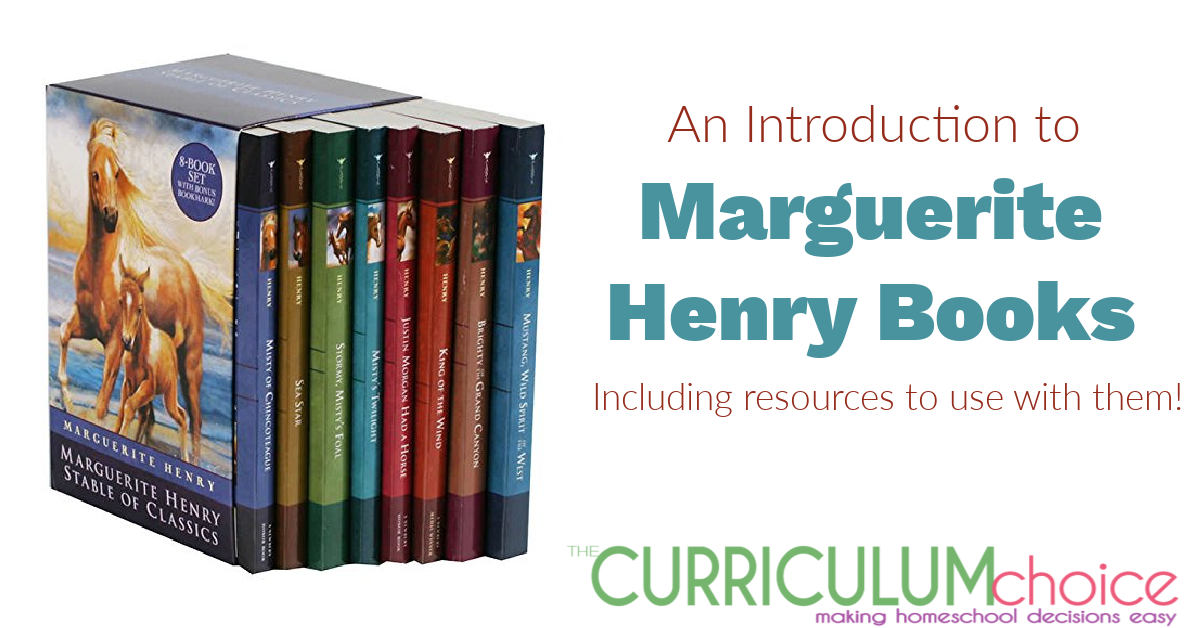
Our collection of Marguerite Henry’s horse books was rescued from the trash. Library books thrown out to make room for new stories. Brighty of the Grand Canyon taken home only once in eight years. Was this spirited burro on the shelf at my school library? If he was, I didn’t take him home either.

Marguerite Henry was not introduced to me in my youth. But I know her now.

Her stories are revisited often in this home. Benjamin West and his Cat Grimalkin roam the house resting next to Father’s side of the bed, then Mother’s. Justin Morgan Had a Horse cracks my voice and spills tears over my eyelids. Children gasp, “Why are you crying?”

For many reasons, I’m sure. Because life is full. Because ideas are powerful. Because children crowd around me to enjoy the lacing of words. Stories crafted to communicate ideas of liberty, hope, and faith. Morsels I want to savor together as we read book after book…

Written by Renae Deckard, Biblical Principled mother of 3. Find Renae’s reflections about homeschool and family life at Life Nurturing Education.

_________

If you subscribe to The Curriculum Choice, I apologize for the lack of updates lately. Our feed was not being sent out. That has hopefully been rectified. Thank you for your patience.


After two year of homeschooling, I heard an idea I quickly embraced. In fact, I don’t know why it hadn’t been implemented already.

Start each day with worship.

We read the Bible. Math lessons were completed. Spelling done. But what about ideas wrapped in melody? I wanted words from the saints echoing in our soul.

Our worship time varies greatly from new music to old. We use CDs, YouTube videos, or simply our voices. It can be one song or many. And it usually includes at least one little person dancing. When I hear humming throughout the day, I know the effort of gathering everyone is worth it.

One resource we’ve enjoyed is the series by Bobbie Wolgemuth and Joni Eareckson Tada entitled, Hymns for a Kid’s Heart.

48986: Hymns For A Kids Heart, Volumes 1 and 2

Before the words and music for each hymn, there is a beautiful illustration, an introduction to the hymn writer, and a personal story from Joni Eareckson Tada.

There are twelve hymns per book. I read the short biography one day and “From My Heart to You” the next, spending one week on each hymn. The accompanying CD includes children singing with both of the authors. The arrangements are engaging and pleasant.

There is also a version for Christmas Carols and Passion Hymns. They don’t include the biography section, but instead have a Scripture verse and Bible story to introduce the music.

These books are not just for kid’s hearts. My heart needs the inspiration, too. We pulled out the Christmas one this morning to sing, O Come All Ye Faithful. Yes, I need to come. I need to rest a moment and lift my thoughts heavenward before the day’s work begins.

Written by Renae Deckard, Biblical Principled mother of 3. Find Renae’s reflections about homeschool and family life at Life Nurturing Education.


HeroTales by Dave and Neta Jackson

Homeschooling moms are great multi-taskers and always on the lookout for items that also multi-task. Hero Tales by Dave and Neta Jackson, the authors of Trailblazer Books, is part church history, part devotional, and part character study. This book can be used with various age groups and double as a family devotional. The book is geared for children aged six to twelve, however, with guidance you can engage a younger child. An older child could benefit by using this as an outline for further in depth study into one or more of the featured Christians in the book. However, the text would be too simple for a child above the age of 12 to read on his own. If you have have a vast array of age groups this book is best used as a family devotional.

Hero Tales, compiles the lives of Christian heroes from William Tyndale to Harriet Tubman to Dwight L. Moody. The stories are inspirational and teach valuable character traits which glorify God. Each hero is presented by a brief biography and followed by three true stories each focusing on a particular character trait. At the end of each true story there is a verse linking the trait to the Bible and three study and discussion questions.   Martin Luther

For example the book includes Martin Luther as one of the heroes featured. Martin Luther’s life is briefly outlined for background. Following the short biography, the child will focus on vision, courage and joy in each of the stories on Martin Luther.

These heroes will inspire and teach Godly character. Along the way, your child will begin to learn an overview of church history. You can read this book daily or you can take the time to focus on each hero or a character trait you want to instill in your child. I am using this book with my 11, 9, and 4 year old. I will be assigning my 11 year old to choose a person from the book to write a biography. My 9 year old will focus on writing a few short paragraphs on a character trait that he can begin to implement in his life. My 4 year old, will begin to memorize short verses on the character traits studied. As a family, we will use the questions to open up lines of communication and instill values.

I recommend this book to anyone who wants to bring church history, devotional time, and character study to their elementary aged children.

Written by Richele, classical and Charlotte Mason inspired, homeschooling mom, to four reflections of God’s love.  She blogs at www.underthegoldenappletree.blogspot.com.


I knew my son needed to learn how to read, but I’d never taught anyone. I debated the decision to homeschool. I worried and fretted. Then I resolved to trust the process. I’d been taught the basics of teaching phonics through a program called, Writing Road to Reading.

We used it. It worked!

Then we got to the spelling rules and the notebook work. I had a general idea of what to do, but really wanted more examples. That’s when I discovered Spell to Write and Read by Wanda Sanseri.

Spell to Write and Read

Mrs. Sanseri started her program by writing helpful tutorials to go along with Writing Road to Reading. Soon it became it’s own separate manual.

I purchased an older version called, Teaching Reading at Home, but from what I can tell the new version is similar. There are specific tutorials for teaching letter formation, step by step instructions for working through the program, and sample notebook pages.

By the time I invested in this curriculum, my son had already learned the 70 phonograms, but I still found it helpful. What we did use daily was the second part of the curriculum, The W.I.S.E. Guide to Spelling.

The W.I.S.E. Guide breaks down the spelling lists and gives lots of ideas for using each week’s words. I found that especially helpful.

Spell to Write and Read is a total language program. It teaches reading, writing, and spelling all at the same time. Children learn to write the letters as they learn their sounds. Then they compile their own spelling book that reinforces what they already learned. It is an investment that can be used for multiple grade levels. The spelling portion can be used all the way through high school.

There are a lot of recommended resources, but all that is really needed are the two books mentioned above and some form of the phonogram cards. Mine were cut out of our Writing Road to Reading book and covered with contact paper. Two of the phonograms are different, but my son didn’t even notice.

This year I added two Learning Logs from Wanda Sanseri’s site, Back Home Industries. A composition book can be used instead. I splurged a bit, because it’s time to teach my two little girls to read.

I’m looking forward to it this time around. The fear is gone. It’s been replaced by the wonder and simplicity of laying a solid foundation of learning.


Guest post by Dana Hanley

I never thought much about handwriting when I started homeschooling.  I never thought about its principles or developed any particular philosophy of what handwriting was or how good handwriting should be developed.  I taught it exactly as I had been taught:  through repetition and drill, expecting perfect conformity of letters.  I must confess that I have had no more luck using this method with my daughter than my teachers had with me. 

Each of my daughter’s letters are formed neatly during handwriting practice, but this neatness fails to carry over to any writing she does no matter how I emphasize the importance of neatness.  By the beginning of this school year, I decided that maybe she needed something more than just more drill and began searching for a handwriting program that went beyond merely how to form letters. 

Reading the introduction to The Palmer Method of Business Writing, I knew I had found something which fit my educational philosophy and our attempts at using the Biblical Principle Approach.

The copy-book has but one purpose–to secure absolute mechanical accuracy.  The copy-book headline is usually first carefully penciled by a skilled penman after a given model, and shows none of the individuality of the penman employed in its construction.  The penciled copy is given to a skilled script-engraver, who engraves it by hand and further perfects it wherever possible.  This impossible and lifeless ideal the child is required to imitate through long, dreary pages of copying.  No wonder he fails!

Yes, I despise rote copying as much as my daughter!  But this was the first time I had heard that there was another way to teach handwriting.  According to Palmer’s method, there are four components to neat and efficient handwriting, each as important as the other.

When a letter is poorly made, it may be due to one or all of four causes–first, the position may be poor; second, the muscles may be rigid, preventing easy action; third, the mind may not have a good picture of the form; and forth, movement direction may be wrong. (p. 30)

The book seeks through successive exercises to teach students these basic principles of handwriting so that they may be applied at all times, in all assignments.

Unfortunately, the book is out of print.  I purchased a used copy through Amazon, but it has been out of print long enough to also be in the public domain.  Scanned copies are available for free from several sources online, including The Internet Archive.

Dana homeschools her five children using the Biblical Principled Approach.  She blogs at Principled Discovery.

© 2011-2012 The Curriculum Choice All rights reserved. DMCA Notice