I am always on the lookout for living math books, and when I stumbled upon Arithmetic Village, I knew I had to read this new series of books with my children. The five books arrived, and after one reading we were hooked. Ever since then my children, ages 5, 7, and 9, have chosen to read these delightful stories again and again. (Yes, even the nine-year old boy enjoys them!)

The Arithmetic Village series, written by Kimberly Moore, is set in a lovely, magical village nestled in a fairytale countryside where glittering jewels fall from the sky. The reader is gently introduced to place value, addition, subtraction, multiplication, and division, as the children in the village collect, lose, and share the jewels with others.

The series includes:

Arithmetic Village – This first book of the series introduces the five main characters: Polly Plus, Linus Minus, Tina Times, and King David Divide. The concept of place value is introduced through the use of jewels, velvet sacks (ten jewels go in a sack), and treasure chests (ten sacks go in a chest). You can read the story in its entirety here.

Polly Plus – This story demonstrates the concept of addition as Polly goes about the village collecting jewels and adding them in her neat and precise manner.

Linus Minus – Described as “an adorable mess”, Linus shows us how to subtract by losing and scattering jewels everywhere he goes.

Tina Times – Speedy Tina demonstrates multiplication by quickly and efficiently counting groups of jewels as she gathers them.

King David Divide – The wise and fair king of Arithmetic Village, David Divide shares jewels with everyone. He distributes them equally, but if some are left over they go to his pet dog, Rover. (I love the idea of Rover receiving the remainder.)

My favorite things about this series:

  • Rhyming text
  • Engaging and whimsical story line
  • The characters’ demonstrations of sharing, kindness, and other noble qualities
  • The use of fun props – jewels, sacks, and treasure chests – that bring the math concepts to life
  • The Arithmetic Village website. The author offers free hands-on activity ideas and downloads to accompany the books. She has posted several videos showing how to easily make (or buy) your own set of jewels, sacks, and treasure chest and how to use them with your children to reinforce through play the concepts taught in the stories. This website is a valuable resource and is not to be missed.

To purchase any or all of the books in the series, visit Arithmetic Village’s shop page where you can receive an online discount.

I am excited to announce that Kimberly is graciously giving away a set of Arithmetic Village books to one Curriculum Choice reader.

Two Ways to enter the giveaway – you can do both:

  1. Browse the activities at the Arithmetic Village website. Leave a comment here at CC telling us your favorite activity!
  2. Follow Arithmetic Village on Twitter, and leave a comment here at CC to let us know that you did.

Please make sure to leave a separate comment for each of your entries, as well as an email address or blog url where you can be contacted should you win. Entrants must live in the continental U.S.

**Deadline for entries is Monday, June 14th, 10:00 pm (EST).

Good luck, and enjoy your time in the Village!

(Disclosure: The Arithmetic Village series was provided to me for free for review purposes. The views and opinions expressed in this review are purely my own.)

Written by Shannon, who blogs about living books and other homeschool-ish things at Song of My Heart.


Do You Doodle? coverThough I never did well in art in school, I like to encourage lots of different types of art activities with my children.  I want them to feel like art has many different forms and it can be fun.  Although we do artist studies, Artistic Pursuits, and lots of free art time, we also really enjoy doodle books.

What is a doodle book?

There are a variety of doodle book available.  Each of my children have their own copy of Do You Doodle? by Nikalas Catlow, which they all enjoy reading through and figuring out exactly what they might draw.  In a doodle book, there is typically the beginning of a picture and a caption to help the children know what to draw.  For instance, there might be a page with a genie lamp at the bottom and the description at the top “Make the Genie Appear.”  The child can then choose how to finish drawing the scene.

Do You Doodle? is a doodle book that has a variety of picture starters and is perfect for boys and girls alike.  There are also doodle books that are specifically made for boys (such as a starter for an alien invasion) or for girls (such as a starter with drawing in shoes in a boutique-style shoe store).  While I realize that may sound stereotypical, I know that my kids would actually really enjoy the gender specific ones (probably even more than the general ones, to be honest).

What we enjoy about Do You Doodle?

I like that this book not only encourages children (or adults!) to use their drawing skills, but even more so, it inspires their creativity and problem solving skills.  It is fun to watch what they come up with.  In fact, it often makes me wish that I could steal a book away from one of them and make my own creations.

Not only is Do You Doodle? a great art activity, but it can be picked up for under $10 (at Amazon, though the actual retail price is $12.95) and can make an excellent gift.

If you’re a creative type, however, I will have to warn you about one thing: You just might want to buy an extra copy for yourself so you can join in with your children while they are drawing.

Angie is a former domestic flunkie who records her attempts at domesticity, and everything else that happens in between all of those loads of laundry that keep piling up, at Many Little Blessings.  She is also the founder of The Homeschool Classroom and Catholic Mothers Online.


I have recently had the pleasure to read the first e-book by Kris, the widely read author of the blog Weird, Unsocialized Homeschoolers.  The book, in true WUSH fashion, features games, projects, learning centers, and presentations all with a focus on hands on learning.

Get Your Hands on Learning! has four main sections, as well as an appendix full of even more information.  The sections include:

  • Projects: Papier-mache Model, Salt Dough Map, Cookie Dough Map, Ongoing Studies
  • Games: Bingo, Memory/Matching, Go Fish, Board Games
  • Learning Centers: Writing Center, Preschool Learning Centers, Mini-Offices
  • Presentations: Around the World Day, Night at the Museum Party, The Castle Presentation Board, Knights Shields and Swords
  • Appendix: Helpful Websites, Basic Papier-mache Paste Recipe, Basic Salt Dough Recipe, Fifty State Friday Resources, Blank Bingo Card, Reading Bingo Card, Learning Center Resources, Hands-on Activities to Enhance Any Study, Narration, Paper Bag Report

What I Liked:

  • Great Variety – There is a great variety of activities in this e-book, which can appeal to both the families that don’t mind mess, as well as the families that avoid it like the plague.  It’s a nice reminder that hand-on doesn’t have to mean messy, but it can.
  • Step-by-Step Directions – Things like the word “papier-mache” give me hives.  However, with Kris’ easy to understand, step-by-step instructions, it makes me a little less nervous.  The layout, in general, makes it easy to read and follow.
  • Lots of Full Color Photographs – Because I am a visual learning, the combination of photographs with the step-by-step directions are exactly what I would need to execute these projects.  It’s also always nice to see what a finished project should look like.
  • Length of Book – At 50 pages, this is a book that I felt comfortable sitting down and reading in one sitting.  Not that I can’t read a book that will take me many sessions over several days (because of other commitments), but it’s nice when I can sit down and just finish a book.
  • Well Organized – I enjoyed that the activities are each in their own section, so that when I want to implement an idea, I don’t have to skim back through the whole book to find what I was looking for.
  • Reasonably Priced – At only $7.95 for an immediate download, this e-book is competitively priced compared to other e-books that I have purchased.

What I Would Change:

  • It’s Just What I Was Looking For – This e-book was exactly what I anticipated it would be, so I couldn’t really think of anything that I would have changed.

Get Your Hands on Learning! is available for immediate download for $7.95 at Weird, Unsocialized Homeschoolers.


Disclosures: I received this e-book for free in order to review it, although I had planned to buy it before receiving it for free.  Although I have been a fan of Kris’ blog for several years, in interest of full disclosure — I am the founder/editor of The Homeschool Classroom where Kris is a writer.

Angie is a university trained elementary and special ed teacher turned eclectic homeschooler.  She can be found working at Many Little Blessings, The Homeschool Classroom, and Catholic Mothers Online.  It is also very likely that if you find her, she will be tired.


Discovery Bay Games offers a variety of fun and often educational games for families to share. Their mission is simple: bring friends and family together to play, interact, and laugh! This mom believes they have won victories on all counts. As a homeschooling mother of four with a background in educational psychology, I appreciate games that spark imagination while reinforcing lessons learned during school. It is my pleasure to introduce you to three games that your family will beg to play over and over again.


Baffle Gab

Ages: 7 and up

Basic Description: Five word cards are placed for all players to view. The challenge is for the players to write a story in one minute usin the words correctly. Bonebucks are earned for word usage and creativity. The one who earns the most Bonebucks wins.

Educational Value: The game encourages creativity, quick thinking, and the proper use of nouns, verbs, adjectives and adverbs.

Thoughts from my family: I played this game with my 12, 10 and 4-year-old. The game is not for children under 7 because it requires reading, writing and a basic sense of sentence structure and grammar. Being a homeschooling mom, I have learned to tweek things to allow all ages to participate and have fun. My four year-old loved the game! I allowed her to tell me her sentences and practice writing some of the words on the cards. I also gave her plenty of Bonebucks to keep her imagination flowing. With my older children, they played the game as described in the instructions and had a wonderful time. My kids have had assignments before that included a wordbox and using those words to form sentences. My son always hated that assignment and claimed it was too hard. Maybe it was the one minute timer or the competition but he mastered the most creative and well structured sentences he’d written all year. My daughter loved the challenge of using all five words in one sentence. She was the queen of mastering that skill and earning double Bonebucks. We all had a wonderful time and laughed through most of the game. It was a nice break from worksheets. The game encourages proper use of grammar, sentence structure, word choice and sparks imagination.


Beezi: A Spelling Bee Game

Ages: 12 and up

Basic Description: Players try to spell as many words as possible to earn Beez tokens to complete their honeycomb.

Educational Value: The game primarily encourages spelling. However, vocabulary and language concepts are reinforced.

Thoughts from the family: The test subjects were my children again. We found the game to be very challenging. The game is divided into levels of difficulty for a word. The level is chosen by a roll of the die. This only enhanced the game’s fun. The kids had a good time learning new words. They even loved the challenge of trying to spell very difficult words. This game was fun for the kids and the adults. For those who love to watch spelling bees and try to spell the words this game is for you. For those who just want some fun and a challenge this game is for you. I was surprised how much my kids enjoyed playing even while getting many of the words wrong. The challenge is the fun. I let my 4 year-old in on the act by giving her easy words to like her name, mom, dad, cat, dog, etc. to play along also. If you are creative you can add in all your family members. For homeschoolers…you can use the misspelled words for your spelling tests. Or for an added twist replace the words provided with spelling lists you have used all year long for a spelling bee of your own. It’s great fun!

Spooky Tales the Interactive Story Telling Game

Ages: 8 and up.

Basic Description: Players compete by weaving the most creepy tale of the group. Players are given cards with prompts for the beginning of the story, cards to enhance the story and cards with story endings. This game also features a party game called Vampires Rise where players have to figure out who are the vampires and who are the villagers.

Educational Value: Players are using their imaginations to come up with stories from prompts. The game is mostly entertainment and great for sleepovers. Although the game does not hold you to grammar or proper word usage, it does promote the skill of story telling which had its own reward. I feel children need time to think without boundaries and let their imaginations flow. If you want to add on to this game, as a homeschooler or teacher, you may have children write down the stories once the game is finished. At that point you can reinforce language skills for complete writing lesson.

Thoughts from the family: This set comes with a very cool flashlight. By the press of a button you can make the flashlight emit scream sounds, wolf howling, creepy laughing and thunder. My kids loved this part the best! This is perfect for sleepover parties!

My kids are not exposed to horror movies or scary shows, therefore, some of the images on the cards were a bit scary for them. My daughter, at 12, thought the game was too scary for 8 year-olds and maybe even for her. However, once you begin to play the “scary” was of the fun and laughing variety. My daughter ended up enjoying the game and has requested to play it several times since. Keep in mind, the images on the cards can consist of scary things yet it would not be considered graphic nor is it in color. The cards show sketch drawings of a cheerleader with a knife behind her back, an insane asylum, a butcher knife, a grinder or things of that creepy nature. There is one card called “Make Out” with an image of a car parked. So, if you are concerned remove that one before playing. Personally, I feel this game is too mature for an 8 year-old but loads of fun for 12 and up. I did not allow my four year-old to play this game nor go through the cards. I did allow her to play with the flashlight which is a family favorite.

I think it is always nice when family game night can include reinforcing lessons learned in a fun way.  Free learning and time to express yourself without boundaries helps keep the imagination and creative juices flowing.

 
photo by allyrose18

photo by allyrose18

After my recent post on thinking games, I felt that this post on word games would be appropriate since our family enjoys several word games that are both fun and educational.  One challenge about playing word games with the whole family is that it is necessary for children to be able to read, unless, of course, they are playing an introductory child’s word game (which are usually not that fun for the older members of the family). We typically relax the rules of the more advanced word games that we play in order to level the playing field.  We often assist the children in finding and/or spelling words.

The great thing about playing word games is that children get spelling practice and an introduction to new vocabulary words within a fun, game-playing context.  As an older player uses a word unfamiliar to some of the others playing, the meaning can be discussed, the spelling clearly seen, and new knowledge is gained by all.  It seems that we are more likely to remember things that we have learned within the context of having fun.

A final educational benefit that word games provide for children is practice using the dictionary. Not many people find it particularly fun to look up words in the dictionary as part of an assignment.  But when kids are trying to score points in a game, looking up words becomes much more motivating.  In addition, the children are usually seeking these words secretively (so they don’t give parents an advantage in the game).  In other words, they are motivated to act and learn independently (which is sometimes a struggle during the school day for some members of our family).  So find a word game and gather your family together for a fun and educational experience.

If you don’t already have a favorite word game, here are a few suggestions from our list of family favorites.

Bananagrams:

This game consists of letter tiles, packaged in a zippered banana pouch. There is no board, so this game is very portable. Each player draws tiles and makes words using only their own tiles. They join other words like a crossword puzzle. My favorite part is that everyone plays at once. It is fast-paced and no one has to wait for someone to take a turn. Call me impatient, but it does get boring waiting too long for the other players to take their turns in certain games.

Boggle:

This is another compact game where all the players play at the same time. The game consist of letter cubes and a small case to hold the cubes and shake them. For each round the case is shaken and the 25 cubes allowed to rest in the bottom of the case. Players then look for words by connecting the letters. After the set time has passed, players take turns calling out the words that they have found. You only get points for those words that no one else has found, so it is good to write down unusual words. There are points awarded for each unique word with longer words scoring more points.

Quiddler:

This great card game is from the makers of The Set Game. Each card has a letter or a blend of letters on it. For the first hand, each player is dealt 3 cards. Each subsequent hand the number of cards is increased by one, until the last hand where each player is dealt ten cards. Each player tries to use all their cards to spell one or more words. Each turn they must draw one card and discard one card. After the first player is able to use all their cards, all the other players get one more turn and must make whatever words they can from the letters in their hand. The points from unused cards are deducted from their scores. This game lasts longer than the other ones, but it provides more opportunity to help the children find words.

As we homeschool our children, let’s not forget about the natural opportunities that arise for educating our children within our everyday activities.

Written by Kristen, Relaxed Classical Homeschool Mom of 4. Kristen blogs at A Day in the Life.


NaturExplorers graphic

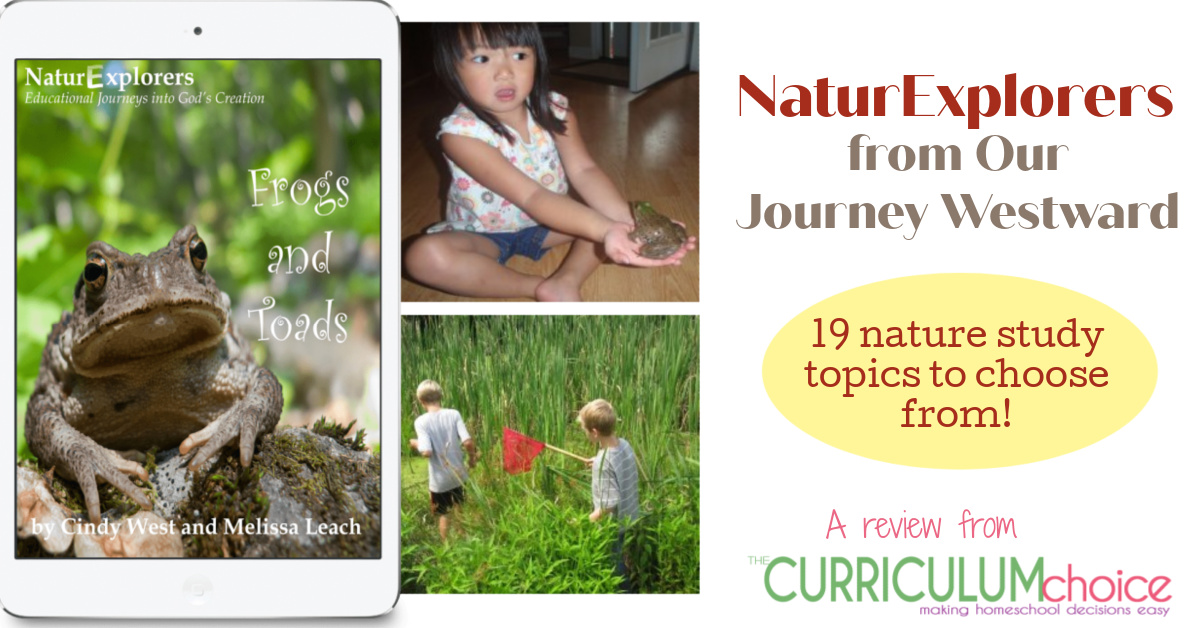
I am excited to tell you about NaturExplorers, a new series of nature-based unit studies written by Cindy West and Melissa Leach. The authors are both veteran homeschooling Moms who are passionate about studying nature with their children and inspiring other Moms to do the same. No matter what type of homeschooler you are, and whether or not you already do nature study with your family, these studies will give you encouragement and ideas for getting outside with your children and exploring God’s beautiful creation.

Here is a sampling of titles in the series:

  • Animal Signs
  • Peaceful Ponds
  • Captivating Clouds
  • Delightful Deciduous Trees
  • Hard as a Rock
  • Creatures of the Night
  • Frogs and Toads

331

One of the things that I really like about these units is their flexibility. They are designed so that you can adapt them to be used in whatever way best meets your needs. A title can be used in its entirety as a complete science-based unit, or you can simply pick up the study and choose an idea to focus on as you head out the door for a nature walk.

However you decide to utilize these studies, you will find that they are jam-packed with plenty of ideas to keep you inspired about that particular nature topic for quite a long time.

Each unit includes the following:

  • A section just for you, the teacher, to spark your interest and excitement about the topic
  • Suggestions for quality, living books that will inspire your children about the topic
  • Background knowledge for the teacher to equip you with some basic information about the topic before beginning the study 
  • A great number of ideas for nature walks and outdoor activities
  • Hands-on activities such as science experiments, art projects, recipes and more
  • Writing and research ideas
  • Bible lessons
  • Poetry
  • Artist and Picture study references
  • Composer and Music references
  • Helpful internet links
  • Ideas for including younger and older children
  • Suggestions for nature clubs and co-ops
  • Nature Notebooking Pages

wetlandwaterobservation3

I found the  ideas to be creative and engaging, and as you can see, the units cover a lot of ground.  I’d also like to mention that they are available in e-book format and are budget friendly.

I encourage you to head over to Shining Dawn Books where you can check out all of the themes that are available and find a wealth of free helpful nature study ideas, information, and photos as well.

Written by Shannon, who blogs about her family’s homeschooling adventures at Song of My Heart.


eva21 Shortly after I started homeschooling, I came across a wonderful activity that we now incorporate into our curriculum regularly.  With the popularity of new technological gadgets, many people are familiar (to varying degrees) with Geocaching.  Fewer, however, are familiar with Letterboxing.

      Letterboxing is an intriguing pastime that combines navigational skills and rubber stamp artistry in a fun outdoor quest. Letterboxers hide small, weatherproof boxes in publicly-accessible places and post clues to finding the box online. There are over 20,000 letterboxes hidden in North America alone. Individual letterboxes usually contain a log book, an often hand-carved rubber stamp and may contain an ink pad. Finders make an imprint of the letterbox’s stamp on their personal log book or nature journal, and leave an imprint of their personal stamp which they carry with them in the letterbox’s logbook .

      As explained on the website Letterboxing North America, “Letterboxing is said to have started in England in 1854 when a Dartmoor National Park guide, James Perrott of Chagford, left a bottle by Cranmere Pool with his calling card in it as an invitation to those who found the bottle to add theirs. Eventually, visitors began leaving a self-addressed post card or note in the jar, hoping for them to be returned by mail by the next visitor (thus the origin of the term letterboxing; letterbox is a British term for a mailbox). This practice ended in time, however, and the current custom of using rubber stamps and visitor’s log books came into use. It caught on in the US in 1998 after an article in Smithsonian magazine.”letterbox-journal-page

      Letterboxing is intended to be an environmentally friendly activity, with as little impact as possible on the environment involved in hunting for letterboxes.  As we hunt for letterboxes, we always pick up any litter or debris that was left behind by people who care less for the land than we do.  The most important things to remember when letterboxing are respect and safety. Respect for the environment and for the letterbox that someone has created and your personal safety.  

      Sometimes we’ve searched for the letterbox and have not been able to find it. This could be because it was simply too difficult or because the box is in fact missing. Although this can sometimes be frustrating, we always remember the great time we had with the hike and the hunt, even if we are not successful.  After all, it provides us with an opportunity to observe nature and occasionally catch glimpses of wildlife (elk, ground squirrels, birds of prey, etc.). 

      Several of the letterbox quests require the use of a traditional compass.  This provides a great opportunity to introduce orienteering to children.  Most, however, rely upon simple written instructions.  In Ashland, Oregon, home of the renowned Ashland Shakespeare Festival, many of the hidden boxes are inspired by William Shakespeare and the clues incorporate passages from his many theatre plays.

      In spite of often rainy, inclement weather, Charlotte Mason insisted on going out once-a-week for an official Nature Walk, allowing the children to experience and observe the natural environment firsthand. These excursions should be nature walks, not nature talks, explains.  Letterboxing has always provided us with the incentive to get out there when we may otherwise feel inclined to stay indoors.

      Not only can a wide variety of adventures be found to suit all ages and experience levels, but letterboxing can also be done year-round in most areas.  Only those boxes that may be concealed beneath the snowfall would be unobtainable.  One of the unexpected challenges that can arise during the winter months, however, is that many of the clues relate to plants and trees in full foliage. This provides the perfect opportunity to learn about plant identification in the winter.

      On of our most memorable quests was in February.  Though it was chilly at the start, we didn’t expect the surprise that nature provided us…snow!  Charlotte Mason would have been proud of our enthusiasm and commitment to learning about nature in all its glory. She believed that bad weather was no excuse for not having the daily outing and the weekly nature study. As long as the children are dressed adequately to protect them from the cold or rain, the nature study can still proceed in the same way as on clear, lovely days. Winter or wet days will each offer their own variety of nature to experience.

      Frequently, upon our return home following a letterbox quest, the children will illustrate their favorite discovery (a new wildflower or an interesting cloud they observed).  They are beginning to also include questions and to occasionally include poetry.  As interest develops, creating a letterbox of their own would provide children with additional opportunities for writing, orienteering or navigating practice, and expressing themselves (carving the stamps). 


Written by Makita, an eclectic homeschool mother of two.


For more information: 

Letterboxing North America.  http://www.letterboxing.org 

The Letterboxer’s Companion

by Randy Hall 

It’s a Treasure Hunt! Geocaching & Letterboxing

by G & R Publishing

© 2011 The Curriculum Choice DMCA Notice Suffusion theme by Sayontan Sinha