Shannon

Jun 162011
 

I’m always looking for new and different resources to use for our morning Bible time around the breakfast table. I first heard about My ABC Bible Verses on a Christian radio broadcast and placed it on my wishlist. I recently purchased it and am so glad that I did. We are almost to the end of it now and have been incredibly blessed by it. Not only does this book provide morning devotional material for us, but it is also a valuable tool for memorizing Scripture.

The author, Susan Hunt, has chosen one Bible verse for each letter of the alphabet. Accompanying each verse is a short story that demonstrates how the Scripture is applicable in daily, real life situations that are common to children. Each of these twenty-six stories follows the everyday childhood joys and trials of Missy and Bill, a brother and sister whose parents continually show them how God wants to use His Word to make them more like Jesus.

Here is the layout of each day’s reading:

  • the verse for the day
  • a short (two or three sentence) explanation of the verse
  • the story
  • a “Let’s Talk” section with two or three questions you can discuss with your child, which help to cement the truth and application of that day’s Scripture
  • a prompt to say the day’s verse three times in order to memorize it
  • a built-in review of a few of the verses that have already been memorized (This has helped us to retain so much Scripture!)
  • a “Let’s Pray” section that serves as a reminder to ask God for help in applying the day’s verse to your life

Although this book is said to be written for children ages three to seven, my nine-year old looks forward to and thoroughly enjoys each day’s story, as do his five and seven-year old sisters. When we finish this book, we will have twenty-six Bible verses hidden in our hearts, and we will have learned how to apply these Scriptures in our daily lives.

If you try out My ABC Bible Verses, I pray that you will be as blessed by it as our family has been!

Written by Shannon, who can be found blogging about her family’s homeschool adventures at Song of My Heart.

Jun 152011
 

Congratulations to commenter #12, Dawn!

Our winner was chosen using the online Random Number Generator. :)

Dawn, please email me at songofmyheartblog at yahoo dot com within three days for info. on how to claim your set of Arithmetic Village books. I know that and your children are going to enjoy them!

Thank you to all who participated in our giveaway!

written by Shannon from Song of My Heart

Jun 022011
 

I am always on the lookout for living math books, and when I stumbled upon Arithmetic Village, I knew I had to read this new series of books with my children. The five books arrived, and after one reading we were hooked. Ever since then my children, ages 5, 7, and 9, have chosen to read these delightful stories again and again. (Yes, even the nine-year old boy enjoys them!)

The Arithmetic Village series, written by Kimberly Moore, is set in a lovely, magical village nestled in a fairytale countryside where glittering jewels fall from the sky. The reader is gently introduced to place value, addition, subtraction, multiplication, and division, as the children in the village collect, lose, and share the jewels with others.

The series includes:

Arithmetic Village – This first book of the series introduces the five main characters: Polly Plus, Linus Minus, Tina Times, and King David Divide. The concept of place value is introduced through the use of jewels, velvet sacks (ten jewels go in a sack), and treasure chests (ten sacks go in a chest). You can read the story in its entirety here.

Polly Plus – This story demonstrates the concept of addition as Polly goes about the village collecting jewels and adding them in her neat and precise manner.

Linus Minus – Described as “an adorable mess”, Linus shows us how to subtract by losing and scattering jewels everywhere he goes.

Tina Times – Speedy Tina demonstrates multiplication by quickly and efficiently counting groups of jewels as she gathers them.

King David Divide – The wise and fair king of Arithmetic Village, David Divide shares jewels with everyone. He distributes them equally, but if some are left over they go to his pet dog, Rover. (I love the idea of Rover receiving the remainder.)

My favorite things about this series:

  • Rhyming text
  • Engaging and whimsical story line
  • The characters’ demonstrations of sharing, kindness, and other noble qualities
  • The use of fun props – jewels, sacks, and treasure chests – that bring the math concepts to life
  • The Arithmetic Village website. The author offers free hands-on activity ideas and downloads to accompany the books. She has posted several videos showing how to easily make (or buy) your own set of jewels, sacks, and treasure chest and how to use them with your children to reinforce through play the concepts taught in the stories. This website is a valuable resource and is not to be missed.

To purchase any or all of the books in the series, visit Arithmetic Village’s shop page where you can receive an online discount.

I am excited to announce that Kimberly is graciously giving away a set of Arithmetic Village books to one Curriculum Choice reader.

Two Ways to enter the giveaway – you can do both:

  1. Browse the activities at the Arithmetic Village website. Leave a comment here at CC telling us your favorite activity!
  2. Follow Arithmetic Village on Twitter, and leave a comment here at CC to let us know that you did.

Please make sure to leave a separate comment for each of your entries, as well as an email address or blog url where you can be contacted should you win. Entrants must live in the continental U.S.

**Deadline for entries is Monday, June 14th, 10:00 pm (EST).

Good luck, and enjoy your time in the Village!

(Disclosure: The Arithmetic Village series was provided to me for free for review purposes. The views and opinions expressed in this review are purely my own.)

Written by Shannon, who blogs about living books and other homeschool-ish things at Song of My Heart.

Nov 122010
 

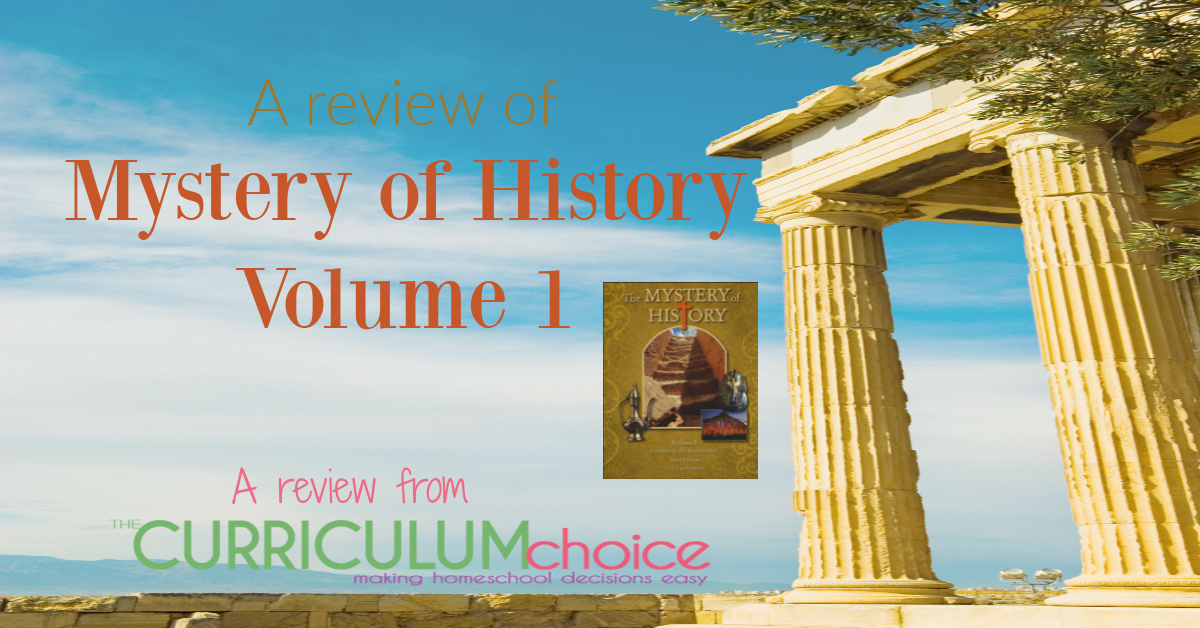
Whether you study history chronologically or, like we do, in whatever order that strikes our fancy, The Mystery of History is a curriculum worth considering.

It is a complete, chronological history of the world, which combines secular and Biblical history. The hardback textbook is written in a conversational style that holds the reader’s attention.

The Companion Guide, which is used in conjunction with the hardback reader, contains:

•28 weeks worth of learning activities for younger, middle, and older students

•Memory cards

•Hands-on projects

•Field trip suggestions

•Review games

•Informative articles for the teacher

•Form for recording grades

•Outline maps

•Geography activities

•Supplemental book list

•Pretests, quizzes, and answer keys

•Timeline helps

The curriculum can be used with grades K-8th, but the author states in her letter to teachers that she has provided “tracks to run on that best match Middle Students, those from about 4th to 8th grades”. The activities can be adapted to fit the needs of younger and older students as well.

Pros:

  • God is placed at the center of the world’s history. The reader can see how His hand has shaped human events.
  • Mrs. Hobar’s writing style is much more interesting than that of most dry, traditional textbooks.
  • The Student Reader is a beautiful, colorful, hardback volume.
  • The activities and helps in the Companion Guide are fun and hands-on, helping to make the history lesson come alive.
  • The curriculum is written in a way that simplifies multi-level teaching, especially if you use the Companion Guide.
  • Students are encouraged to keep a history notebook in which they place their completed activities. I think it’s nice to have a keepsake like this for reviewing material.
  • Even if you don’t teach history chronologically, this is a wonderful resource for studying a specific time period.
  • Traces world events chronologically, lining them up with Biblical history. (For example, the reader learns what was going on in the rest of the world when King David was on the throne of Israel.) Obviously, the events of Volume 3 take place after Bible times.
  • Encourages the use of and gives instructions for making a timeline, which is a wonderful tool for helping students to visualize the unfolding of historical events.

Cons:

  • The only drawback I could find to The Mystery of History was the fact that the textbook did not hold the attention of my 5 and 7 year old.  My 9 year old, however, listened and enjoyed it as a read aloud. My youngers could easily be included in many of the Companion Guide activities though.

To see a video explaining more about The Mystery of History and to view prices for the textbook, companion guide, and supplementary products, visit Bright Ideas Press.

Written by Shannon, who blogs about her family’s hands-on history studies and other homeschool adventures at Song of My Heart.

Aug 162010
 

It’s that time of year again! Many homeschoolers are finishing up their summer breaks, the smell of new school supplies is in the air, and co-ops and support groups are gearing up again. For many folks it’s Back-to-School time.

There is something exciting about the fresh start of a new school year! Even though we school year round, we take a short break at the end of summer and officially kick off our new school year in the fall. I think it’s important to start the year off with a special “first day”, and it can be a great way to get your children excited about school.

Regardless of your homeschool style, having some fun first-day-of-school traditions can breathe new life into your schooling and set the tone for the new year.

Here are a few things we’ve done over the years that have created some excitement and made for some sweet memories:

  • Take a picture of your child holding a sign that says “_____’s First Day of ______Grade”. You might also take this picture with your child standing in the same place each year (on the front porch or in front of a special tree, etc.), so that you and your child can look back and see how much they grew and changed each year.

    First Day Photo

  • Go out for breakfast, or cook a special breakfast. One year I let the kids help me whip up a batch of dino-shaped pancakes for our back-to-school breakfast because we were going to be studying dinosaurs. (You can use cookie cutters or shaped-pancake molds to design different themed pancakes.)
  • Send your children on a scavenger hunt around the house for their new school supplies. I do up a new package of crayons, markers, colored pencils, and a pair of scissors in a plastic pencil box for each child to find. You could even wrap it up in pretty paper or let them decorate the plastic boxes with Sharpie markers and stickers. If you’re a notebooking family, you could let them find and decorate their new binder. You get the idea!

    Display Table for Our Bird Study

  • Set up a table or other area with books and props relating to something you’ll be studying. The year we were studying dinosaurs our table included: a toy dinosaur, books about dinosaurs, a couple of fossils, some small dinosaur posters printed from the internet, and a clear container filled with small plastic dinosaurs with slips of paper for the children to write a guess of how many they thought were in the jar. The possibilities for display tables are endless, and they are a great way to pique your child’s curiosity about a certain topic anytime of the year.

    Making A Special First Day Snack

  • Incorporate some sort of fun activity into your day.  Play a game, do a fun art project or science experiment, go on a nature walk, or take a trip to the library.

    Going on A Leaf Walk

Please realize that we don’t do all of these things each year – just one or two. After all, it’s important to keep things simple so Mom doesn’t stress out!

I hope that you’ve found something fun to try from this list, or perhaps it has sparked some ideas of your own. If so, please leave a comment and share your suggestions.

May you have a wonderful first day and a blessed year of learning and making memories with your children!

Written by Shannon, who blogs about her family’s homeschool adventures at Song of My Heart.

Jul 142010
 

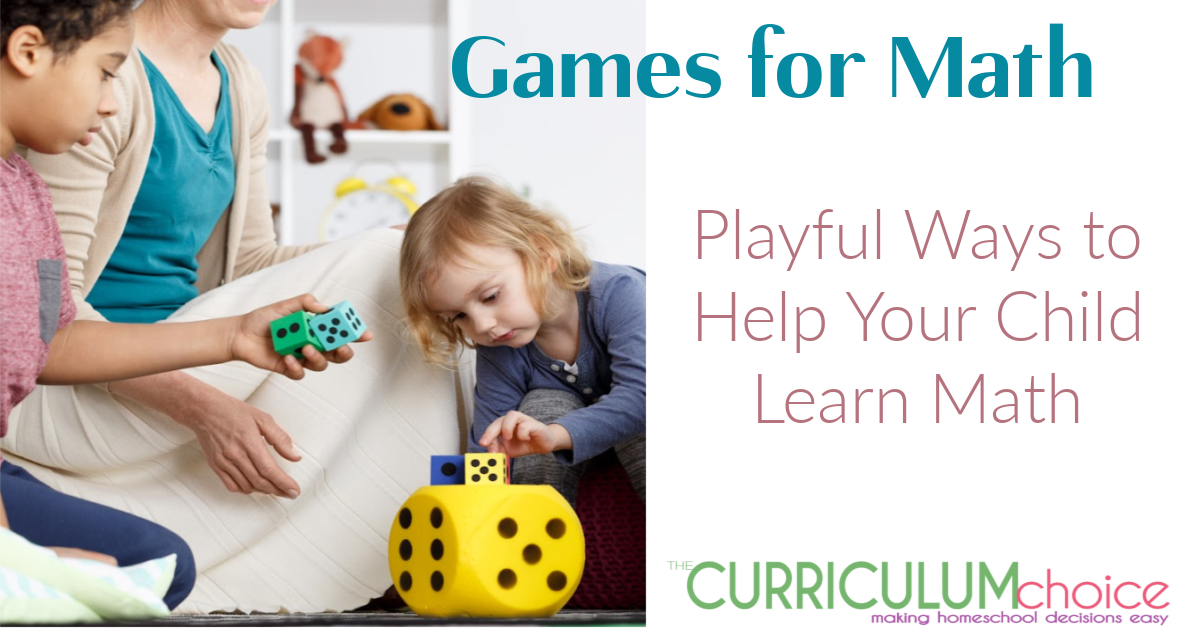
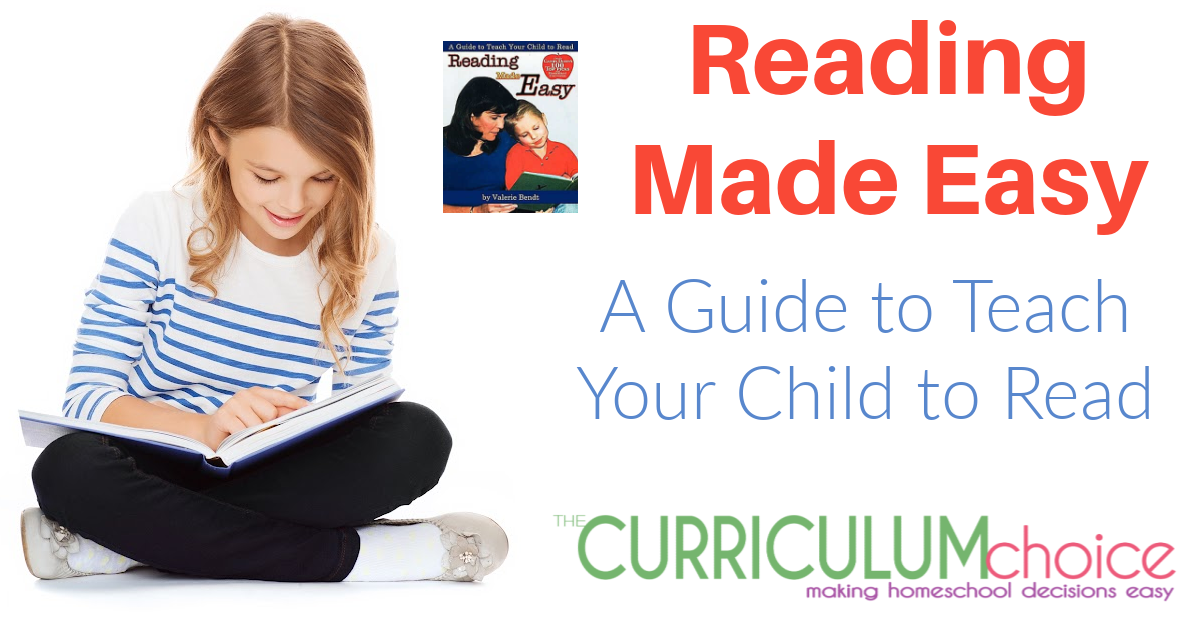
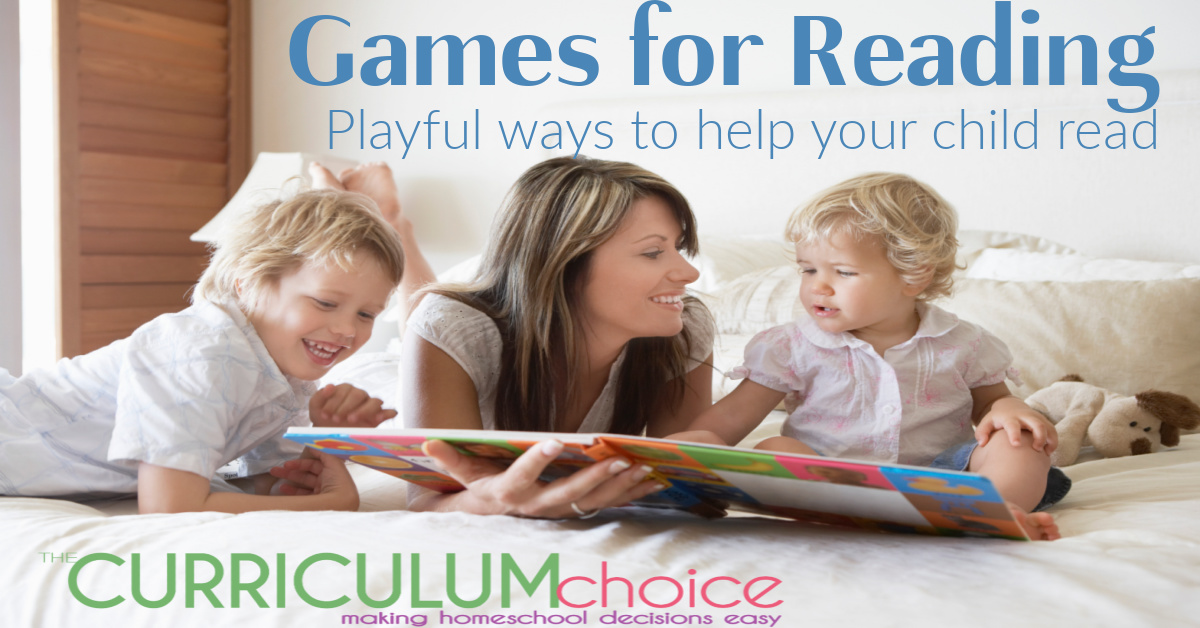
At the risk of being redundant, I’d like to highlight one more of Peggy Kaye’s Games books. I’ve already reviewed Games for Math and Games for Writing here at The Curriculum Choice. All three books are similar in format, but I’ve found each of them to be of such great value that I just had to share Games for Reading with you.

Games are a wonderful way to spice up any reading method or curriculum. Children love to play, and fun games can take the drudgery out of drill. Plus, games are a great pastime when it’s too hot to go outside!

This book contains seventy-six games that cover nearly every skill needed for reading. Although they are aimed at beginning readers, meaning 1st through 3rd graders, these games are valuable for proficient readers too.

The games are organized into four parts:

•Part 1 – Games to improve sight vocabulary

•Part 2 – Games that develop phonics/sounding out skills

•Part 3 – Games to strengthen reading comprehension

•Part 4 – Games to get children to love books and want to read!

If you’d like to check out some of these games, you can visit Peggy Kaye’s website to download samples from each of her books.

There are two additional Games books which I have not seen, Games for Learning and Games with Books. If anyone has used these, I’d be interested in hearing about them.

I hope that you and your children can get your hands on a copy of Games for Reading and have some fun playing and learning together!

-Written by Shannon, who blogs about her family’s homeschool adventures at Song of My Heart.

May 252010
 

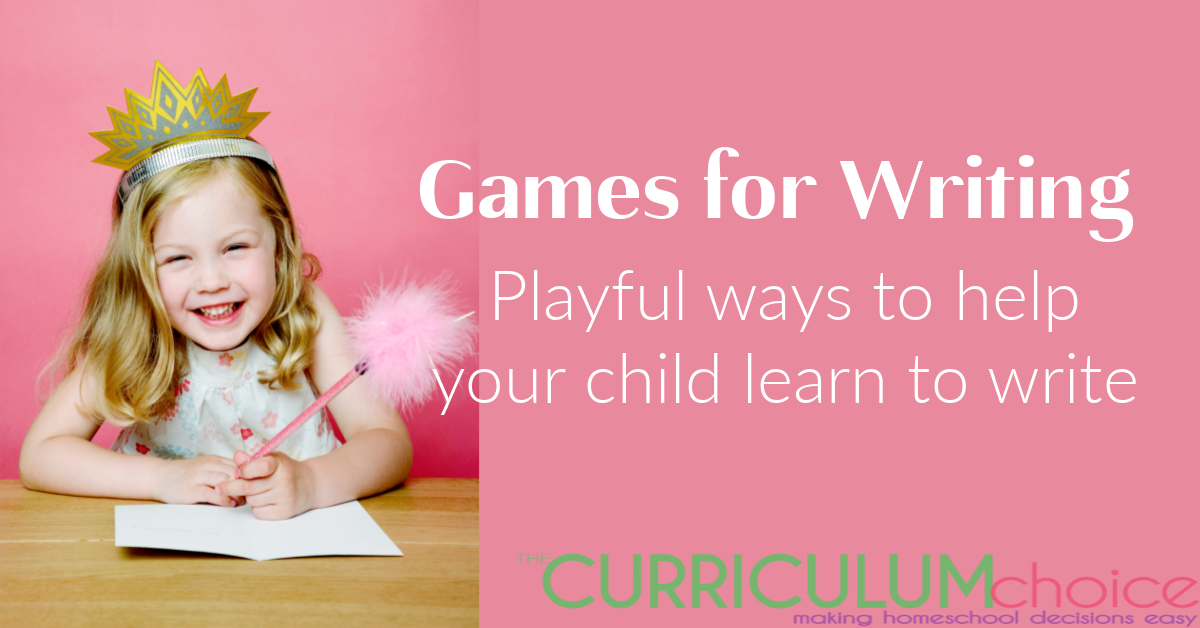
Do have a child who is a reluctant writer, one who has an allergy to writing instruments, or who fills your house with moans and groans when it’s time to put pencil to paper? Whether you do or not, Games for Writing by Peggy Kaye is sure to make writing a fun subject for all of your children – and for you too!

The book contains fifty-two games designed for ages ranging from kindergarten through third grade, and is divided into five sections:

  • Part One: Just for Starters – These activities are designed to ease kindergarteners and first-graders into writing, helping them to learn pencil control, letter formation, and how to tell a well-organized tale.
  • Part Two: Stress Busters – These are silly activities that help children get over writer’s block, choose a suitable topic, and get words down on paper. These are quick games and will probably have your child giggling before they’re finished.
  • Part Three: Bugaboos – Spelling, Handwriting, and Grammar – The section title pretty much says it all.
  • Part Four: Writing with Style - These games will help children create unusual characters, develop an understanding of story structure, and learn to choose the right words to express their ideas.
  • Part Five: Made with Pride – These are longer writing projects that can take anywhere from a half-hour to several sessions of work to complete.

What I like about this book:

  • This is a “grab it and use it” kind of book. The games do not require many supplies or much preparation. Many just require pencil, paper, and a few minutes to sit down and have fun with your child.
  • The games are fun and motivating. (The ones I’ve played with my children have had them asking for more.)
  • The activities provide a great opportunity for some enjoyable parent/child interaction – not just another boring writing lesson.
  • The author includes entertaining stories of how she has used each specific game with her own students. This makes for an interesting and informative read that shows you how to practically apply the games with your children.
  • In the introduction Ms. Kaye shares insights she has gained from her experience as a reading and math teacher and tutor over the last twenty-five years. I have found her ideas to be extremely helpful in my own teaching.

What I don’t like:

  • Every now and then a game features witches or monsters, which may or may not be a problem for you. I’ve found that these games can be easily adapted by using characters that are more to my family’s liking and interest.

Games for Writing is available in many public libraries and can be purchased from most online booksellers. You can visit Peggy Kaye’s website to view samples of the games from this book and others she has written.

I hope that you’re able to try some of these games and that they will inject some fun and pizzaz into your writing program!

Written by Shannon, who blogs about her family’s homeschool adventures at Song of My Heart.

Apr 072010
 

This is one of the first books I purchased when we began homeschooling, and it remains an all-time favorite of mine. I’m typically not a text-book kind of homeschooling Mom – except when it comes to math. It was always my weakest subject, and I don’t have the confidence to stray from my dearly beloved math curriculum. However, I do like to spice math up a bit so that it will be an enjoyable subject for my children.

Contrary to my need for a math curriculum, Games for Math by Peggy Kaye was the only resource I used when my oldest was in Kindergarten, and it nurtured in him a real enjoyment of math. Now it makes a nice supplement to our curriculum.

It includes games for Kindergarten through Third Grade, covering a wide variety of topics including:

  • Counting
  • Logical Thinking
  • Size and Shape
  • Addition and Subtraction
  • Multiplication and Division
  • Estimation
  • Geometry
  • Measurement
  • Place Value
  • The Number System (Base-10)

I have also benefitted from the author’s teaching experience, as she offers valuable insights into a child’s development, how they think about math concepts, and how she has used games to successfully teach math to children for over twenty-five years. Her writing style is conversational and makes for an enjoyable read. She really makes me think about how I interact with my own children when teaching math.

You can download some of the games from the book at Peggy Kaye’s website. (Please note that the math games are interspersed with games from her other books on reading and writing, which I will review in the future.)

If sampling a game or two whets your appetite for more, you can find her book at certain local libraries or an online bookseller.

I hope that this resource will help you and your children to have some fun with math!

Written by Shannon, who blogs about her family’s homeschooling adventures at Song of My Heart.

Mar 112010
 

For some of us the idea of doing hands-on projects with our children can be daunting. I am neither crafty nor artistic, and I don’t enjoy making and cleaning up messes during the course of our school day. However, I have come to the conclusion that with a little bit of forethought and planning, including hands-on activities in our history lessons can be painless and fun.

Most importantly, the right project can bring a historical topic or time period to life for children. I am always amazed when one of my children brings up a project we completed several months ago and is still able to associate it with the concept about which we were learning.

Today I thought I would share with you a couple of my favorite resources for user-friendly, hands-on history projects. Most of these books can be found at your local library or an online bookseller.

Most of the games, crafts, recipes, and other projects that we have done in these books were moderate to easy for my 6 and 8 year old to complete, along with a little bit of help and guidance from me. The time required to complete each project was anywhere from 15 minutes to an hour. (O.K., except for the candle-dipping. That one required a lot of help from me and took a long time to complete, but the kids have not forgotten it!)

For most of these projects, we used supplies we already had on hand or recycled household items. Some of the projects do require materials that you would probably have to purchase, for example, the paraffin wax for the candles.

I hope that you’ll check out these resources and find them helpful in spicing up your history studies with some hands-on fun.

Written by Shannon, who is a history-buff at heart and enjoys blogging about her family’s homeschooling adventures at Song of My Heart.

Jan 012010
 

hunthoneychildIf I were stranded on a desert island with my family, destined to homeschool my children there until the next boat arrived, and I could only have one educational resource there with me, I would have to choose my library card. Of course, there would need to be a local library on that island, but that’s beside the point.

All joking aside, reading with my children is the one thing I have done almost everyday without fail since their babyhood. Whether we’re learning about the Middle Ages, celebrating a special holiday, or just cuddling up with a bedtime story, good children’s books are at the heart of our family life. I’ll venture to guess that the same holds true for many homeschooling families out there.

Because of my affinity for good children’s books, one of the first resources I purchased as a new homeschool Mom was Honey for a Child’s Heart: The Imaginative Use of Books in Family Life by Gladys Hunt. This book is a treasure trove of wisdom regarding the use and impact of books on a child’s life, and it contains excellent lists of book recommendations that I find myself referring to over and over again.

Some of the topics the author covers include:

  • the importance of words and using them to nurture your child
  • how good books can broaden a child’s creativity and enhance their own writing skills
  • the importance of reading aloud together to strengthen the family bond and create a lifetime of memories
  • the enrichment of a child’s imagination through reading
  • using books to nourish your child’s spiritual life
  • using books to communicate with your children
  • reading together as a necessary ingredient for influencing your child’s life
  • what makes a good children’s book

This is just a sampling of the nuggets of wisdom Mrs. Hunt shares with her reader. The last half of the book is a compilation of book lists containing the best of the best children’s literature, culled from works both old and new. The lists are categorized by age (beginning at birth and continuing into young adulthood) and genre, including categories such as…

  • picture book classics
  • first books for beginning readers
  • classic children’s novels
  • stories for animal lovers
  • historical novels
  • fantasy novels
  • poetry
  • and more

 In one of my favorite quotes Mrs. Hunt says,

“Young children, fresh uncluttered minds, the world before them – to what treasures will you lead them? With what will you furnish their spirit?”

Honey for A Child’s Heart has helped me in answering this question on many occasions. It has aided me in choosing  some of the best and most beloved stories to share with my children. I hope that you might find it a useful tool as well.

Written by Shannon, who blogs about her family’s homeschooling and reading adventures at Song of My Heart.