Renae

Sep 032010
 

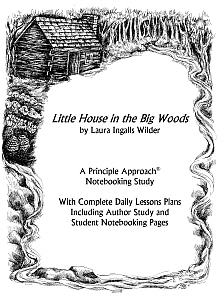
I can’t remember how I stumbled upon September West’s 4RPress, but I was immediately drawn to her beautiful notebook pages for a few of my favorite books, Hans Brinker, The Apple and the Arrow, and Heidi.

When her Little House in the Big Woods study was published, I added it to my wish list. A few days later, September offered me a free copy in exchange for a review. I was thrilled!

I printed it out, put it in a nice binder, and have been hauling it around to show all of my homeschooling friends. It even has the stamp of approval from a local, Principle Approach, master teacher.

This Little House in the Big Woods study is divided into two parts.

The first part contains 48 detailed lesson plans for the teacher. The second part is the wonderful notebooking pages for the student.

The 52 notebooking pages include:

  • a timeline
  • a map
  • a letter from Laura Ingalls Wilder to children
  • gorgeous, black and white illustrations
  • charts and lines for taking notes
  • spaces for student drawing

48 lessons may seem like a lot, but this is the only book my little ones will really study for a whole semester. (We’ll still have numerous read alouds.)

There is so much to be learned by going through one book slowly.

We’ll examine the five elements of literature: characterization, plot, setting, theme, and style. We’ll have time to be immersed in the story and all the ideas presented. When we are finished, we plan to celebrate a “Little House Day” with friends.

If you are looking for an excellent introduction to notebooking or the Principle Approach, this would be a great, affordable place to start.

This study is geared towards elementary students, but I’m tempted to join in the coloring and simple note taking.

Little House in the Big Woods Notebooking Study by 4RPress can be previewed and purchased at CurrClick.

Written by Renae Deckard, Biblical Principled mother of 3. Find Renae’s reflections about homeschool and family life at Life Nurturing Education.

Disclosure: I was given a free copy in exchange for a review, as stated above.

May 202010
 

The resource I’m sharing this month isn’t actually curriculum, but it is helping me with the home part of homeschooling.

I’ve tried various chore charts, including one with tabs and tokens and hooks. It was a good idea, but it was so complicated I quickly tired of it. Then set up a filing box divided by task frequency: daily, weekly, monthly. That, too, worked for awhile.

photo credit: spinneraf

Lately, I’ve used the free-for-all method. Basically, that means dust accumulation hides the color my furniture and my feet stick to the kitchen floor. When I can’t stand that anymore, I finally clean.

Some people are fine with this arrangement. Some of these care-free, happy people even live in my house. I wish I was more like them, but my perfectionist tendencies run deep.

I’ve relaxed tremendously, but I can concentrate on the school part of homeschool when I know the floor will get washed and the bills will get paid. Not having to think about when those tasks will be squeezed in between distractions is bliss.

Chore Buster is perfect! The free online chore chart generator has many unique features that make it ideal for my family.

First, I entered each individual in my household and attached a percentage of chore assignments to them. For instance, my husband works all day, so he has only 25% of chores. (To view in detail, please click on the photo.)

Then I began listing the jobs. Each chore can be assigned a difficulty rating and frequency. Here’s a partial list of what I entered to get you started:

As I was entered in chores, I discovered one of the best options. Chores can be set for specific people. Thus, I added menu planing and paying bills which are specific to me. My children easily see they are not the only ones with chores, and I don’t have to write out my to do list every day.

Chores are randomized based on the factors entered. (To view in detail, please click on the photo.)

Various option for printing are available. I print out one week of chores for our entire family on one sheet of paper. It’s very utilitarian and plain, so I draw lines with my daughters’ colored markers to separate family members. As chores are completed, we mark them off and at the end of the day a sticker appears as a small reward.

If you want to calculate points for a reward system, it is easy to do with Chore Buster, as well. As you add chores, insert a point value and then at the end of the week you can “Calculate Rewards.” That option is underneath the “My Schedule” tab.

The best part of this system is that once it is in place it’s automatic and easily tweaked. Now if I could find a computer application to actually complete the chores…That wouldn’t build character though, would it?

Written by Renae Deckard, Biblical Principled mother of 3. Find Renae’s reflections about homeschool and family life at Life Nurturing Education.

Apr 122010
 

Searching for geography curriculum has been a fruitless pursuit for me, so I dabbled in creating my own. We discussed earth being our home, looked at maps, and located places on the globe from our history and literature studies. That was enough, but I wanted to go more in depth.

When I was introduced to A Child’s Geography, Explore His Earth by Ann Voskamp, I thought, “Maybe this is it!”

A giddy, homeschool mom drooling over curriculum is not new, but I’m still excited after starting the lessons, examining the activities, and skimming the suggested reading lists.

The first lesson echoes the first idea I presented to my children. This amazing earth was created by God as a home for us, but Ann goes deeper to explain the enormity and beauty of our world.

Engaging, conversational chapters expand a child’s understanding of atmosphere and climate, continents and earthquakes, maps and oceans, and more. The Scriptures scattered throughout are an integral part of the text.

Each chapter is followed by a clever review. Postcards are used to record the main ideas of the lesson. (template included) Thorough instructions for hands-on activities further enrich the lessons.

My favorite parts are the Reaching Out segments, because they include tangible ways to minister to our neighbors on this spinning sphere. Geography is God’s handwriting on the earth he created, so it is fitting to intertwine his loving purpose while studying. Ann Voskamp does this eloquently and practically. She gives a portion of the proceeds to World Vision.

The only thing I want to change is the ebook format. I wish I’d gotten a print copy, which are now available at Christianbook.com and Timberdoodle.

Written by Renae Deckard, Biblical Principled mother of 3. Find Renae’s reflections about homeschool and family life at Life Nurturing Education. (Originally published at Heart of the Matter Online.)

Mar 092010
 

History textbooks have a tendency to be boring, but I discovered a series of about American history to treasure. These books do not contain dry lists of dates or a simple retelling of events. Instead, they focus on the causes behind events: people and Providence.

The Mighty Works of God consists of three volumes for the early elementary years. They are not listed by grade-level, but gradually increase in difficulty. This review will focus on the 1st level, which is roughly 1st or 2nd grade.

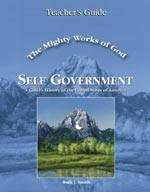
The first lesson from The Mighty Works of God: Self Government introduces history as the story of God working in the lives of men and nations. For his title page, my son wrote,

“You are the God who works wonders…Psalms 77:14”

He was so inspired considering the works of God in his own life that he composed a song:

God, You are so good to me. God you set me free…

That moment I knew it was a good curriculum choice.

We placed the carefully written song in his notebook along with the variety of colorful pages created from the CD in the Teacher’s Guide Timelines, coloring pages, t-charts, maps, and notes created a meaningful overview my son still enjoys purusing.

The Teacher’s Guide also includes detailed lesson plans and suggestions For Reflection and Reasoning and Cultivation Mastery. Each lesson is one leading idea, so it is simple to implement.

The lessons are derived from original source documents whenever applicable and those sources are shared in The Teacher’s Guide. I still refer to the quotes and research even though we aren’t using this particular curriculum right now.

I requested permission to use some images and samples from the book, and it was graciously given to me. The following list of files (pdf) were sent to me by the author, Ruth J. Smith.

You can get a good understanding of what is covered in the year-long program and a glimpse of the beautiful artwork throughout:

I learned so much using this curriculum. It gave me examples of how to use leading ideas and how to research lessons. It also filled many holes my own history education, especially in regards to looking for internal causes instead of merely at external events.

The best part is that it inspired my song-writing son to remember the Mighty Works of God.

Written by Renae Deckard, Biblical Principled mother of 3. Find Renae’s reflections about homeschool and family life at Life Nurturing Education.

Jan 112010
 

Child Studying

Curriculum collects on shelves in our living room and peaks from boxes in the shed. A glance in either place reveals more stuff than we can realistically use. I’m so thankful for the options, but options can paralyze.

So how do I choose what to help me teach my children? How did these books end up in our possession instead of others?

I search for items that line up with our purpose for homeschooling, and trust God to lead me. Yes, the academics are important, but when I consider our goals getting an A in calculus isn’t top priority.

  • I want my children to have godly character.
  • I want my children to know how to think and reason.
  • I want my children to grow in responsibility and self-government.

Can curriculum really address these deeper heart issues? I think that is the whole purpose of learning. So the curriculum crowding the shelves in our home has certain qualities.

It is reflective in nature.

Children need time to think about ideas. I keep multiple choice and fill-in-the-blank worksheets at a minimum.

It lays out the principles of a subject in a sensible way.

Definitions fill full the ideas words represent. A young child can understand that letters make sounds, sounds create words, and words turn into sentences. In this way, they can understand the whole subject of reading before they begin the practice.

It uses original source documents.

Reference materials lay a foundation for self-learning. Quotes inspire us to dig deeper into the context of historical events. Biographies are some of my favorite resources.

The writing is high-quality and inspirational.

This benefits my whole family. When we read good literature, we all enjoy lessons more. Yes, “Spot ran,” is technically a sentence, but it’s not engaging. Every student craves ideas and well-crafted stories.

When I started homeschooling, I had no idea how many wonderful resources I would find. I used to search to find enough for a complete year. Now it seems curriculum finds me.

What about you? What do you look for in curriculum? Do you have more than enough or not enough?

Written by Renae Deckard, Biblical Principled mother of 3. Find Renae’s reflections about homeschool and family life at Life Nurturing Education.

photo credit: kaleid

Dec 152009
 

Growing up I read book after book. However, very few of the volumes I read are remembered or revisited.

At the library I checked out whatever looked interesting: Nancy Drew mysteries, Grace Livingston Hill romance novels, or historical fiction. My random searches hid some amazing authors. Now I get to discover these imaginative writers with my children.

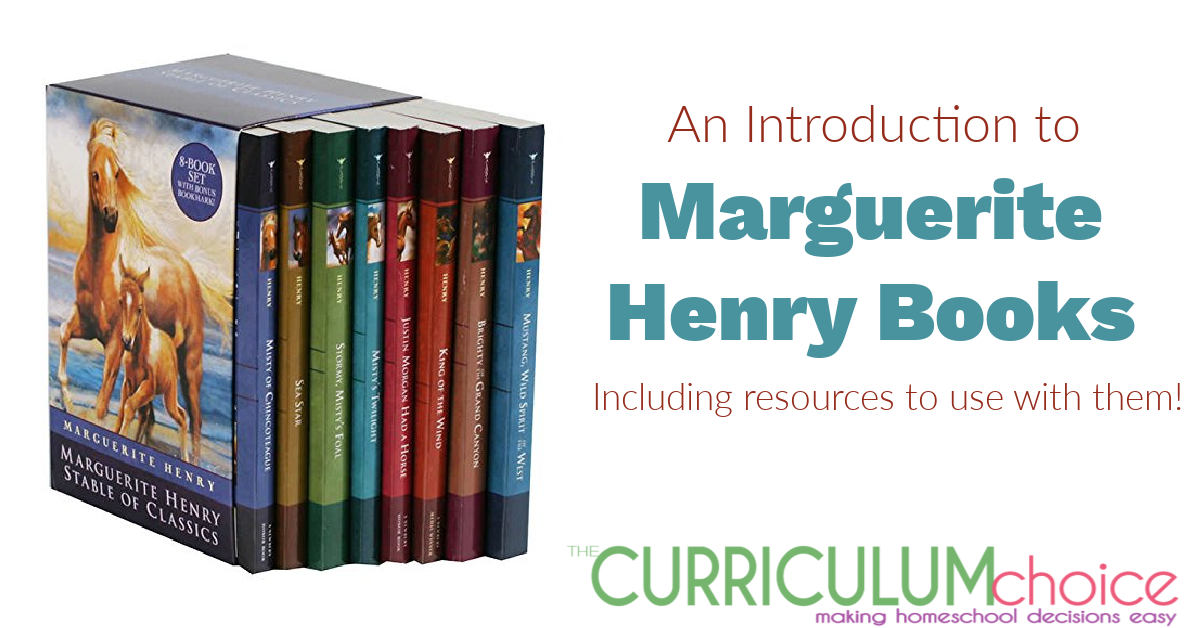
14858: Brighty of the Grand CanyonAfter lunch I read aloud Brighty of the Grand Canyon.

“One more chapter please!” begs my three-year-old.

Her five-year-old sister crowds close and grins widening bright blue eyes. Eleven-year-old brother peeks in almost every chapter. As the verbs bounce off my tongue, the suspense of the story pulls him away from Lego.

Our collection of Marguerite Henry’s horse books was rescued from the trash. Library books thrown out to make room for new stories. Brighty of the Grand Canyon taken home only once in eight years. Was this spirited burro on the shelf at my school library? If he was, I didn’t take him home either.

Marguerite Henry was not introduced to me in my youth. But I know her now.

Her stories are revisited often in this home. Benjamin West and his Cat Grimalkin roam the house resting next to Father’s side of the bed, then Mother’s. Justin Morgan Had a Horse cracks my voice and spills tears over my eyelids. Children gasp, “Why are you crying?”

For many reasons, I’m sure. Because life is full. Because ideas are powerful. Because children crowd around me to enjoy the lacing of words. Stories crafted to communicate ideas of liberty, hope, and faith. Morsels I want to savor together as we read book after book…

Written by Renae Deckard, Biblical Principled mother of 3. Find Renae’s reflections about homeschool and family life at Life Nurturing Education.

_________

If you subscribe to The Curriculum Choice, I apologize for the lack of updates lately. Our feed was not being sent out. That has hopefully been rectified. Thank you for your patience.

Dec 012009
 

After two year of homeschooling, I heard an idea I quickly embraced. In fact, I don’t know why it hadn’t been implemented already.

Start each day with worship.

We read the Bible. Math lessons were completed. Spelling done. But what about ideas wrapped in melody? I wanted words from the saints echoing in our soul.

Our worship time varies greatly from new music to old. We use CDs, YouTube videos, or simply our voices. It can be one song or many. And it usually includes at least one little person dancing. When I hear humming throughout the day, I know the effort of gathering everyone is worth it.

One resource we’ve enjoyed is the series by Bobbie Wolgemuth and Joni Eareckson Tada entitled, Hymns for a Kid’s Heart.

48986: Hymns For A Kids Heart, Volumes 1 and 2

Before the words and music for each hymn, there is a beautiful illustration, an introduction to the hymn writer, and a personal story from Joni Eareckson Tada.

There are twelve hymns per book. I read the short biography one day and “From My Heart to You” the next, spending one week on each hymn. The accompanying CD includes children singing with both of the authors. The arrangements are engaging and pleasant.

There is also a version for Christmas Carols and Passion Hymns. They don’t include the biography section, but instead have a Scripture verse and Bible story to introduce the music.

These books are not just for kid’s hearts. My heart needs the inspiration, too. We pulled out the Christmas one this morning to sing, O Come All Ye Faithful. Yes, I need to come. I need to rest a moment and lift my thoughts heavenward before the day’s work begins.

Written by Renae Deckard, Biblical Principled mother of 3. Find Renae’s reflections about homeschool and family life at Life Nurturing Education.

Oct 062009
 

If lessons are meant to be creative, mine fail. This year, lessons are pretty much straight from the book. Commendable plans smolder in my thoughts. Our idea books are perused often, but not by me. My son has taken to finding his own creativity. I applaud his efforts.

Pilgrim's Progress
Pilgrim’s Progress

When I asked him to record the characters in Pilgrim’s Progress, he hunted for Alternatives to Worksheets. Not taking into account my paper-cutting, creative-sketching, engineer-type son, I had traded it on Paperbackswap. Similar books grace our shelves, so I did not think it would be missed.

It was, but only momentarily. Once my son explained his idea, I found another tab book as an example. He finished his lesson with flourish.

Enter guilt. Where is my creativity? I should be adding interesting projects to make school exciting. If I battle laziness, and quit being distracted, maybe my son will not draw incessantly at the bottom of every assignment.

Then again, maybe that isn’t so bad. His mark of individuality is on each page, and every doodle tells a story. I need some of his inspiration. Thus the thoughts clash in my heart. I can choose guilt and despair, or forgiveness and hope.

In Pilgrim’s Progress Hopeful and Christian are captured by Giant Despair. Thrown into the dungeon and tormented the prisoners refuse to die, so the giant plans to kill them. Fearful captives intercede through the night. Then Christian delivers a passionate speech,

What a fool, am I, thus to lie in a stinking dungeon, when I may as well walk at liberty! I have a key in my bosom, called Promise, that will, I am persuaded, open any lock in Doubting Castle.

The key does indeed unlock the doors, and the companions escape, free to continue their path to beloved Celestial City.

Like these two pilgrims, I cannot remain burdened by fear any longer. Wallowing in guilt cripples. There are keys for me to use. They are principles to challenge my negativity.

Promise 1

He who began a good work in you will carry it on to completion. Philippians 1:6

I am unfinished. The grace of God is my hope as I forge ahead on this pilgrim journey.

Promise 2

A battered reed he will not break off, and a smoldering wick he will not put out, until he leads justice to victory. Mathew 12:20

I am not ashes yet. The breath of the Holy Spirit blows on my heart to ignite my soul.

With these promises firmly in my grasp, I hear the chains clatter as they hit the floor. The gate swings open, and the paralyzed giant is no longer a threat. I am free!

Written by Renae Deckard, Biblical Principled mother of 3. Find Renae’s reflections about homeschool and family life at Life Nurturing Education.

Sep 222009
 

It isn’t a book my son picked off the shelf. The plain red cover is worn, stained, and wrapped with tape.  It looks uninspiring, but after the first chapter we are both captivated by the amazing story of two brothers.

47008: Landmark Books: The Wright Brothers

The Wright Brothers- Pioneers of American Aviation by Quentin Reynolds was originally published in 1950 by Random House for the Landmark Series. This series contains some of the best children’s history books I’ve come across. (In fact, Raquel Werk recommends beginning a Principle Approach study with one, The Landing of the Pilgrims.)

It would be simple to use The Wright Brothers as a foundation for the science and history of  flight. My son and I discussed those things, but I observed something even more wonderful.

While reading about the insatiable curiosity of Wilbur and Orville Wright, my son’s eyes sparked with understanding. Ideas tumbled out and half grins flashed often.

Now he knows exactly where those old, history books are on the shelf.

For more information:

Our small collection of Landmark Books is from library sales and second-hand stores, but many have been republished. Valerie’s Living Books has more information about available titles and current versions.

What books have captivated the imagination of your children lately?

Written by Renae Deckard, Biblical Principled mother of 3. Find Renae’s reflections about homeschool and family life at Life Nurturing Education.

Aug 242009
 

My enjoyment of historical fiction and biographies began as soon as I could read. In elementary school a new ValueTales biography came home in my backpack every week. In high school The Stonewycke Trilogy carried me to Scotland.  The timeline in my mind wasn’t very cohesive, but I still have memories of people, places, and events I visited in those books.

78312: Early American History

Don’t we all learn so much through stories? And what is history but a story written by God through all of time?

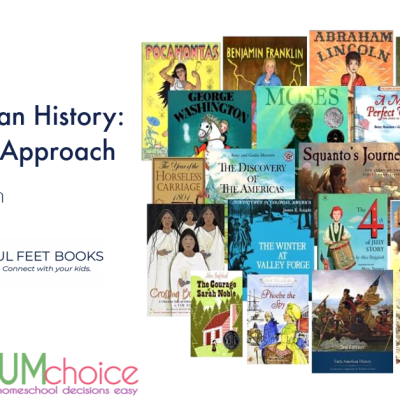
One of the resources I found at the beginning of our homeschooling was Beautiful Feet Book’s Early American History. I wasn’t sure how to implement Principle Approach philosophy, but this curriculum was a good introduction.

The curriculum is actually a study guide which takes you step by step through about twenty books. I found many of the books at the local library, but some of them I went onto purchase because they were so wonderful.

Our favorites include:

38031: Beautiful Feet Books: George Washington

Beautiful Feet Books updates their guides as books go out of print. Often I prefer to use older books, but I understand they want to choose books that are readily available. We did enjoy all the books listed in my guide (published 1992).

This curriculum briefly introduces the first five principles of history, education, and government: individuality, self-government, Christian character, conscience, and form of government. I prefer to focus on one or two principles a year, but the poems and guided discussions lay a foundation.

We used Early American History- A Literature Approach when my son was around seven-years-old. We read all of the books aloud and we delighted in the discussions. The notes are only one sentence long (perfect for those beginning grades) and vary from map work to coloring sheets. I can see older children benefiting from this study as well.

If you are looking for a gentle introduction to history from the time of Leif the Lucky to Buffalo Bill, this would be a good choice.

Written by Renae Deckard, Biblical Principled mother of 3. Find Renae’s reflections about homeschool and family life at Life Nurturing Education.