Jun 062011
 

At a Glance:

Product:  The Curiosity Files Unit Study: Zombie Fire Ants

Age level: 8-13

Use as: unit study

Instruction time: Fun filled and moderate to high as it is a hands on unit study.

Prep time: Low since it includes everything you need for a fun study.

Cost: $19.90 for a bundle that includes the The Secondary Schoolhouse Planner and your choice of one Curiosity Files Unit Study.

Rating: 5 out of 5 golden apples

Purchase HERE.

Anyone who has read anything I’ve written or is familiar with me knows I strive to instill a love of learning in my children.  I want to spark their imagination and get them excited about the world created by God for them.  I’ll be honest, that’s a lot of enthusiasm to put in your morning coffee.  Some days, no matter how hard you try, you cannot make direct and indirect objects exciting. Facing facts that sometimes school is, well, school, I try to look for fun unit studies and projects to keep up the excitement.  It was when I saw my children’s eyes glazed over at the mention of a unit study, I realized that making something fun is not always the answer.  Sometimes our amazing world provides enough wonder that the need to make graphing into some fun unit study is thankfully pushed aside.  This is the reason I love The Curiosity Files.  That and as soon as I said zombie fire ants my kids stood to attention with jaws dropped waiting to hear more!

The Curiosity Files explores the oddities in the world that make learning a joy.  These unit studies do not entertain by cheap thrills but educate by tapping into a child’s innate curiosity.  It provides the heart of a scientist so it’s easy for your child to feel inspired.  More over, the study never fails to give glory to God.  Yes, science and God do mix and The Curiosity Files proves it.

So what can you expect from The Curiosity Files unit studies?  You can expect to learn something new, exciting and fun.  You can expect a science lesson, copywork, bible lesson, games, puzzles, geography, projects, notebooking and lapbooking.  The material is solid and the method is smooth, logical, and fits any teaching or learning style.

The unit study is recommended for ages 8-13.  I have a 13, 11, 5 and 2 year old.  While my five year old needed to have some things adjusted, she learned quite a bit and enjoyed being a part of this.  My 2 year old was none the wiser as we did this while she slept.  My 11 year old boy had the most fun with this study.  I would not suggest this study for a child under 5 or over 13.  I think the 8-13 recommendation is perfect.  If you seek to add some fun, creativity, and curiosity into your routine without resorting to cheap thrills and entertainment, I recommend The Curiosity Files. The studies include: Zombie Fire Ants, Blue Diamond, Dung Beetle, Red Tide, MRSA, Puffer Fish, and Blue-Footed Booby.

Written by Richele, mother of 4 children, homeschooler for 9 years, and proud to say she taught tying your shoes and physics in one day.  She blogs at Under the Golden Apple Tree.

Oct 042010
 

We love unit studies and were thrilled to be able to begin a trip around the world with Expedition Earth: A Journey Through God’s World ($15.00 instant download) from Confessions of a Homeschooler.  In the last few months my children and I have visited China, South Korea, and India.  We’re headed to several countries in Africa next, and I have to say we’ve been having a wonderful trip from the comfort of our couch!

Just what is Expedition Earth? It is a unit study curriculum plan that takes your K-3rd grade children through 31 countries on all seven continents.  Expedition Earth lays out plans for a week in each country, telling you which books and resources you’ll need and what to do each day with your family.  There is a small core resource list that these weekly plans center around, which means you can just gather these resources and be set for the entire curriculum.   We have most of the core resources, so each week I can simply print the schedule for the country, gather any craft materials, and we’re ready to go.  An extra book list is included to take your learning further if you wish to spend more time in some countries.  I usually grab a few extra books for each country from my library to make Expedition Earth meaty enough for my 4th grader to join in the family adventure.  If you want to see a sample week check out the plans for a visit to Brazil here.

Expedition Earth also includes:

  • craft ideas
  • recipes
  • a Christmas around the World unit
  • a study of geography and ecosystems
  • printable flag and map for each country
  • a mini language study where you learn to say hello in each country’s main language
  • a free Animal Classification unit and mini-book for animals from each country

There are five report pages you can use for students on the older end of the age range, giving you a variety of focus over the course of your travels.  We tend to choose one or two reports per country for my 4th grader to do.  The reports are:

  • Country Report
  • Continent Report
  • Animal Report
  • Ecosystem Report
  • Children Like Me Report

My children look forward to Mondays now, ready to add a new flag to their passports and start their adventure in a new country. Each day they browse the book basket and come back to me asking questions, wanting to know more about the people, the places, and the animals God has placed on this Earth.  I love that so much of the planning is done for me, and I love that all my children can learn together.  We’re making memories and discoveries as we use Expedition Earth to travel the world.

-Written by Tristan, mom to 5 going on 6 children, homeschooling through unit studies with a side of lapbooks.  You can visit her at her blog, Our Busy Homeschool, or read her other Curriculum Choice posts here.

{Disclaimer: I received Expedition Earth free to enable this review.  I received no other compensation and all opinions presented herein are my own.}

Jul 122010
 

I have yet to meet a homeschool family that did not love books.  On my quest to find wonderful books to be read to or by my children I have read quite a few ‘books about books’.  One volume has earned a place on my personal shelf to be used often.  That book is Read for the Heart: Whole Books for Wholehearted Families by Sarah Clarkson.

Read for the Heart is 384 pages full of information and ideas.  The first four chapters give the reader an in-depth look at the author’s personal view of books, a guide for becoming a reading family, as well as a chapter on the state of literacy in America today.

The next eight chapters are booklists divided into the following topics:

  • Picture Books
  • The Golden Age Classics
  • Children’s Fiction
  • Fairy Tales and Fantasy
  • History and Biography
  • Spiritual Reading for Children
  • Poetry
  • Music, Art, and Nature

Each chapter begins with a story and treatise by Miss Clarkson on the book genre at hand, giving you an even better idea of what qualities she has used to select books for that chapter. I love this part.  It makes me feel like I’ve just sat down to chat with a good friend, and she is sharing adventures she has had with books.  The lists in each chapter are generally arranged alphabetically by author, with the main exception being the history and biography section arranged by time period.  That has been a big help when I am looking for books to go along with our current history studies.  Most of the books have a review telling more about the story, awards won, general age guidelines, and any cautions if necessary.

The end of Read for the Heart has six appendices of book lists such as Newbery and Caldecott Award winners and special favorites of the author.  There are two indexes, one sorted by author and illustrator, one by title, giving a quick way to check on a specific book or to find more by an author or illustrator my children enjoy.

You can view a 32 page excerpt from Read for the Heart on the Apologia website.  The book can be purchased there or on Amazon for $17.00.  I bought mine through Amazon with some gift cards I had.

My only complaint about Read for the Heart is that she stopped at 384 pages!  Sarah Clarkson’s guide has been a huge help as I have navigated the library catalog searching for books to share with my children.  I would love if she made a second book with reviews of even more titles.

Written by Tristan, mom to 5 going on 6 children, homeschooling through unit studies with a side of lapbooks.  You can visit her at her blog, Our Busy Homeschool.

Jun 142010
 

What a wonderful experience I have had the last few months!  I received the All-Day Charlotte Mason Seminar on DVD, seminar workbook, and the Laying Down the Rails book and Workshop on DVD from Simply Charlotte Mason to review.  If you have never been over to visit Simply Charlotte Mason, I highly recommend you take a look.  They offer free curriculum guides, free ebooks, and many materials for purchase as well.  They truly help make Charlotte Mason’s homeschool ideas simple.  Their blog is one that always inspires me.

I began by watching the 3 DVDs for the All-Day Charlotte Mason Seminar and taking notes through the accompanying workbook.  I did this over the course of several evenings while my children were falling asleep in their beds, which allowed me some quiet to focus.

Session 1 (34 minutes) introduced me to Charlotte Mason, who she was, when she lived, and her ideas about education.  It was neat to get to know her this way.  I had tried to read her books in the past, but just could not get through them.  It took too much brain power at a time when I was trying to just keep up with my young children and get sleep.

Session 2 (78 minutes) and 3 (71 minutes)held my hand as we went through each subject applying Charlotte Mason’s methods.  Here is where I had many, many ah-ha moments. Short lessons, living books, and narration – these things made sense and could easily be integrated in our unit study family.  I appreciated that I was not expected to add everything in at once.  The appendix explained a doable plan for making the transition to a Charlotte Mason approach a step at a time.  Here is a short clip from the workshop about using narration.

Are we now becoming a Charlotte Mason family? Yes and no.  (grin)  I think narrowly defining any homeschooling family by one method is usually inaccurate.  We prefer to pick and choose the pieces that work for our family.  I have discovered that many of the Charlotte Mason pieces fit our family!  We have already begun to incorporate the following:

  • living books
  • narration
  • scripture memorization

We have plans to incorporate these ideas over the next year:

  • map drill
  • picture study
  • music study

Now let me tell you a little bit about the  Laying Down the Rails book and DVD Workshop that came as part of this set.  I watched the DVD first (45 minutes), using the workbook section for it from the All-Day Charlotte Mason Seminar as I went.  I love Charlotte’s idea that good habits are like railroad tracks, they smooth life out because a child is not having to make the same decisions over and over and over.  I know that is true, even in my own life.  Habits help me to accomplish many of the routine things in my day without the extra effort of decision-making.

Sonya, the workshop presenter, is funny and helpful as she leads you through many of the habits a child can learn.  While there is an extensive list, she emphasizes to start with one habit, and not to add another until the first is truly habit.  It was really helpful to watch the DVD with my husband. He was not up for reading the book, all 230+ pages, but the workshop got us both on the same mental page easily.  He was as excited about habit training as I was.  You can watch a short clip from the DVD right here.

I next spent nearly a month reading and pondering the Laying Down the Rails book.  What a treasure!  It contains Charlotte’s words on each habit gathered into one place, prefaced by a concise definition of the habit and a story that shows how the habit is important.  There are entire chapters on ‘repairing the rails’ – breaking the bad habits we already have, including chapters on some specific problems like dawdling, temper tantrums, and lying.  See a sample from the book HERE.

Where are we now? Well, habit training is a process, and I will be honest that the first person who has to acquire the new habit is me.  However, we are working on our habits slowly and steadily, and I find a lot of support and encouragement when I read through Laying Down the Rails.

Would I buy these products? Yes!  That is an unequivocal yes.  The entire set can be purchased HERE for $54.95.  That includes 3 All-Day Charlotte Mason Seminar DVDs, the Session workbook, 1 Laying Down the Rails workshop DVD, and a print copy of the Laying Down the Rails book.  I love having the All-Day Charlotte Mason Seminar on DVD, a shot of motivation that I can turn on whenever I need a boost.  Homeschooling is a process, and the experience is different with each child.  Having Charlotte Mason’s ideas broken down into manageable tasks gives me easy action plans to try when we need something adjusted.  Laying Down the Rails is a treasure trove of ideas for habit training.  Time will pass and our children will acquire habits.  The question is what habits will they develop – ones we have carefully helped them build or contrary habits that we lazily let develop?

Written by Tristan, mom to 5 going on 6 children, homeschooling through unit studies with a side of lapbooks.  You can visit her at her blog, Our Busy Homeschool.

{Disclaimer: I received these products free from Simply Charlotte Mason to enable this review.  I received no other compensation and all opinions presented herein are my own.}

May 062010
 
When this time of year rolls around, there’s one thing my kids ask for more than anything…”When are we going to plant our garden, Mom?”  I have to admit, I’m just as excited to get my hands dirty as they are.  There’s something about sticking a tiny plant or seed into the dirt and a couple months later, enjoying the  best salad or handful of strawberries ever!

I decided to end out our school year with a unit on plants.  I thought we could make our little garden into an even more educational experience this year by learning more about what’s going on underneath that dirt.  We’ll take the next couple of weeks to learn about seeds, the parts of plants, and what they need to thrive.  Then when it’s warm enough, we’ll put our knowledge to work and plant (hopefully) our best garden yet!  If you are planning on doing a unit on plants, I found a great post over at The Homeschool Classroom.  Melissa posts her lesson plan in detail, giving great ideas on projects and resources.

Over the years I’ve come across many great books on gardening with kids but I wanted to share with you two of them that I love.

{Roots, Shoots, Buckets, and Boots}

This book by gardening guru, Sharon Lovejoy, is a great addition to your library!  Besides the her beautiful illustrations, Sharon gives numerous project ideas, tips, and lists for the rookie or advanced gardener.  Some of her projects include:

  • The Pizza Garden
  • Buckets, Boxes, & Boots: Container Gardens
  • Moon-Garden
  • Snacking & Sipping Garden

One of my favorites is her idea for a Pizza Garden.  In the book, she shows how to plant this type of garden in a circular shape and section it off with rocks or pavers so it looks like a sliced pizza.  Each section includes vegetables that you’d find on a pizza, such as:

  • Tomatoes
  • Eggplant
  • Bell Peppers
  • Oregano
  • Basil
  • Onions

She gives tons of great tips for gardening with kids, like all the tools you’ll need and a list of the Top 20 Plants for Kids.  The thing I love most about Sharon Lovejoy is her absolute love for nature.  Her love exudes from the pages of this book and it makes you want to spend more time outside.   I’m totally in love with this book!  If you’re looking for supplements to add to your plant units this Spring or just want a great book, I totally recommend it.

{Gardening with Kids}

This great gardening book written by Catherine Woram & Marlyn Cox is also a terrific addition to any mom’s library.  This book includes over 30 projects you can do with your kids.  Everything from growing cactus planters to playing games with water.  Again, the introduction includes tips on equipment, maintaining a garden, and everything else you need to know.  Gardening with Kids has a lot of information about the plants themselves and how choose the best ones for your climate.  They provide lists of what to grow and what you should avoid.

There are 35 projects in this book to be exact, and we’ve completed many of them.
Here’s an idea of the projects you’ll find when you check out Gardening with Kids:

  • Herb Garden
  • Butterfly Baskets
  • Crystallizing Pansies
  • Terrarium in a Jar
  • Pressing Flowers
  • Nesting Box
  • Flower Chains
  • Burlap Tote Bag

    Again, I highly recommend both of these fabulous books.  I can say that both of them provide hours of fun for you and your kids…now go get your hands dirty!

Alicia can be found either blogging at La Famille or out in her garden :)

Apr 282010
 

Have you ever read to your children a book that explains an old fashioned way of doing things?

Maybe a book about a family that makes their own maple syrup, goats milk cheese, raises cows or sews quilts?

Have you ever wanted a resource book that will help you learn more about living a simple life?

Maybe you want to grow organic tomatoes or make bread without preservatives?

Back to Basics is a practical book I’ve used over and over again in our unit studies to help my children and I

experience and learn about skills and handicrafts our grand parents practiced.

I used Back to Basics with our February read aloud Miracles on Maple Hill by Virginia Sorensen.

On pages 242 –243 in Back to Basics, we learned about how three maple trees, the Sugar Maple, the Black Maple and the

Norway Maple tree produce the most syrup. We also read about the tools and techniques for tapping and how to turn sap into syrup.

Did you know goats milk makes a mild cheese and can develop an ammonia taste if stored to long?

Or that mozzarella cheese is made from the milk of the water buffalo?

Learn about how to make cream cheese, build a simple cheese press and make cheddar cheese on pp. 236-237.

Reader’s Digest Back to Basics How to Learn and Enjoy Traditional American Skills is

published by The Reader’s Digest Association, Inc., Pleasantville, New York /Montreal.

It’s 450 pages and is divided into six parts.

Part One Land: Buying It- Building on It includes:

  • Buying Country Property
  • Planning Your Home
  • Preparing the Site
  • Converting Trees Into Lumber
  • Building a Log Cabin
  • Building with Adobe
  • Building a Stone House
  • Raising a Barn
  • Developing a Water Supply
  • Saunas and Hot Tubs
  • Sanitation
  • Fireplace Construction and Design
  • Stone Walls and Brick Pavements
  • Fences

Part Two: Energy From Wood, Water, Wind and Sun includes:

  • Making Your House Energy Efficient
  • Wood as a fuel
  • Heating With Wood
  • Water Power
  • Wind Power
  • Solar Energy
  • Other Energy Sources

Part Three: Raising Your Own Vegetables, Fruit, And Livestock includes:

  • The Kitchen Garden
  • Gardening in Limited Space
  • Herb Gardens
  • Fruits and Nuts
  • Pest Control
  • Grains and Grasses
  • Beekeeping
  • Fish Farming
  • Raising Livestock

Part Four: Enjoying Your Harvest The Year Round includes:

  • Preserving Produce
  • Preserving Meat and Fish
  • Making Your Own Dairy Products
  • Maple Sugaring
  • Homemade Beverages
  • Baking Bread
  • Regional Cooking
  • Cooking With Wood

Part Five: Skills and Crafts for House and Homestead includes:

  • Natural Dyes
  • Spinning
  • Weaving
  • Hooked Rugs
  • Braided Rugs
  • Patchwork Quilting
  • Rope and Twine
  • Tanning and Leatherwork
  • Woodworking
  • Broom making
  • Scrimshaw
  • Household Recipes
  • Metalworking
  • Stenciling
  • Flower Drying and Pressed Flowers
  • Gourd Craft
  • Soap making
  • Candle making
  • Basketry

Part Six: Recreation at Home And in the Wild includes:

  • Old-time Good Times
  • Crafting a Mountain Dulcimer
  • Celebrating Holidays
  • Canoeing And Kayaking
  • Wilderness Camping
  • Outdoors in Winter
  • Fishing
  • Living With Nature

Also included is a Appendix that lists organized Assistance: The Extension Services and Other Groups and an Index.

I thought you would enjoy seeing the quilt pages from Back to Basics.

And these are the quilt blocks my nine year old daughter made.

Back to Basics can be purchased from a bookstore or borrowed from the library.

Apr 092010
 

Not everything has to become a formal lesson at our house, but I love being able to sneak in some learning with a helping of fun.  I have seen in my own life that songs I have learned as a child I can still remember to this day.  While this has many applications to homeschooling I only want to talk about one today, called Schoolhouse Rock.

Schoolhouse Rock is series of short musical cartoons that aired originally before I was born during the Saturday morning cartoons beginning in 1973.  Topics covered in the original series include songs for multiplication, grammar, science, American history and lawmaking, and computers.  Later offerings from the makers of Schoolhouse Rock include songs about money and taking care of our earth.

In August of 2002 Disney released a 30th Anniversary DVD set of over 40 Schoolhouse Rock songs.  A few years later we bought the set for our family.  I said it was for homeschool and my husband said it was just for fun.  We were both right! Our children enjoy watching different sections of the DVD.  Each has a favorite song or two.  My 8 year old daughter’s current favorites are:

  1. No More Kings – A song about the beginnings of our country and the Revolutionary War.
  2. I’m Just a Bill – A song that boils the legislative process down so that even a child can understand how our countries laws are made.  Here it is on You Tube to watch.  (Like everything else on YouTube, the comments below the video may not be appropriate.  We like to click the handy arrow beside the comment section to close it, or watch the video in full screen.)

I love that my children are easily learning many educational topics without a formal lesson.  The DVDs spark my childrens’ interest in topics like conjunctions, multiplcation facts, money and debt, and the branches of the US Government.  We may watch a few songs while waiting for dinner to finish cooking, or have a sing-along as a family for fun.  There are many ways to use the Schoolhouse Rock DVDs.  I am sure we will just happen to pull it out when a child has trouble learning those pesky times tables for another way to reinforce math facts.

The internet abounds with free resources.  Here are a few related to Schoolhouse Rock:

  • The lyrics to many of the songs.
  • Ideas from educators of lessons that use Schoolhouse Rock songs.
  • Many of the songs are available on YouTube with a simple search.  (Remember to close the comments section or watch the videos on full screen to avoid inappropriate material.)

I would love to hear if you have a favorite Schoolhouse Rock song, or any fun ways you can see incorporating Schoolhouse Rock into homeschooling, so please leave a comment!  If you want to learn about some other things we have used in our homeschool read my other Curriculum Choice reviews HERE or visit my blog.

Written by Tristan, mom to 5, homeschooling through unit studies with a side of lapbooks.  You can visit her at her blog, Our Busy Homeschool.

Mar 112010
 

For some of us the idea of doing hands-on projects with our children can be daunting. I am neither crafty nor artistic, and I don’t enjoy making and cleaning up messes during the course of our school day. However, I have come to the conclusion that with a little bit of forethought and planning, including hands-on activities in our history lessons can be painless and fun.

Most importantly, the right project can bring a historical topic or time period to life for children. I am always amazed when one of my children brings up a project we completed several months ago and is still able to associate it with the concept about which we were learning.

Today I thought I would share with you a couple of my favorite resources for user-friendly, hands-on history projects. Most of these books can be found at your local library or an online bookseller.

Most of the games, crafts, recipes, and other projects that we have done in these books were moderate to easy for my 6 and 8 year old to complete, along with a little bit of help and guidance from me. The time required to complete each project was anywhere from 15 minutes to an hour. (O.K., except for the candle-dipping. That one required a lot of help from me and took a long time to complete, but the kids have not forgotten it!)

For most of these projects, we used supplies we already had on hand or recycled household items. Some of the projects do require materials that you would probably have to purchase, for example, the paraffin wax for the candles.

I hope that you’ll check out these resources and find them helpful in spicing up your history studies with some hands-on fun.

Written by Shannon, who is a history-buff at heart and enjoys blogging about her family’s homeschooling adventures at Song of My Heart.

Feb 282010
 

What do you want to be when you grow up?” is a question most children love to answer. Those answers change many times through the years.  When I came across a sale for the Wanna Be series from The Old Schoolhouse, which are unit studies about different careers, I grabbed my debit card and ordered.  We love unit studies and I had nothing for careers in yet.  The series covers the following ten careers:

  • Firefighter
  • Veterinarian
  • Chef
  • Military
  • Doctor
  • Police Officer
  • Missionary
  • Farmer
  • Artist (upcoming release)
  • Pilot (upcoming release)

While these units are written for ages 4 – 10, even my husband and I learned a lot as we used our first two units.  I love that these units are written from a Christian homeschool perspective. I love reading how families make these careers work in their life.  The information for high school homeschoolers is wonderful, giving them direction on how to prepare for that career, while the end of unit activities have fun games and activities for younger kids.

What’s inside a unit?

  • Information pages about the career, with information for preschoolers through high schoolers.
  • Crossword puzzles
  • Coloring pages
  • Handwriting Practice
  • Vocabulary
  • Copywork
  • Applied math problems – relating to the career.
  • Word Search
  • Creative Writing Prompts
  • Quiz
  • Fill in the Story
  • Experiments
  • End of Unit Activities – games, memory verses, and ideas for great themed parties.
  • Great resource lists that are internet linked.

Our first adventure centered around a police officer’s job as peace keeper and law enforcer with When I Grow Up, I Want to Be a Police Officer. Each day we read a few pages from the e-book as a family and did activities.  I used the library list to gather books for our unit study basket, which we explored throughout the week.  You can find the ones we chose HERE.  We found out the tools of the trade, training needed for the job, and even some of the science behind fingerprinting.

My oldest wrote a story called The Jewelry Thief (read it HERE ) in response to one of the writing prompts in the unit.  She really enjoyed learning about how police use clues to solve a crime.  We finished up our unit with a trip to our local police department.

Our next Wanna Be adventure took two weeks using When I Grow Up, I Want to Be a Firefighter. We were able to compare many things we had learned about becoming a police officer with the path to becoming a firefighter.  Again, the library list and end of unit activities gave me plenty of ways to include my younger children.  Our second field trip in a month led us to Fire Station 3, where we saw up close and personal many of the things we had learned about during the unit.

The Wanna Be series is a great fit for our unit study family. Each title is a complete unit study.  I do not have to find books at the library unless I want to.  Many creative ideas are included for some themed games and activities perfect for my younger crowd, while the information is meaty enough that we will reuse these when the kids are older.  My children are already debating which career we will learn about next – I hope they choose chef!

Written by Tristan, mom to 5, homeschooling through unit studies with a side of lapbooks.  You can visit her at her blog, Our Busy Homeschool.

{Disclaimer because the FTC says I have to:  I bought these books with my own money, and yes, we really used them.  All opinions presented herein are my own.}

Sep 112009
 

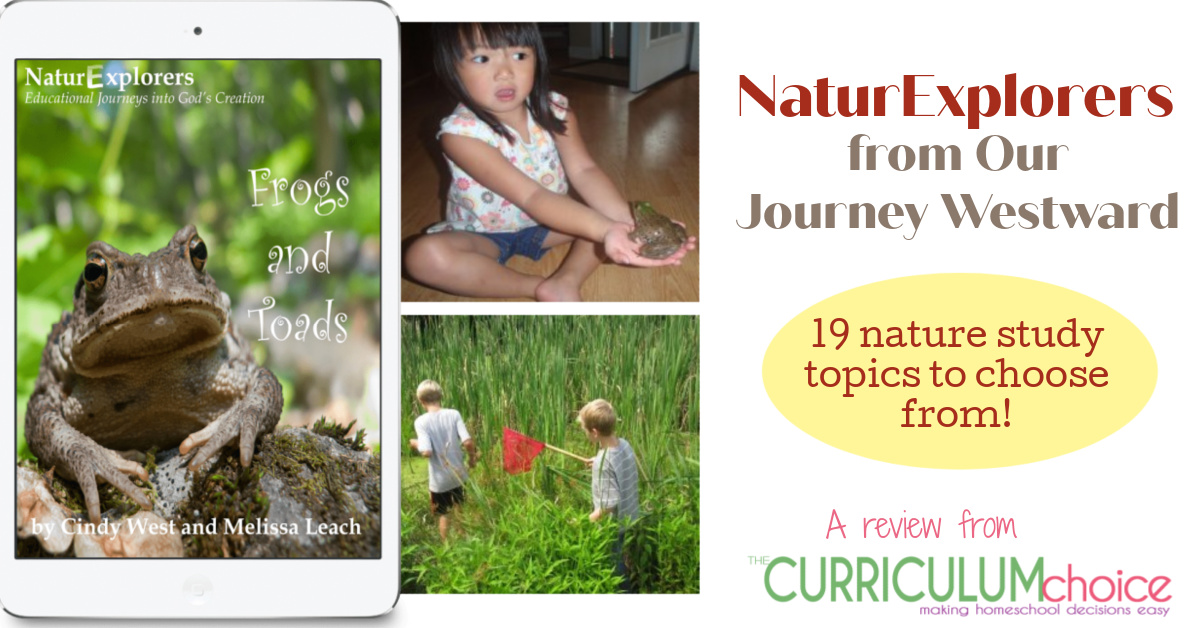
NaturExplorers graphic

I am excited to tell you about NaturExplorers, a new series of nature-based unit studies written by Cindy West and Melissa Leach. The authors are both veteran homeschooling Moms who are passionate about studying nature with their children and inspiring other Moms to do the same. No matter what type of homeschooler you are, and whether or not you already do nature study with your family, these studies will give you encouragement and ideas for getting outside with your children and exploring God’s beautiful creation.

Here is a sampling of titles in the series:

  • Animal Signs
  • Peaceful Ponds
  • Captivating Clouds
  • Delightful Deciduous Trees
  • Hard as a Rock
  • Creatures of the Night
  • Frogs and Toads

331

One of the things that I really like about these units is their flexibility. They are designed so that you can adapt them to be used in whatever way best meets your needs. A title can be used in its entirety as a complete science-based unit, or you can simply pick up the study and choose an idea to focus on as you head out the door for a nature walk.

However you decide to utilize these studies, you will find that they are jam-packed with plenty of ideas to keep you inspired about that particular nature topic for quite a long time.

Each unit includes the following:

  • A section just for you, the teacher, to spark your interest and excitement about the topic
  • Suggestions for quality, living books that will inspire your children about the topic
  • Background knowledge for the teacher to equip you with some basic information about the topic before beginning the study 
  • A great number of ideas for nature walks and outdoor activities
  • Hands-on activities such as science experiments, art projects, recipes and more
  • Writing and research ideas
  • Bible lessons
  • Poetry
  • Artist and Picture study references
  • Composer and Music references
  • Helpful internet links
  • Ideas for including younger and older children
  • Suggestions for nature clubs and co-ops
  • Nature Notebooking Pages

wetlandwaterobservation3

I found the  ideas to be creative and engaging, and as you can see, the units cover a lot of ground.  I’d also like to mention that they are available in e-book format and are budget friendly.

I encourage you to head over to Shining Dawn Books where you can check out all of the themes that are available and find a wealth of free helpful nature study ideas, information, and photos as well.

Written by Shannon, who blogs about her family’s homeschooling adventures at Song of My Heart.