May 182012
 

We did a product review some time back and part of the suggested items for doing that review was Mind Benders. I had never heard of them but the curriculum said they were “highly recommended” and that they had actually tried removing them from the curriculum but received so many complaints that they put them back in! With that information I immediately had to get them, of course. *grin*

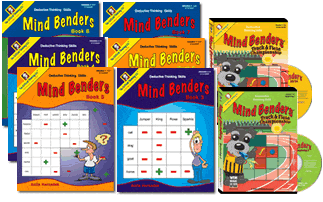
There are three sets of books: A (1-4) for Grades 3 – 6, B (1-4) for Grades 7 – 12+ and C (1-3) also for Grades 7 – 12+. Each book normally costs $9.99 but they are currently (as of the time of this writing) on sale for $6.99 each! (Or you can get lucky, like me, and find them for sale on a used curriculum site for a bit less as a bundle.) The set I found consisted of ALL the sets of books including the Instructions and Detailed Solutions book and the Warm Up book. In the introduction of the book the levels are considered “Easy”, “Medium” and “Hard”. Each “A” book consists of 15 mind benders while the “B” & “C” books each have 14. (There are books available for younger students as well, but that is not covered in this review.)

From their website:

Mind Benders®, our best-selling deductive thinking puzzles, develop the logic, reading comprehension, and mental organization skills vital to achieving high grades and top test scores in all subjects. They’re also great for developing real-life, problem solving skills.

Your student will carefully analyze each Mind Benders® story and its clues, identifying logical associations between people, places, and things. The key is to start with the most obvious associations, then deduce less obvious associations until everything finally fits together.

Apparently a large part of the reason one would use Mind Benders is to help increase thinking skills for standardized tests but quite honestly, we just simply enjoyed them because they were so much fun! We too, like the others mentioned in the very beginning of this post, LOOKED FORWARD to when it was time to work on more Mind Benders. I can’t explain why they are so much fun, but they are! When we first started doing them we were totally clueless (thank goodness the answers are provided!) but once we started seeing how it worked, we started figuring out the answers on our own. And then, my son and I started having competitions to see who could get the answers first!

Here are a couple pictures of our books. The first one shows A1 at the top, B1 in the middle and C1 at the bottom – this shows you a little bit of the difference of complexity from A to C.

So, you read the information on the left and use the chart on the right to help figure out the answer to each problem. Click HERE to see an up close example (then click “Click to Look Inside”).

The following picture is of the covers of our current editions (as I understand it, they are older editions):

Something the person we bought our used set from included with our set were laminated blank charts – EXCELLENT IDEA! We use an erasable marker so we can wipe it off and then we can use them over and over and over (and can change something in the middle of a problem, if necessary). You can tell from the picture below that they have been well used! *grin*

We have GREATLY enjoyed working with Mind Benders, and have been very satisfied with the change in our thinking skills! We would HIGHLY RECOMMEND these to everyone ~ as we all need to increase our logic, reading comprehension, and mental organization skills.

Here’s praying you have fun learning!

Come visit Dawn over at her blog, Guiding Light Homeschool, on Facebook and on Twitter…friends are ALWAYS welcome!

Jan 182012
 

To be honest, when I was approached about writing a review for K5 Learning, I was going to pass. We just haven’t liked any online sites that we have tried. I decided it was only fair to give it a quick look before saying no, and my five-year-old was immediately drawn into the site. I responded to the request with a yes.

We started with the recommended learning assessment, to see where my son scored on grade level, so the program could correctly place him to start the program. The assessment has a variety of levels given within it. Some answers will be too easy, others too hard. This is the only way the program can know where your child is in his learning.  However, I wish there was a button for parents to choose “does not apply”, as my son correctly answered some questions he had no clue about, just by chance.  Once the assessment is over, the parent can log in to see where your child was placed. Evan scored 1st grade, and he is in Kindergarten. (I thought he was reading above K!) After the program knows where your child’s skill level is, you are ready to learn.

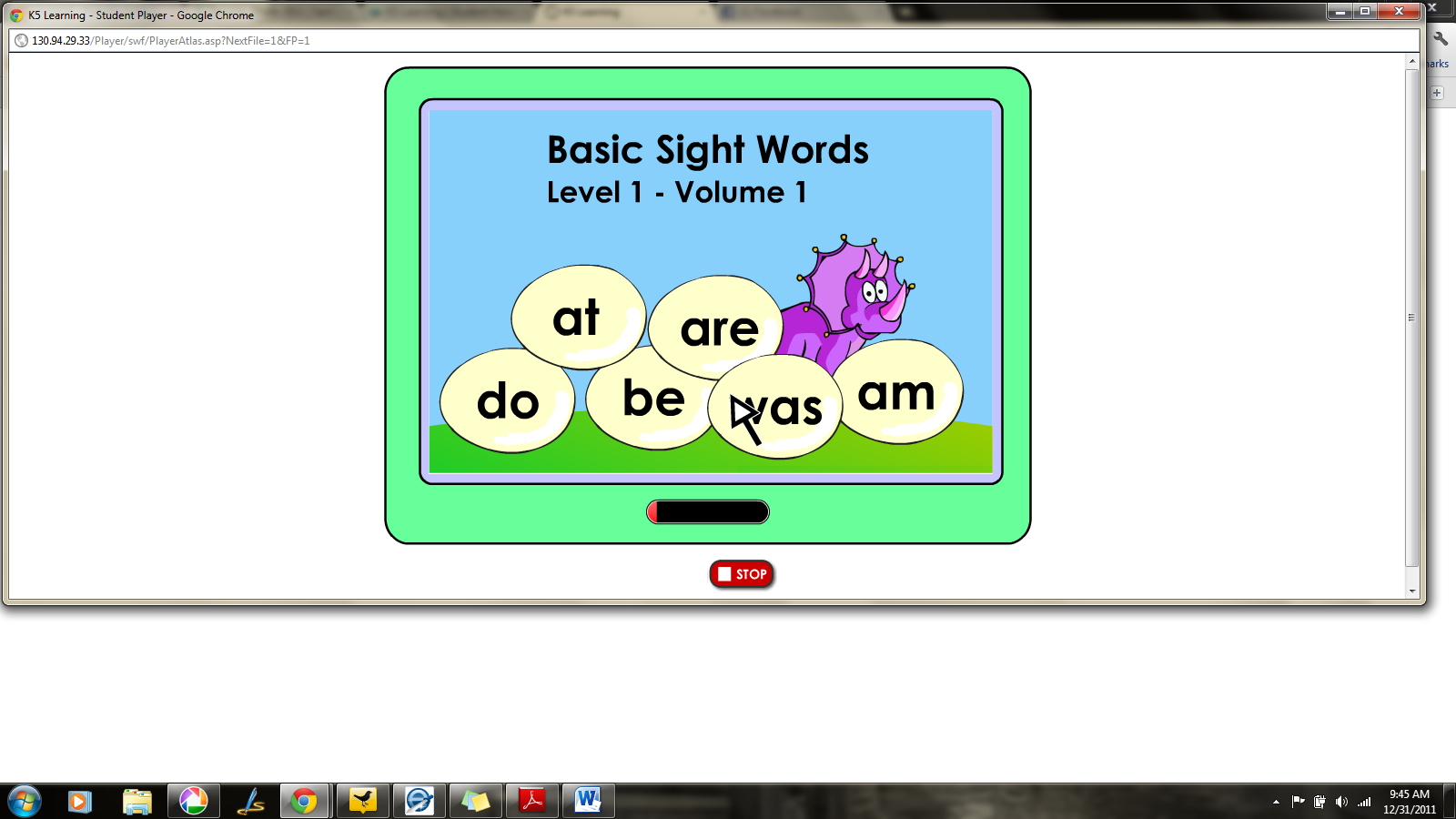
The layout is attractive and inviting. Evan has really enjoyed learning his lessons with this program. I wanted to share with you a few examples of the curriculum in action, to give a better idea of what a lesson looks like.

The pros:

These lessons aren’t full of games and a little education, your child will really learn:

  • phonetic awareness, phonics, sight words, vocabulary and reading comprehension.
  • numbers and operations, geometry, measurement (including time and money), algebraic thinking and data analysis.
  • basic addition, subtraction, multiplication and division facts. (with monitored progress for mastery)
  • spelling-you can even assign your own word lists.

Other positives:

  • works for special needs learners.
  • parents have access to learning reports to track progress.
  • the lessons adjust to your child’s individual learning automatically.


{my favorite part of the lesson}

  • Each lesson also has a preview of sorts that explains what you are about to learn and how to answer. I really like that about the program.

{this math lesson was challenging, but enjoyable}

{we apparently needed this, as Evan asked if dragons were real!}

The con:

This online curriculum has some great positives and I am glad we were invited to try it. I do have one negative to give, however:

When we went to work on the math facts for mastery, we found they are timed drills. Drills makes sense for older children – but Evan is five, with little keyboard skills. He never could get fast enough to pass, even though he answered all of the questions correctly.


As you can see, 0 were answered quickly enough, but all were correct. It had nothing to do with knowing the facts. I do wish the curriculum had thought of smaller children with little hands and no knowledge of why the numbers don’t go in order on mommy’s computer pad. Evan couldn’t understand why he didn’t pass when he knew all of the answers.

The rest of this site is great, so we will likely just be skipping this section unless that aspect is changed. Overall, it is a great program with true learning as the star. It is just fun enough to keep Evan from feeling overwhelmed, but this isn’t busy work. I would definitely recommend this if you have any interest in computer learning.

Purchase info:

  • After the trial ends, the monthly subscription for one child is $25 or you can purchase one year for one child for $199.  K5 Learning has a free 14 day trial that doesn’t require your credit card to begin. (I love that.)
  • I would recommend giving the free 14 day trial a try. Evan has really enjoyed this in the few weeks he has been using it. If we had the extra $25 in our budget, I would continue on when our subscription expires. I wasn’t expecting to enjoy K5 Learning this much. It has been a great addition to our day.

Sam's Noggin

**I was given a 3 month subscription in exchange for an honest review. All opinions are my own.**


Pin It
Oct 242011
 

Remember my love for logic? Well, here I am again talking about incorporating more logic into your homeschool – this time through games!

I’m teaching a logic and critical thinking class at co-op this year and needed some activities that were both fun and challenging.  I hit the jackpot with Foxmind Games!

  • Each of the games below can be played by one person or a group of kids – it doesn’t matter.
  • They can be used with younger/beginning logic kids all the way up to adults.  Seriously.  Each game includes cards of varying skills.  The earlier cards are easier and require less critical thinking ability.  Each card as you go through the deck builds in logical intensity.
  • All the games use manipulatives, making them very hands-on and good for tactile learners.  But, they don’t have too many pieces to try to keep up with.
  • They are colorful and inviting.
  • All directions are concise and easy-to-implement.

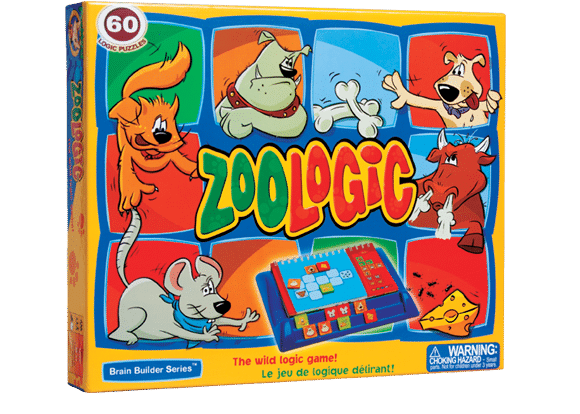
ZooLogic requires you to arrange animals on a grid so that all the animals are peaceful.  In other words, no animal can be placed next to its rival or beside its favorite food.  A simple, illustrated chart supplies you with a quick-reference about who and what can/can’t be placed next to each animal.

My four-year-old is able to complete the earlier puzzles and loves the colorful animal pieces.  He had no trouble at all catching on to the rules.  Conversely, my middle school logic class gets a kick out of the game, too.  Obviously, they work more towards the middle and end of the spiral bound deck of 60 cards, but they can’t get enough.

Meta-Forms includes a simple 3×3 grid as the playing board, with nine attribute blocks as the playing pieces.  At first, the directions make the game seem as if the puzzles are nothing more than merely looking at a clue and placing an attribute block on the appropriate square.  Very quickly, though, the clues get harder and there is nothing extremely easy about placing nine shapes on the board.

My middle and high school logic classes have already spent many moments pondering the clues and working (then reworking) the pieces to try to find the correct configurations.  Each of the 80 puzzles (also in a spiral bound deck) in supposed to take only 5 minutes.  Tell that to my high school students.

Equilibro offers a spiral-bound deck of 50 cards on which 2-dimensional figures are pictured.  At the bottom of each card, you are given specific 3-diensional shapes you must pull out from the supplied set of blocks.  Using the photograph, you are to build a 3-dimentional structure with the blocks.

Again, the directions sound easy enough, right?  Again, the puzzles are only supposed to take 5 minutes each, right?  Again, tell that to my high school students!  The earlier puzzles are easy enough for 1st graders, but they quickly become more complicated and require much more critical thinking.  (Don’t worry, answer keys are provided for each of the games! )

What’s super-cool about Equilibro?  You can purchase other guides in their Brain Builder series which will utilize the same blocks from Equilibro, but focus on different structural concepts!

I’m new to Foxmind Games, but I’m in love!

-Written by Cindy, eclectically Charlotte Mason mom of three – 9th grade, 6th grade and K4 – living in Central KY.  You can find Cindy blogging at Our Journey Westward and find her NaturExplorers studies and other creative curricula at Shining Dawn Books.

Cindy was provided review copies of these games upon her request.  Her opinions are always her own.

Sep 012011
 

“From the time my children were in kindergarten, I have followed the same basic weekly schedule for math. We typically complete three textbook lessons per week and two living math lessons per week.” ~ Cindy West

Cindy West’s Loving Living Math has given my family permission. Permission to learn and enjoy the real life stuff of math. See, I admit I am not a math type mom. But I do thrive on the practical. That’s why Loving Living Math speaks to me. I can see math all around us now.

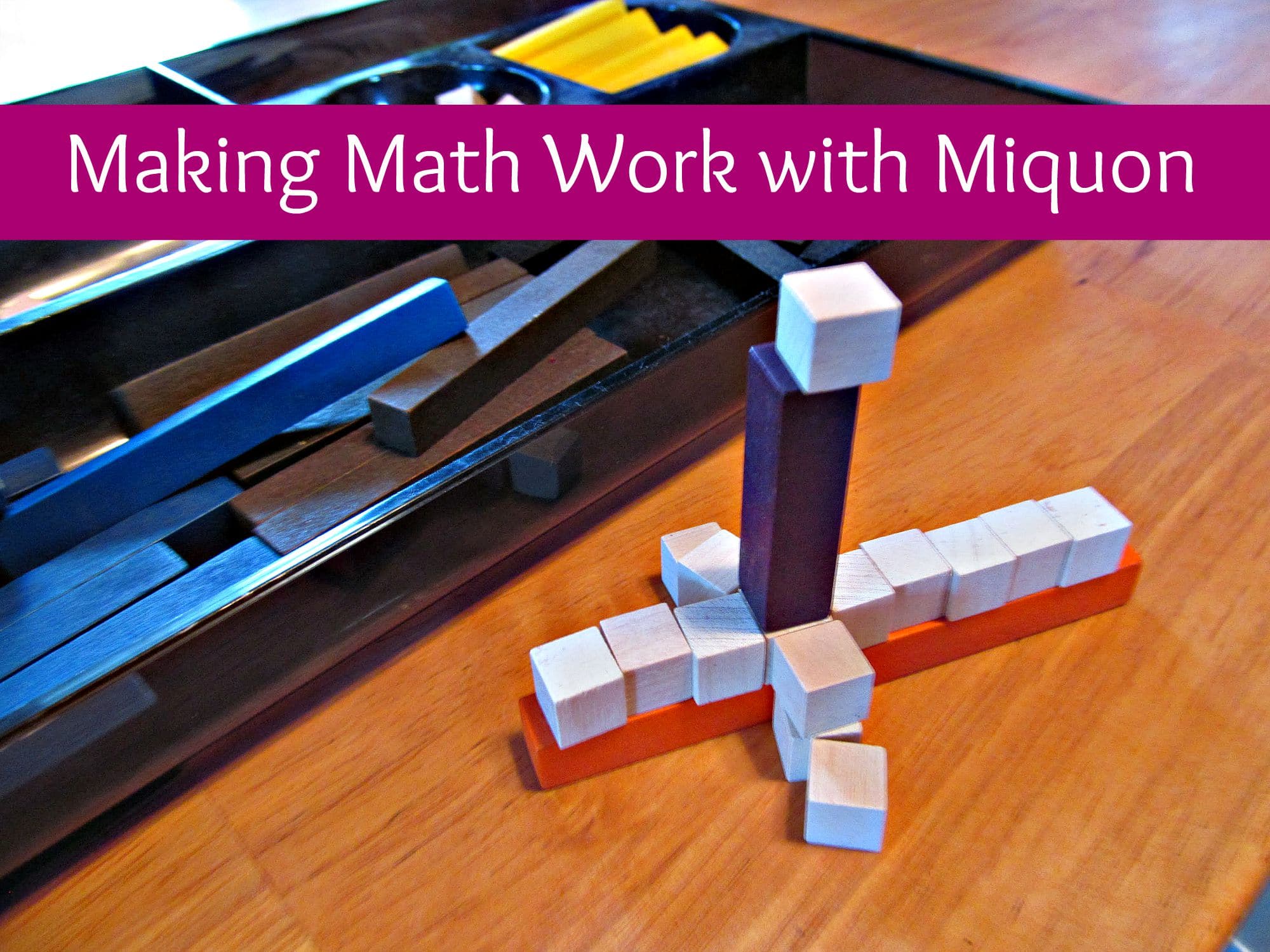
This ebook also opened my eyes to the fact that we were already enjoying many living math opportunities in board games, Snap Circuits, Saturday morning trips to the store and simply setting the table! Our favorite game, Blokus? Check!

Dear Parent – Loving Living Math is for you! Most often curriculum is for the student. This is for you. To teach you. To encourage you.

Coaches the parent in how to:

  • teach outside the textbook. You don’t have to complete each and every textbook lesson!
  • add living math to your homeschool. Practical ways for working your schedule.

Offers lengthy lists of resources for:

  • Logic
  • Problem solving
  • Favorite skills and drills
  • Making the most of website links
  • Using manipulatives

Includes worksheets with math puzzles (e.g., popcorn puzzler, Valentine math, coordinate candy graphing) to mix in. (Complete with the answer key at the end of the book.)

But there’s more! Did you know you can teach math through literature?? Through hands on projects?? Yes! In the photo above, my son is enjoying both a Tapestry of Grace assignment and living math.

Loving Living Math even shows the parent ways to incorporate writing into math and infuse math into other subjects. The latest, greatest technology? How about Excel spreadsheets, balancing the family online bank account, designing a graph for the science fair project? All math.

Baking. Oh I can see this area expanding even more. All that Cooking Fun we do during our week? It can all count as math. And Loving Living Math gives examples for doubling, tripling recipes, sorting candies…

For my family, Loving Living Math cued up the fun. Added in the logic that was lacking. My children are traditional math textbook learners. But this approach throws a bit of delight into math learning. I can see Loving Living Math being a successful tool for families that might have difficulty learning the traditional textbook way.

Loving Living Math taught me, the teacher, how to see the everyday math learning opportunities. It helps answer the practical question, “How will I use this in the real world?”

Loving Living Math is a 48 page ebook. Excerpt from the book description: “Loving Living Math will answer all your questions, ease all your fears, and bring skeptics at least closer to the idea. This is a book for parents who would like to learn more about living math – a “how-to” book of sorts. In 46 straightforward pages, you’ll understand what living math is, learn why it can be so effective in your homeschool, and consider various ways to incorporate it into your homeschool schedule.  Don’t get the impression that Cindy wants you to get rid of math textbooks!  Although some parents use living math exclusively, this book encourages you to supplement textbook lessons with living math lessons and shows you how to effectively do that.”

What age/grade is Living Math designed for? All ages. What you, the parent and teacher will learn will help students of all ages.

View a sample on the NaturExplorers site: Loving Living Math

Loving Living Math! So many children (and parents) struggle with math during the school day. Whether you’re hoping to learn how to ease the whining, add some new lessons to the regular textbook schedule or overhaul your math curriculum, this workshop will inspire you. Learn how to add “real” math lessons that make sense to your child. Questions will be answered very practically! What is living math? How will it help my child enjoy math again? How can I add it to my textbook curriculum without overwhelming my child? Why would I want to add living math to our schedule? What are some super ideas and resources for living math? ~ Heart of the Matter session description

But don’t take it just from me. I had the privilege of hostessing Cindy’s Heart of the Matter Online winter 2011 conference session. I heard directly from the author how simple it is to incorporate living math ideas in our homeschool. And you can too. The mp3 of her session is available for purchase HERE.

I’m off to oversee children tripling some recipes…

Before you leave, here’s a special note from Cindy West…Please enjoy $3.00 off Loving Living Math through the month of September!  Use the code “livingmath” (without quotes) at checkout.

~Tricia faces a daily dose of chaos homeschooling five children. She contributes a blend of writing at parenting, frugal living and homeschool sites as well as her own daily Hodgepodge.

Aug 152011
 

By now, y’all know I love logic.  Whether the more mathematical side of logic puzzlers or the more formal side of logical thinking, I’m on board (and so are my kids!)  And I’m on a mission to get your family excited about this important subject.

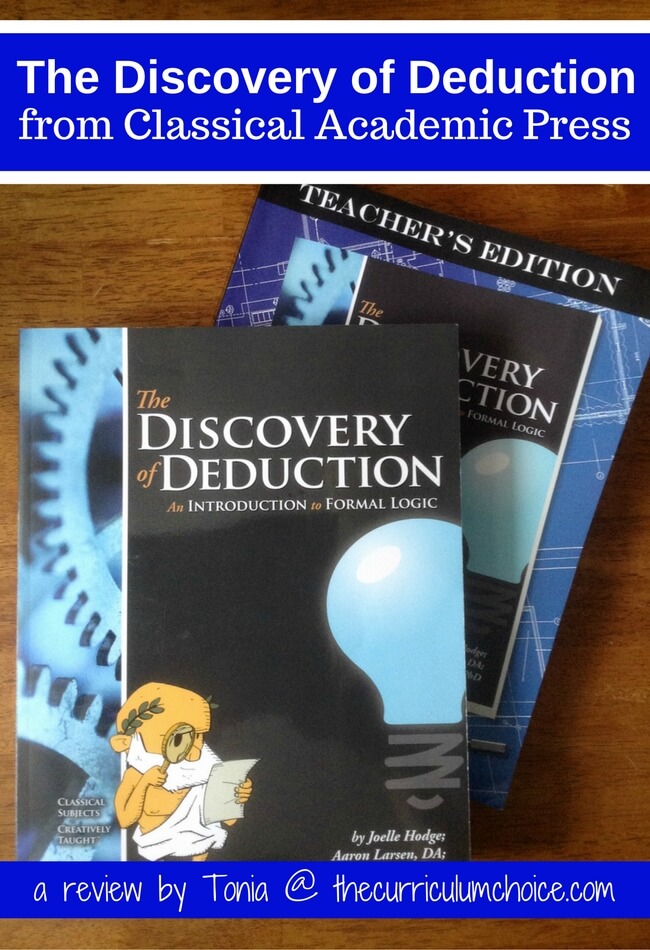
This time around, I’m reviewing Art of the Argument: An Introduction to the Informal Fallacies by  Aaron Lawson and Joelle Hodge.

Written for middle school students, I’ve found it to be appropriate for many high school aged students as well.  (Especially considering my 9th grader is the child currently using it.)  In approximately 50 lessons, your child will cover 28 fallacies of irrelevance, presumption and clarity.

An informal fallacy is when an argument does not support itself. (Not an angry argument, mind you, but any time someone takes a position in a conversation.)  For example, I might say, “My dog sheds like crazy in the spring, so all dogs must do the same.”  I have committed the fallacy of generalization – taking my experience with one dog and transferring it to the entire population of dogs.

Everywhere you look, you can find informal fallacies – commercials, newscasts, political campaigns, and even in churches.  When we aren’t aware of fallacies or don’t take the time to evaluate whether statements are well supported, we set ourselves up to believe whatever we hear. In today’s world, we simply cannot allow our children to grow up without the knowledge and encouragement to think clearly, lest they be pulled farther and farther away from the only real Truth that exists.

Now that I’ve gotten all serious on you, I’ll tell you that the program is far from serious and stuffy.  Your children will have fun learning how to argue correctly and recognize fallacies. A series of dialogues between Socrates and two college students is sprinkled throughout the book and are both humorous and enlightening.  Lessons are clear and concise with several illustrated examples to drive home the meaning of each fallacy.  Socrates often comes in at the end of a lesson, too, to challenge your child to think about real-life fallacies and/or complete brief assignments.

Although the lessons are brief (15-20 minutes most days), your child will still get lots of experience recognizing fallacies, rewriting fallacies, noting definitions and answering short essay questions.  At the end of each chapter, there is a review; and at the end of each unit, there is a cumulative review.  A glossary at the end of the book as well as charts on the inside of the covers serve as reminders of each fallacy and its definition.

The Teacher’s Guide is exactly like the Student Workbook, except it includes all the answers AND supplies you with tests for each chapter and unit, with a final exam, too.

You’ll notice my review of The Fallacy Detective and The Thinking Toolbox by the Bluedorn’s below.  Both are written for the same age level and concentrate on informal fallacies.  How do they compare? Both cover similar material, with the Bluedorn’s possibly covering a tad more.  However, the Bluedorn books are far more casual.  While they include lots of oral questions, there is not much writing involved and no reviews or quizzes.  I think both are extremely valuable in the middle/high school years!  I recommend starting with The Fallacy Detective and The Thinking Toolbox (in that order), reading them together with your child and answering the oral questions together.  Then, move into The Art of the Argument, allowing your child to take the reigns without as much direct involvement by you.  (If anyone else has an opinion on this, please comment!)

We LOVE our time exploring logic and hope you do, too!

Find my other logic reviews:

The Fallacy Detective and The Thinking Toolbox

Lollipop Logic

Logic Games

Prufrock Press Logic Resources

-Written by Cindy, an eclectically Charlotte Mason mom of three (high school, middle school, K4) in Central KY.  You can find her blogging at Our Journey Westward and find her NaturExplorers series and other creative curricula at Shining Dawn Books.

(Cindy received a copy of Art of the Argument free in exchange for her honest opinion.)

Jun 082011
 

Many of you know that I’m a huge fan of teaching logic in the homeschool. For most people, the word ‘logic’ brings to mind older children in middle school and beyond. Believe it or not, I’ve successfully used logic materials with my children as early as the preschool years!

Today I’d like to introduce you to one set of fantastic books which I’ve used with K-2nd graders – Lollipop Logic and Lollipop Logic 2 by Bonnie Risby and Robert Risby.

The logical/critical thinking skills of relationships, analogies, sequences, deduction, inference, patterning, decoding and analysis are covered in simple and attractive worksheets. Each page has only five or six problems, but it’s the perfect amount for a little ones.

Although teacher’s notes aren’t really necessary, there are some for each new section that help you know how to introduce various things to your child. Answer keys for each page are included, too.

It’s helpful if a child can read since there are directions at the top of each page, but reading skills aren’t necessary for completing the pages. I simply read the directions orally and my non-readers have no problems with the activities.

Like all logic materials we use, my kids eat these up! I’ve used a bunch of them and have loved every one.  In fact, I wrote a review back in 2009 about some of my favorites that you might like to reread.

-Written by Cindy West, eclectically Charlotte Mason mom of three from Kentucky. You can find her blogging at Our Journey Westward and find her NaturExplorers studies at Shining Dawn Books.

(These books were provided to Cindy for free.  However, as always, her reviews contain only her honest opinions.)

Dec 062010
 

While browsing the Christian Home Educators of Kentucky Convention last year, I came across a booth with several games that looked exciting.  The company, HL Games Limited, allowed me the opportunity to review three of those games.

All of them are appropriate for middle elementary children and older.

Amuse Amaze happens to be our favorite of the three, although all of them are fun.  Your job is to meander your way through the game board collecting three of four target cards and reach the finish line before your opponents.  In order to make a move, you have to go from space to space spelling words.

Even my slightly spelling challenged child enjoyed the game because being able to spell long words doesn’t necessarily get you any farther than steadily spelling smaller words.

The game is different every time you play since the board comes in squares that are put together in different orders each time you set up.  Couple that with the removable white tiles (in the picture) changing each new game and you’ll never experience the same words twice.  We love this game!

My 13 year old daughter and I have really enjoyed Beadecked.  My son, although entirely capable of playing, feels like it’s too “girly” since beads are the topic.  I disagree and don’t find it to be “girly” at all, but I can’t convince him otherwise.

There are six different ways to use the deck of cards, all of which enhance logical/mathematical thinking.  Essentially, each of the game options require you to make bead matches of some type from card to card.  That sounds easy, but the beads each have varying characteristics of shape, color and pattern – and you usually have to match two or more of the characteristics in order to complete the play.

For those of you who have played SET, this game is similar in that you have to really think through corresponding characteristics.  Critical thinking can be very fun!

And finally, Go Mental SacraMental is a trivia game for learning and reviewing Bible knowledge.

Players take turns reading game cards to one another.  On each game card there are four phrases having to do with something from the Bible.  One of the phrases doesn’t belong.  The player whose turn it is gets to move one space on the board if they can tell which phrase doesn’t belong.  They get to move three more spaces if they can tell how the other three phrases are connected.

There is a Bible reference on the answer card if you wish to give your child an opportunity to answer the question with help from the Bible.  Players can also give and take questions to move their playing piece ahead or send opponents backward on the board.

With 1,ooo questions, we won’t be repeating cards for quite some time!

What games are you playing?

-Written by Cindy, eclectically Charlotte Mason mom of 3.  You can find her blogging at Our Journey Westward and learn about her nature study curriculum at Shining Dawn Books.

Sep 102010
 

We love logic in our homeschool! I’ve used logic puzzlers with my children as early as 1st grade with such materials as Mind Benders, Prufrock Press books, and Logic Links. Now that my oldest is moving into upper middle and high school level courses, we’ve begun some more formal logic/reasoning instruction.

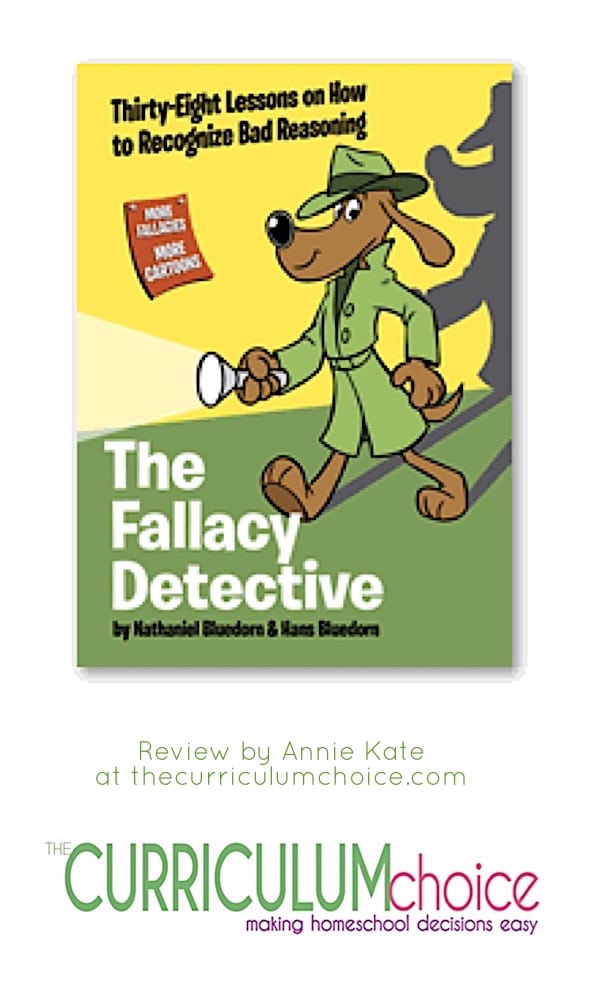
Brothers, Nathaniel and Hans Bluedorn, have written two very easy-to-understand and fun books for students in middle and high schoolThe Fallacy Detective and The Thinking Toolbox. Both books are excellent and offer 35-38 lessons including:

  • simple, solid teaching about reasoning/logic skills.
  • short lessons that only take 10-15 minutes to complete.
  • tons of pertinent vocabulary.
  • fun illustrations and cartoons to help you visualize the concept.
  • an attractive layout.
  • lots of conversational examples to explain the concepts being taught in each lesson.*
  • exercises with answer keys to practice the reasoning skills from each lesson.*

To help you see the simple and sensible explanations within the lessons, here’s a conversational example from The Fallacy Detective, Lesson 12: Straw Man. In teaching the student about a straw man in an argument, this simple conversation is given.

“POLITICAL CANDIDATE A: Due to this year’s budget problems, I think our state should decrease the amount of money going to the schools. This would solve the problem. We could bring the amount of money back to normal next year.

POLITICAL CANDIDATE B: My fellow citizens, is this what you want in a candidate? Someone who is against our schools, against our children’s education, and against our future?”

The authors use plenty of examples such as these as part of their explanations of reasoning and logic that help students begin to question and think through all the rhetoric and influential arguments in our world.

At the end of each lesson, your student is given exercises to practice distinguishing arguments. From The Thinking Toolbox, Lesson 11: The Good, the Bad and the Ugly Evidence, this is one of the exercises.

“In the examples below, choose which piece of evidence seems especially strong or especially weak when compared to the other evidence.

1. Bonnie thinks that Robey’s excitableness stems from something in his diet.

a. Robey loves to eat.

b. Robey eats a special dog food made with organic meatballs.

c. Every morning, before Bonnie takes him for a walk, Pringle’s instructed her to give Robey his special treat called a “Zip and Zaz Cookie” made for older dogs that need more energy.”

Your student is expected to determine which statement logically makes the most sense.

We have loved these books so much and they are really preparing my children to think logically! They are confronted daily with advertisements, worldview arguments, political arguments, peer pressure and so much more.  These books are training their minds to look past the glitz and glamour to get to the real truth of the matter.

As Christians, we especially need these truth seeking logical skills to help us keep our eyes on the Lord and not be swayed by the devil’s wily tactics!

-Written by Cindy, eclectically Charlotte Mason mom of three.  You can find her blogging at Our Journey Westward and find her nature study curriculum at Shining Dawn Books.