Annie Kate

Annie Kate and her husband are the parents of five busy blessings, ages 8-18. Though inspired by classical and Charlotte Mason education, they have discovered that the best learning involves real life: music, cooking, dairy farming, nature walks, bee keeping, reading, judo, blogging, website development, gardening, photography and more. Annie Kate's goal is to inspire and equip her children to love the Lord their God with all their heart, soul, and mind, and to love their neighbors as themselves.


The Youth Virtue Journal is a slim ring-bound workbook with a huge goal:  to help teens choose virtues.  Working with a mentor, teens will learn how to be attentive, content, forgiving, gentle, helpful, honest, obedient, perseverant and respectful.  The booklet contains a form for parental input as well.

Each of the nine chapters contains a moment to dream and a chance to see how virtues could help achieve dreams.  In fact, the booklet states that “ …though you add virtue to your life because it is the right thing to do, it will also tremendously improve your ability to live your dreams.”

Each virtue is defined in a very personal way.  For example, Attentive is defined as

I am attentive: I watch and listen carefully.

I am not …forgetful, distracted or distracting and I don’t ignore or interrupt.

Teens are asked to discuss a list of questions about this virtue in themselves and are given a chance to rate themselves on a scale from 1 to 10.  Then they are asked questions that show how this virtue, in themselves or others, has affected their relationships, either because it was practiced or ignored.   Quotes from various sources highlight the virtue being discussed. Then the teens are given an opportunity to relate the virtue to their dreams, write down thoughts about this virtue in their lives, and sign a resolution to ‘take a stand for what is right’.

This whole process is meant to guided by a caring mentor and supported by parents at home.

How we used it:  I quickly realized that the Youth Virtue Journal would be suitable for all ages, so we began to discuss it after lunch time, question by question.  We covered a lot of ground besides virtues.

The children shared thoughts, criticisms, hopes, and frustrations.  We laughed a lot.  We discovered some things we needed to change.  We talked about what virtues were and discussed whether or not this journal was right in its definitions and why.  These were very valuable discussions, and I plan to continue them using the insightful questions in this book.

Obviously, this is not how the book was meant to be used, but this is how it worked for our family.  It is very versatile, and its lists of questions can be used in many ways.

Our thoughts:

1.With a bit of tweaking, the Youth Virtue Journal can be a valuable tool in a homeschooling family.

2.In this study, written by Christians, I was startled to find no references to sin, salvation, and our inability to become virtuous on our own.  When I contacted the author, Heather McMillan, about this, she wrote (and I added the bold face type):

This particular tool was written at the request of a government truancy court in Nampa, Idaho. In writing this Youth Journal I was fighting against the very philosophy that there is no such a thing as right and wrong, that we do nice things because it benefits ME instead of because it is RIGHT, that obedience to authority is dangerous (I know, seems extreme, but it is the prevailing thought of our day when it comes to raising children), and that correction is to be avoided instead of embraced.  

We Choose Virtues is a tool that is not the complete story. For Christians and non-Christians alike, it sets a standard of truth for people who have no biblical standard operating in their lives or who simply need a way to explain it to their children. It forces children and youth to face their true character.  So many of us walk around believing that we have no sin because we live in a lawless generation. Parents are afraid to set a consistent standard because their own parents rejected authority. Once a true standard is set before us and we compare our lives to it, then we have a place from which to repent.  If anything, perhaps repentance will come when the true condition of a young person’s heart is revealed through this journal. Beyond that, I hope (no, actually I pray) that when this tool is in the hands of Christian parents and youth pastors, the true power behind the transformation of a heart will be explained. As you stated, there is no way we can change ourselves. It is the power of the Holy Spirit that transforms us, and that only by the work of the cross. (quoted with permission)

In this sense, then, this booklet shows people what is in their hearts.  In the hands of a Christian parent or mentor, it could be a tool to show us and our children our sinful nature and our need for redemption.  That is something we can never understand deeply enough.

3. If you want a resource to promote open discussions, the Youth Virtue Journal has excellent lists of questions.

In summary:  Our family benefitted from our time with the Youth Virtue Journal and will continue to use itAlthough it was written for a different audience, it can be a valuable resource for Christian homeschoolers.

The Youth Virtue Journal is available from We Choose Virtues.  Similar products for younger children are also available.

Disclosure:  I received a review copy of the Youth Virtue Journal from We Choose Virtues in order to share my honest opinions.

-Written by Annie Kate, a Christian homeschooling mom of five, who reviews and blogs at Tea Time with Annie Kate.

Pin It
 

Ambleside Online has influenced our family in many ways, not the least by introducing us to great books.  One that we’ve been using for many years is English Literature for Boys and Girls by H.E. Marshall, written in 1909.  We are blessed to have a century-old copy for our children, complete with roughly cut pages and sturdy binding.

In 85 delightful chapters, H.E. Marshall traces English literature from the ancient Irish legend “The Cattle Raid of Cooley” to Tennyson. She includes excerpts of stories and poems, summaries of larger works, and many interesting biographical and historical tidbits. She expresses strong opinions about authors and works, and occasionally makes some disparaging remarks about various branches of the Christian faith.

English Literature for Boys and Girls is a solid book, full of information.  Since history and literature are so closely entwined, it includes numerous references to kings and queens, to the changes in the English language, and to cultural innovations such as the rise of newspapers.

As a random sample, in chapters LVII and LVIII Marshall discusses Milton, “a cold and lonely man.”  She begins with his childhood, quotes 14 lines of On his being arrived to the age of twenty-three, and continues, discussing his life and his poetry as well as venturing into the conflict between Puritans and Royalists.  While Milton became more embroiled in politics, his personal life suffered. He lost his sight, his wife died, “his children ran wild,” his second wife died, and he began to write Paradise Lost.  Several pages and excerpts later, Cromwell died, Milton married again, and the blind poet wrote Samson Agonistes, the tragic story of Samson in his blindness.

Don’t let the “Boys and Girls” part of the title fool you; this is not a childish book at all and shows just how far educational standards have slipped in the last 100 years. In fact, Ambleside Online, a rigorous Charlotte Mason curriculum with classical leanings, recommends English Literature for grades 7 to 10.  The subject matter is not too easy for today’s teens, but occasionally Marshall’s intended audience causes her to write in a somewhat patronizing way.  As I’ve come to expect from old authors, the English would be considered advanced today even though it was written for boys and girls, but no well-read modern teen would have difficulty with it.

All of our teens have read significant portions of this book over the course of several years.  Each week they studied a chapter or two and I would ask for either an oral or a written narration.  They have become familiar with early English literature and I am amazed at the history they know.

English Literature for Boys and Girls is a brilliant work, ideal for introducing modern teens to both literature and history.  It is fascinating, lively, thorough, and eminently suitable for young people since no ‘adult’ topics are included as is often done nowadays.  Of course, modern literature is not covered (and Jane Austen was left out, a serious flaw in my opinion). Even so it is an excellent book for homeschooling families, especially those interested in classical education or Charlotte Mason’s methods. 

It is available online at Project Gutenberg  and The Baldwin Project.  You can also buy a book here.

-Written by Annie Kate, a Christian homeschooling mom of five, who reviews and blogs at Tea Time with Annie Kate.  You can read her other Curriculum Choice reviews here.

Disclosure:  As usual, I am not paid for my reviews and my opinions are my own.

Pin It
 

Here’s a wonderful introduction to Canadian history and literature for the whole family:  Sisters in the Wilderness. This DVD portrays the mid-19th century pioneer life of two sisters who sailed from England expecting an easy existence in the Canadian bush.  Incorporating both contemporary artwork and dramatization, this quality film full of beauty, pathos, humanity, and history tells the story of Susannah Moodie and Catharine Parr Traill, both writers.  Their two families settled in the bush close to each other and, after years of hardship, moved to town.  Throughout their lives both Catharine and Susannah  continued to write about their experiences.  The movie Sisters in the Wilderness is based on their books.

Although not designed as a curriculum, Sisters in the Wilderness can be used as the basis for a thorough study of Upper Canada pioneer life.  It shows

  • the English background of many immigrants,
  • the ocean journey,
  • the arrival in Canada,
  • survival and adaptation in winter and summer,
  • hardship and ingenuity,
  • the Rebellion of 1837
  • and so much more.

Each element of this beautifully produced movie highlights a fascinating aspect of the history of Upper Canada in the middle of the 19th century and beyond.

After watching Sisters in the Wilderness and seeing how real pioneer families lived, younger students understand A Pioneer Story much better.

Sisters in the Wilderness gives older students an appealing introduction to the two women’s books as well.

  • Catharine Parr Traill, the optimistic sister, wrote The Backwoods of Canada, focusing on hints for new colonists and on nature.  There is a wealth of practical and everyday history in Catharine’s writing.  This book is part of our Canadian geography curriculum.
  • Susannah Moodie, more gloomy and literary, wrote the famous book Roughing it in the Bush.  This sombre personal history of an upper class British gentlewoman trying to survive in the woods was written as a warning to those ‘back home’ who were considering such a move.  Roughing it in the Bush has become one of the foundational works in Canadian literature, greatly influencing it in modern times.

In summary, Sisters in the Wilderness, available from Northwoods Press, introduces the whole family to Canadian pioneer life in a delightful way and sets teens on the path to studying Canadian literature.

Disclosure: I received a review copy of Sisters in the Wilderness from Northwoods Press.

Written by Annie Kate, a Christian homeschooling mom of five, who reviews and blogs at Tea Time with Annie Kate.  You can read her other Curriculum Choice reviews here.


You know how, in secret societies, people recognize each other by a sign, a gesture, or a word?  Well, that’s how I used to feel about Geography Songs.

You’d just have to start, “North A-MER-i-ca,” and any homeschooler nearby would join in, “South A-MER-i-ca!”  That’s how we could tell who homeschooled.

I haven’t heard much about this CD lately, and that’s a pity because it’s one of the catchiest ways to learn basic geography facts. In over thirty songs with accompanying outline maps, Kathy Troxel teaches names and locations of countries of the world, as well as oceans, planets, and states of the US. Some songs are just listings of names. Others also tell about the culture of an area.

The music is light, cheerful and catchy, occasionally even tying in with the culture of the countries in the song.  It remains pleasant even after hearing it hundreds of times…and that is important.

My children begged to listen to it. If children color the map while they are listening (mine don’t like coloring), they will learn the locations even more quickly.  In any case, this is a great basis for any geography study.

Our version is old but the CD has been newly updated and includes a large world map as well.

Listen to samples and buy at Audio Memory or download individual songs from Amazon.

-Written by Annie Kate, a Christian homeschooling mom of five, who reviews and blogs at Tea Time with Annie Kate. You can read her other Curriculum Choice reviews here.

Pin It
 

Teens need to think about thinking, studying, time management, and the future. There are all sorts of serious, sober, and expensive approaches to these topics. However, if your family has a sense of humor and likes outside-the-box ideas, Gary North’s free study course might work for you. How to Raise Your High School Grades by Half a Point in One Semester is full of quirky opinions mixed with excellent advice. The excellent outweighs the quirky, but it’s the quirkiness that made this course such a success in our homeschool.

Our children delighted in their weekly sessions with Gary North. There seems to be something in Dr. North’s writing style that brings out humor and independent thinking in my teens, because their summaries were almost always insightful and often downright funny.

In this guide, Dr. North discusses:

  • study skills
  • attitudes
  • time management and tricks
  • study partners
  • vacations
  • textbooks
  • note-taking
  • test-taking
  • writing
  • keeping up with the news

The lessons are short, full of short sentences and definite opinions that sometimes had me sputtering. Aim for a B in your book reports!  Indeed! But they generated great discussion. What’s more, many of the suggestions are truly wise.

Although Dr. North set this course up so that students would get one lesson a day—and presumably raise their marks quickly—our approach was more long-term. Once a week our teens would go to the website, read the lesson, summarize it, and write down the take-home message. This kept them interacting with the material for a much longer time, which is better for real learning and thinking.

I have not read much other material by Gary North and cannot vouch for the rest of the things he says. In fact, I don’t even agree with all he says in this course. However, How to Raise Your High School Grades by Half a Point in One Semester has been a highlight in our homeschool for the past 27 weeks, and my teens are sad that they have finished it. 

Your teens might also enjoy it.  They will certainly learn from it.

-Written by Annie Kate, a Christian homeschooling mom of five, who reviews and blogs at Tea Time with Annie Kate. You can read her other Curriculum Choice reviews here.


We’ve tried many computer and online math drill programs.  We’ve even used flashcards.
But we often return to the first formal drill program we bought years ago: Calculadder by
Dr. Myers.  It’s quick, simple, very effective, and can be used for all the children in a family.

Each drill page has a number of problems, a recommended time limit, and a Bible text that’s
sometimes relevant.   The student is expected to fill out the page as quickly and accurately as
possible.

Because some of our children need to repeat pages over and over before they are accurate and
quick enough, I print each page only once and slip it into a clear plastic page protector so
that it’s reusable.  The children use erasable markers to do the problems.

The unique answer key pages have answers written on three sides of the page, making it very
easy to mark the problems rapidly as long as you have a large desk or table to work at. It takes
a lot of space to rotate that answer sheet, especially if it’s in a binder as mine is, and I
would prefer an ordinary answer key.

So how do you keep track of how a child has done and when he or she has completed a level?
Dr. Myers has provided super-handy sheets for that, too. They are clear and forgiving, even
when, as you can see, I make mistakes when I enter the scores. This is Miss 9′s recent work.
I let her move ahead when she has had several 10’s in a row for a particular level.
Occasionally she gets a score of 11!

And to top it all off, there are certificates.  Miss 9 is just thrilled with them and is
working hard to finish hers so she can hang it up in her bedroom.

I pulled Calculadder out again this fall (after forgetting about it for a long time) when I
realized that Miss 9 was still using her fingers to add. This was making a long, painful ordeal
out of each math page of her regular curriculum.  By now I’ve seen a huge improvement in her
addition and subtraction skills as she learns to rely on memory rather than counting.

And this is exactly what Calculadder is designed to do:

The emphasis on accuracy and rapidity “encourages a shift from laboriously calculating answers
to instantly recalling them.”  Dr. Myers, scientist and father of 12 homeschooled children,
wrote, “Without this sort of repeated, timed, brief drill, the student may still solve simple
problems by subtly counting fingers even after years of exposure to textbook and workbook materials.”

Calculadder is part of the Learning Vitamins series that also includes drill sheets for
alphabetizing and penmanship.  We’ve enjoyed those too. The entire series, as well as
detailed explanations and free samples, is available from School Made Simple.

As authors here on The Curriculum Choice, we review what we love.  Interestingly enough, Laurie recently wrote about her thoughts of Calculadder.  Two positive reviews must mean a doubly great curriculum!

-Written by Annie Kate, a Christian homeschooling mom of five, who reviews and blogs at Tea Time with Annie Kate.  You can read her other Curriculum Choice reviews here.


During school time Mr. 16 was sitting at the computer, chuckling. Having that much fun doing ‘schoolwork’ suggests to me that it’s not really schoolwork on the computer….

So I sternly asked, “What are you doing?”

Sweetly he answered, “Dave Ramsey,” and continued chortling.

After listening to a few more minutes of this laughter, I pulled up a chair beside him to watch “Bargain Shopping,” Chapter 8 of the Foundations in Personal Finance Curriculum, Homeschool Edition, a wonderful curriculum by Dave Ramsey. Soon the Little Misses joined us and we finished the chapter…and then started again at the beginning, laughing and learning all the way.

Sure, not all of the lessons are this funny, but we love this curriculum. It’s fun and relevant and practical. Dave’s mission is “empowering students to make sound financial decisions for life,” and he does it in such an appealing way!

He covers a lot of topics too, and, besides being excellent training for life, this course also meets state standards. In his 4 teaching DVD’s, Dave covers the following topics in great detail:

  • Unit 1: Saving and Investing
  • Unit 2: Credit and Debt
  • Unit 3: Financial Responsibility and Money Management
  • Unit 4: Insurance/Risk Management and Income/Careers

There’s also a Teacher’s Guide CD-ROM with lesson plans, tests, answer keys, activities, case studies, and more, as well as a Student Workbook containing worksheets, reviews, and many interesting tidbits of information. (For more information, please see the very detailed review on my blog.)

We are extremely pleased with the Foundations in Personal Finance Curriculum. While studying other subjects is very important, learning Personal Finance may well have the most practical impact on your teen’s future life. This curriculum is not inexpensive, but I believe it is an investment that will pay back many times over, both in your teen’s life and your own.

-Written by Annie Kate, a Christian homeschooling mom of five, who reviews and blogs at Tea Time with Annie Kate.  You can read her other Curriculum Choice reviews here.

Disclosure I received a complimentary copy of Foundations in Personal Finance, Homeschool Edition, in order to give you my honest opinion of it.


It is very difficult to find living math books that present complex topics in an accessible way.  One math author whose books we have learned to love is Mitsumasa Anno.  Anno believes “that mathematics is more than merely manipulating numbers, it is a way of thinking, and that it has bearing on all scholastic subjects, indeed on all forms of creative thought.”  Children throughout the world have enjoyed his award-winning picture books.

We regularly borrow Anno’s books from the library and indulge ourselves. When very young, my children enjoyed the whimsical illustrations while the older children are intrigued by the puzzles and concepts.  As a math-loving mom, I’m delighted at the way advanced concepts such functions or factorials are presented.   Children comprehend much more than they are given credit for; having enjoyed a concept with Anno, they will be able to understand it so much better when it is introduced in math lessons.

Anno’s many math books include:

Anno’s Math Games

In four pictorial chapters of games and puzzles, Anno presents the ideas of

  • same and different
  • combining and assembling
  • numbers, ordering and coordinate systems
  • more and less.

In an afterword, Anno discusses the concepts presented in each chapter.  Our children have always loved tall Kriss and tubby Kross as they work, ponder, and experiment.

Anno’s Math Games 2


Full of mathematical ideas, this is a fascinating book of games for children.  Anno’s whimsical drawings illustrate ideas such as

  • cause and effect (functions)
  • differences and similarities
  • dots and pixels
  • counting and tabulation
  • volume and units.

Anno’s Math Games 3


This book was every bit as good as the others, but I cannot tell you the details since it is no longer available in our library.

Anno’s Magic Seeds

 An old man gave Jack 2 large golden seeds.  “These are magic,” he said.  “Bake one seed in the oven until it is red and then eat it.  You will not be hungry again for a whole year.”  The other seed was to be planted and would produce two more seeds.  How Jack fared with his seeds, the big decision he made, and what happened next is a fascinating story driven by math, but representing much of history as well.  While children can understand it, adults can continue to ponder it for a long time.

Anno’s Counting Book


With a growing column of cubes on the left side of the page, and a large number on the right, Anno shows the development of a small village.  On each successive page, spread throughout the year, the village increases by one child, one building, and one tree.  Each picture is full of small stories such as building a railroad, photographing a wedding, or fishing, as well as many examples of the number.  There are opportunities for adding, such as when three of the geese on the number 4 page lag far behind the other one, and for thinking about sets, and other concepts.  Though it is a counting book, it is also much more.

Anno’s Mysterious Multiplying Jar


Inside the jar there was water, and there seemed to be just enough wind to set the water rippling…and suddenly we are inside the jar, on a sea, sailing toward 1 island.  On it there are 2 countries.  Fascinating pictures tell the story of factorials in the first half of the book, and Anno explains them explicitly in the second half.

Besides math books, Anno has also created many other amazing volumes, and we’ve enjoyed each one we’ve seen.

Disclosure: As always, I am not compensated for my reviews and I give my own honest opinions.

-Written by Annie Kate, a Christian homeschooling mom of five, who reviews and blogs at Tea Time with Annie Kate. You can read her other Curriculum Choice reviews here.


So now your children know how to read.  Congratulations!  That’s a major step, but does it mean that their reading instruction finished?  Not at all, we’ve found.

How to Read a Book: The Classic Guide to Intelligent Reading teaches the average reader how to understand, analyze, and learn from books.  It takes students beyond the basics of reading to become scholars.  It is, I think, the foundational book in our homeschool high school, besides the Bible.

Summary

How to Read a Book discusses and explains the four levels of reading as well as different approaches to different kinds of reading material.  The book is divided into four exceedingly well-organized parts:

  • Part 1: The Dimensions of Reading” includes information on the first level of reading, which is what we homeschool moms teach our little ones.  Then it goes on to discuss the second level, inspectional reading, occasionally called pre-reading.
  • Part 2: The Third Level of Reading: Analytical Reading” includes topics such as pigeonholing a book, coming to terms with an author, determining an author’s message, and agreeing or disagreeing with an author.
  • Part 3: Approaches to Different Kinds of Reading Matter” presents tips for reading both fiction and non-fiction: novels, plays, short stories, and poems, as well as history, science, math, philosophy, and social science.  It also includes an insightful section on how to read ‘canonical’ books.  For example, it explains how reading sacred writings as the revealed Word of God, rather than as mere literature, is entirely different from other kinds of reading.
  • Part 4: The Ultimate Goals of Reading” explains the idea of syntopical reading and tells us what good books can do for us.
  • Appendices:  These include a recommended reading list as well as exercises and tests at the four levels of reading.

Throughout the book, examples and explanations are taken from the literature of ‘the great conversation’ as the greatest Western literature is sometimes called.  This adds immeasurably to the book.

How we use it

We were introduced to this book several years ago by both Ambleside Online and The Well-Trained Mind (first edition).  Both resources recommended that students work through How to Read a Book in great detail, and that is what we have been doing.  My children go through it paragraph by paragraph, for at least half the book.  Each paragraph is summarized in one or two sentences, and I check each summary.  This process teaches my teens a lot since it’s one of the few books meaty enough to make such careful attention to detail worthwhile.  (It teaches me a lot, too. )

Of course, this is a great deal of work and we spread it out over at least the four high school years.  I allowed Miss 18 to absorb the last half of How to Read a Book on her own during the last two years of high school, since she’s the kind of person who will read ahead and study independently.  Although she would have learned more if she had continued the detailed summaries, there are only 24 hours in a day; she did read it several times. Mr. 16 and Miss 13 are both doing the detailed summaries.

As mentioned, How to Read a Book uses great books as examples.  Thus my teens were exposed to much great writing in an enjoyable and inspiring way.  In fact, Miss 18 designed her Intro to Western Literature course using the reading list in Appendix A. Recently Mr. 16 chose to read and analyze Machiavelli’s The Prince because of How to Read a Book’s discussion of an intriguing statement beginning with “A prince ought to inspire fear in such a way that, if he does not win love, he avoids hatred;…”

Although this book is challenging and uses challenging examples, the subject matter is appropriate for Christian teens.  They will need to think, true, but they will not be taught evil, immorality, modern political correctness, or revisionism.

Our family has been able to understand other books more deeply because of insights gained from How to Read a Book.  Thus studying this one book has had a huge impact on everything we learn from other books.  It both enhances the time spent reading and increases our efficiency in understanding new material.

I highly recommend How to Read a Book: The Classic Guide to Intelligent Reading for all teens whose studies involve a lot of reading, and for their moms as well.

Disclosure:  I do not receive any compensation for my reviews, and my opinions are entirely my own.

-Written by Annie Kate, a Christian homeschooling mom of five, who reviews and blogs at Tea Time with Annie Kate.  You can read her other Curriculum Choice reviews here.


The prospect of getting homeschooled kids into university can seem quite frightening.  I was recently talking with a mom who is going to do online public school so that her children will have ‘the right courses’ to enter university.  She was cheerfully determined to follow this course, so I didn’t try to dissuade her, but really, it’s not necessary.

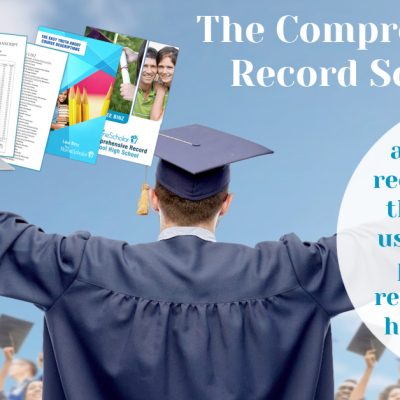
Instead, she could have continued the excellent home education she was giving her children and added a few standard tests such as SAT’s or AP’s, whatever her chosen universities required.  Using the Comprehensive Record Solution would have enabled her to document her homeschooling so that universities would have been eager to admit her children.

I go to great effort to choose rigorous, quality curriculum for my children.  I consider the worldview of each curriculum, its goals, how easy it is to learn from, and the amount of time and effort it will demand from me.  As a reviewer, I love to evaluate curricula, and I’m excited when something exceptionally good crosses my path.  Of course we want to use these excellent resources to provide the best individualized education for our teens.  We don’t want to settle for public school standards and values just to be able to get into university.

And that’s why I love the Comprehensive Record Solution.  It gives me both the confidence and the tools for keeping track of my teens’ high school learning.  It’s clear, organized, effective, and professional looking.  It helps me translate my ‘mommy courses’ and ‘mommy marks’ into something admissions officers can understand and get excited about.

I think this resource will help families continue to homeschool though high school Because it builds parental confidence and provides the tools to justify that confidence, it’s such a valuable resource that I’m posting a review of it here on the Curriculum Choice in addition to the preview and review posted on my blog.

First of all, the Comprehensive Record Solution is a parental confidence builder.  Lack of parental confidence is one of the main reasons for sending homeschooled kids to public school.  “If I keep homeschooling them they won’t be able to get into university,” I’m told over and over.

Lee Binz, mom, author, and successful homeschool high school coach, asserts that the quickest and easiest path to college admissions and scholarships is to focus on helping the student become the person God created them to be.  She does not advocate a rigid, stressful style of high school at all.  In fact, she says that a big advantage of homeschooling is the opportunity to enjoy life-defining experiences during the school year. This is our family’s style, too.  Although we encourage thorough and rigorous courses, we also allow ample opportunity for exploring personal interests.  Knowing that Lee’s philosophy is similar to ours makes me feel more comfortable with her suggestions.

Furthermore, the Comprehensive Record Solution provides helpful tools to prepare high school records.  It consists of four modules:

  • Module 1: Encourage, in which we meet Lee and her family, understand the importance of record keeping, and see the records of her sons and of some other homeschooled students.
  • Module 2: Equip, in which Lee shares a thorough record template as well as all you’ve ever wanted to know about course descriptions, including many examples.
  • Module 3:  Educate, in which Lee gives wide-ranging video and audio advice to help prepare your teen’s comprehensive record.
  • Module 4:  Empower, in which Lee will personally help you, hands-on, with four individual course descriptions you develop.

The backbone of the program is the Comprehensive Record Template from Module 2.  This well-designed document includes transcript forms to help organize and record students’ work in a format which universities and colleges appreciate.  It has prompts to record textbooks, grades, course descriptions, and more.  Because of the template, I could focus on just one step at a time, and that really reduced my stress level.

The program also includes a wealth of helpful information in E-books, audio downloads, videos, templates, and documents.  I loved Lee’s course descriptions, and used them to make my own…and I really enjoyed her empowering and helpful input on four of them.

We used the Comprehensive Record Solution for Miss 18 who is entering her chosen university in the fall, and I am also using it for Mr. 16 and Miss 13.  Although the thought of preparing adequate high school records used to keep me awake at nights, I’m now confident and relaxed about it.  Of course, there’s still work to do, but the stress is now gone.  I am pleased to be able to homeschool right through high school using our own style and top quality resources…and still get my children into university.

As mentioned, more information is available in my earlier preview and review, as well as on the Comprehensive Record Solution webpage.  You can purchase the program there as well.

Disclosure:  I received The Comprehensive Record Solution in order to review it and give you my honest opinion.  I do not receive any compensation for any of my reviews, and my opinions are entirely my own.

-Written by Annie Kate, a Christian homeschooling mom of five, who reviews and blogs at Tea Time with Annie Kate.  You can read her other Curriculum Choice reviews here.


© 2011-2012 The Curriculum Choice All rights reserved. DMCA Notice