It is very difficult to find living math books that present complex topics in an accessible way.  One math author whose books we have learned to love is Mitsumasa Anno.  Anno believes “that mathematics is more than merely manipulating numbers, it is a way of thinking, and that it has bearing on all scholastic subjects, indeed on all forms of creative thought.”  Children throughout the world have enjoyed his award-winning picture books.

We regularly borrow Anno’s books from the library and indulge ourselves. When very young, my children enjoyed the whimsical illustrations while the older children are intrigued by the puzzles and concepts.  As a math-loving mom, I’m delighted at the way advanced concepts such functions or factorials are presented.   Children comprehend much more than they are given credit for; having enjoyed a concept with Anno, they will be able to understand it so much better when it is introduced in math lessons.

Anno’s many math books include:

Anno’s Math Games

In four pictorial chapters of games and puzzles, Anno presents the ideas of

  • same and different
  • combining and assembling
  • numbers, ordering and coordinate systems
  • more and less.

In an afterword, Anno discusses the concepts presented in each chapter.  Our children have always loved tall Kriss and tubby Kross as they work, ponder, and experiment.

Anno’s Math Games 2


Full of mathematical ideas, this is a fascinating book of games for children.  Anno’s whimsical drawings illustrate ideas such as

  • cause and effect (functions)
  • differences and similarities
  • dots and pixels
  • counting and tabulation
  • volume and units.

Anno’s Math Games 3


This book was every bit as good as the others, but I cannot tell you the details since it is no longer available in our library.

Anno’s Magic Seeds

 An old man gave Jack 2 large golden seeds.  “These are magic,” he said.  “Bake one seed in the oven until it is red and then eat it.  You will not be hungry again for a whole year.”  The other seed was to be planted and would produce two more seeds.  How Jack fared with his seeds, the big decision he made, and what happened next is a fascinating story driven by math, but representing much of history as well.  While children can understand it, adults can continue to ponder it for a long time.

Anno’s Counting Book


With a growing column of cubes on the left side of the page, and a large number on the right, Anno shows the development of a small village.  On each successive page, spread throughout the year, the village increases by one child, one building, and one tree.  Each picture is full of small stories such as building a railroad, photographing a wedding, or fishing, as well as many examples of the number.  There are opportunities for adding, such as when three of the geese on the number 4 page lag far behind the other one, and for thinking about sets, and other concepts.  Though it is a counting book, it is also much more.

Anno’s Mysterious Multiplying Jar


Inside the jar there was water, and there seemed to be just enough wind to set the water rippling…and suddenly we are inside the jar, on a sea, sailing toward 1 island.  On it there are 2 countries.  Fascinating pictures tell the story of factorials in the first half of the book, and Anno explains them explicitly in the second half.

Besides math books, Anno has also created many other amazing volumes, and we’ve enjoyed each one we’ve seen.

Disclosure: As always, I am not compensated for my reviews and I give my own honest opinions.

-Written by Annie Kate, a Christian homeschooling mom of five, who reviews and blogs at Tea Time with Annie Kate. You can read her other Curriculum Choice reviews here.


Last February my family spent several days creating murals to hang in their bedrooms.  Coordinating several children to produce something beautiful to hang on the wall can be challenging.  We used inexpensive downloads from Art Murals for Kids as our guide for several reasons:

  • They’re easy – even my 2 year old can color.
  • They’re printable – which meant if a piece got messed up and bothered the children they could just print again and redo it.
  • They make beautiful final products.

My sons chose to use Oil Pastels to color their version of Van Gogh’s Starry Night.  They decided to try following the original for their colors.  This came from the Mini Impressionist Mural Set, which is only $5.00.  In this set the murals are small – our Starry Night printout was 6 pages, measuring 23″x 19″.  It was just right for a family to do together instead of a classroom.  There is a larger version of Starry Night available for download that is 24 pages and measures 48″x 36″.  I really like how the colors of the oil pastels are bold.  The only drawback to oil pastels is they are a bit smudgy – mostly on children’s hands!

My daughters used crayons with this mural for their bedroom.  They chose this one for the animals.  Their file was also $5.00and included two sizes to use: a 36-page version measuring 45″x 45″ and a 9-page mini version measuring 22.5″ x 22.5″.  I think the crayons looks all right, it just does not stand out as much as the oil pastels.  We may try painting a mural sometime for a change.

There are quite a few other mural possibilities to choose from at Art Murals for Kids.  She even offers coloring books of famous paintings that would be a fun addition to an artist study.  Be sure to check out her companion site, Art Projects for Kids for tons of art project ideas to use with your children.  I’ve found some real gems as I’ve explored the archives!

Tristan is a happily homeschooling LDS mother to 6 blessings age 9, 6, 5, 3, 2, and 5 months old.  You can drop in and visit anytime over at her blog, Our Busy Homeschool.  Read her other Curriculum Choice posts here.

{Disclaimer: I purchased these products on my own.  This is not a sponsored post in any way.  And yes, we hope to purchase more murals in the future!}


Here’s one book no homeschooling family should miss:  A Pioneer Story: The Daily Life of a Canadian Family in 1840.  It combines heartwarming stories of a busy pioneer family with the background information and hands-on activities of a unit study.  Truly, it is a winning combination.

Beautifully illustrated, this story of the Robertsons fills our hearts and minds with the life of a pioneer family in the backwoods of eastern Canada.  We follow Sarah (10), Willy(9), George(13), and Meg (15), as well as Granny, Pa, Ma, little sister Lizzy, and baby Tommy, through a whole year of maple sugaring, baby animals, milking, sheep shearing, fishing and more.

With the Robertson children we face the terror of meeting a lynx, the thrills of building a new home, the hard work of bringing in the harvest before the storm, and the joys of surviving a night lost in the wintery woods.  We trade with a jolly peddler, meet a new English boy at the school, and visit Uncle Jacob’s home for a thrillingly different Christmas.

Reminiscent of Laura Ingalls Wilders’ stories, these tales are not only the delightful story of a busy family, but also a wonderful introduction to the book’s detailed explanations and activities.

For example, in the chapter “Finding a Honey Tree,” Uncle Jacob took Sarah and Willy out to mark a bee tree in anticipation of the fall, when the honey could be harvested.   After enjoying the story, we learn about bees, harvesting wild honey, and pioneer remedies.

“Signs of Spring” shows us the family’s house, winter diet, cooking, and farmyard in such wonderfully illustrated detail that we can almost imagine their lives for ourselves.  When Sarah found the year’s first egg, the entire breadth of pioneer experience is revealed in Ma’s response:

Ma stroked the egg dreamily.  “Pudding,” she said.  “I’ll make a nice egg pudding for tonight’s supper.  There’ll be a good mouthful for each of us.”

When the peddler arrived, he brought joy and excitement to everyone in the family.  Itinerant preachers, shoe makers, peddlers, tailors, and tinkers all were welcome visitors at the farm.  Crafts in “The Peddler’s Visit” include making a punched tin picture, a pioneer water carrier, and a sand clock.

Willy spent a lot of time with his friend Neekeek, and occasionally Neekeek’s uncle would teach the boys a new skill.  Once he taught them how to catch trout with their bare hands.  When Willy came home triumphantly with the fish he had just caught, George scoffed at his story.  Granny, on the other hand, laughed, “Och, aye!  Tickling trout. Your granda was a dab hand at that. Many’s the poached fish we had from the laird’s stream.  Scooped up just that way.  Good for you, young Will!”  Of course this chapter discusses fishing, hunting, guns, and snares.

Throughout the book we learn to read the weather, make a balance scale, prepare for winter, make candles, use a bake oven, build a road, and thresh the grain while we live, laugh, and bicker with the family.  While the bickering does bother me, this book is, on the whole, happy and inspiring. The illustrations are a joy, and the stories are a treat.  My children enjoyed A Pioneer Story even more than I did both times I read it aloud, and they’ve enjoyed it on their own as well.

A free Teaching Guide is available.

-Written by Annie Kate, a Christian homeschooling mom of five, who reviews and blogs at Tea Time with Annie Kate.


Wordplay Café by Michael Kline is a set of grammar and vocabulary lessons disguised as a book of games.  Truth be told, there are a few lessons that cover logic and Greek and Latin in there, too.

The set up of the book itself mimics a menu at a café.  There are recipes for games, brain candy (interesting word and language facts), unfortunate cookies (made up but funny definitions for words), keyword kabobs that connect the reader to the internet, taste tests that preview word games and ideas, and Punzles© (puzzles made with puns).

There are six chapters, each named with a pun.

Chapter Won:  Word Nutrition is part history, with its discussion of the beginning of language, Greek and Latin roots, and the alphabet, and part game, proven by the inclusion of “Orange Origin Juice,” a game that asks players to create Latin-sounding words for household objects.

Chapter Too:  Comfort Food contains the old standbys in language games:  anagrams, palindromes, acrostic, and such.

Chapter Free:  Dinner for One is filled with games that can have a one-player option.  Of course, more can play, too.  There is “Homonym Grits,” a game that asks players to alter a nursery rhyme using homonyms and “Spaced-Out Spread,” in which players change familiar speeches, songs, and other writings by combining all of the words into one very long word and then re-spacing the letters into different words and almost words.

Chapter Fore:  Deep-Fried Diction for Two (Or More!) has more games, but these are for a group.  “Knock, Knockwurst” asks players to write their own knock-knock jokes based on puns.  “Bizz Buzz Biscuits” mixes words and numbers as players are challenged to count, but replace multiples of 5 with the word “bizz” and multiples of seven with the word “buzz.”

Chapter 5ive:  PC Pancakes focuses on games that involve the computer.  “Typo Tea and Biscuits,” for example, leads players in scouring internet pages for errors, while “Translation Toast” uses translation software to discover odd wording resulting from repeatedly translating a selection of text.

Chapter Sicks: Put Words to Work in Your Kitchen teaches players about mnemonics and the phonetic alphabet.

Wordplay Cafe, written for kids ages ate to fore-teen, is sure to delight wordsmiths and grammar non-enthusiasts, alike.

It can be found for free in PDF format on Michael Kline’s website or you can purchase a paper copy on Amazon.

Susan S. is a homeschooling mama of three little ones who get bigger and livelier every day. They delight in living books and hands-on math, and are nurturing a love for God and the amazing world that He created.


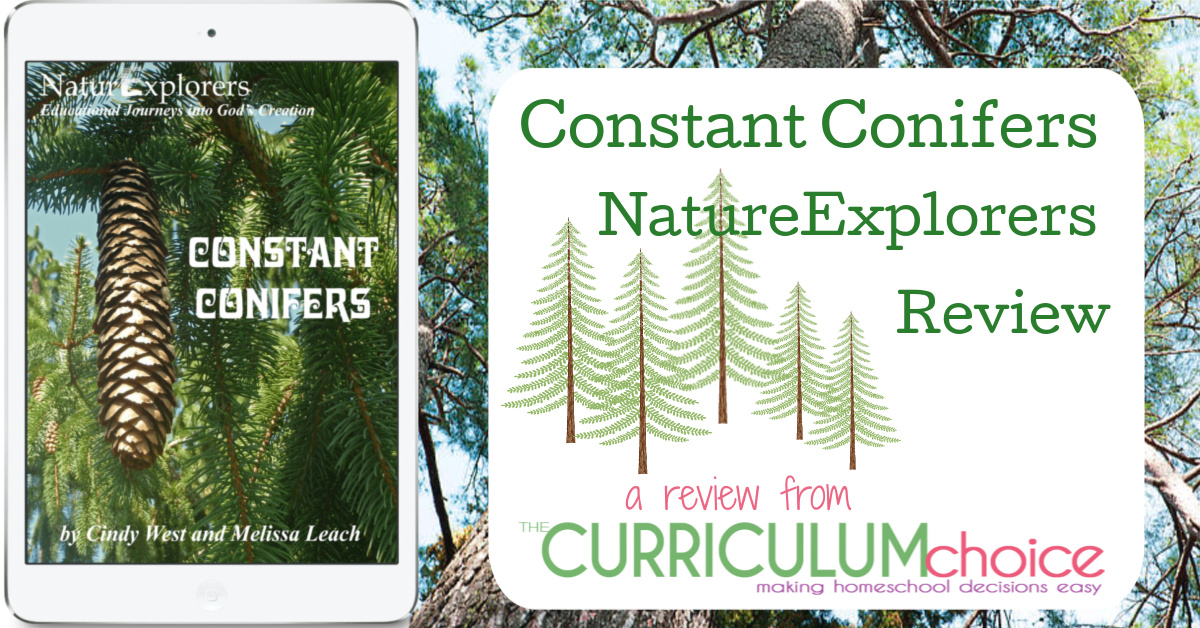
Nature study is something my family has only been doing for a few months now.  When I began looking for something to hold my hand as we jumped into the nature study waters I came across the NaturExplorers series by Shining Dawn Books.  These downloadable unit studies were just what I needed.  I received Constant Conifers ($12.00) for my family to review.

Packed into each unit I found:

  • Inspiration to get me enthusiastic about the topic, and literature suggestions I used at my library.
  • Basic information for the topic in one place so I could just read and go if I wanted to skip the library.
  • Lots of out in nature ideas – the gold mine I was looking for!  I had pages upon pages of ways we could explore our topic in the outdoors.  Each day we went out I knew I was ready to help guide my children to learn a little bit more than they had the last time we were outside.
  • Writing and research ideas to bring our learning back inside.
  • References for Bible study, artist study, composer study and poetry tie-ins, with internet links.
  • Notebooking pages to print and use with many of the activity ideas.

During our study of conifers we learned so much about these ‘cone-bearers’. We chose one special conifer by our backyard fence to explore in detail and compare with a maple tree in our yard.  It really helped to be able to touch and see the trees close up when we were learning about cones, sap, bark, needles/leaves, and more.  We spent one day watching for creatures in and around our conifer, another looking at cones in wet weather versus dry, measuring, drawing, and even smelling our tree.  You can see a sample of Constant Conifers on this page.  The units are written for elementary ages, with ideas for using it with both younger and older students.  All my children were able to learn together with Constant Conifers!

I have plans to pull Constant Conifers back out in mid-winter and see what new observations we can make about our special tree in a new season. There were so many great nature study ideas that we could not get to them all the first time around.  I also have my eye on several more of the NaturExplorer units, including Snow and Ice.  I know my kids would have a blast with that one during the winter blahs around February or March!

Written by Tristan, mom to 5 going on 6 children, homeschooling through unit studies with a side of lapbooks.  You can visit her at her blog, Our Busy Homeschool, or read her other Curriculum Choice posts here.

{Disclaimer: I received a free copy of Constant Conifers when I approached Shining Dawn Books about doing a review.  I received no other compensation and all opinions presented herein are my own.}


I have yet to meet a homeschool family that did not love books.  On my quest to find wonderful books to be read to or by my children I have read quite a few ‘books about books’.  One volume has earned a place on my personal shelf to be used often.  That book is Read for the Heart: Whole Books for Wholehearted Families by Sarah Clarkson.

Read for the Heart is 384 pages full of information and ideas.  The first four chapters give the reader an in-depth look at the author’s personal view of books, a guide for becoming a reading family, as well as a chapter on the state of literacy in America today.

The next eight chapters are booklists divided into the following topics:

  • Picture Books
  • The Golden Age Classics
  • Children’s Fiction
  • Fairy Tales and Fantasy
  • History and Biography
  • Spiritual Reading for Children
  • Poetry
  • Music, Art, and Nature

Each chapter begins with a story and treatise by Miss Clarkson on the book genre at hand, giving you an even better idea of what qualities she has used to select books for that chapter. I love this part.  It makes me feel like I’ve just sat down to chat with a good friend, and she is sharing adventures she has had with books.  The lists in each chapter are generally arranged alphabetically by author, with the main exception being the history and biography section arranged by time period.  That has been a big help when I am looking for books to go along with our current history studies.  Most of the books have a review telling more about the story, awards won, general age guidelines, and any cautions if necessary.

The end of Read for the Heart has six appendices of book lists such as Newbery and Caldecott Award winners and special favorites of the author.  There are two indexes, one sorted by author and illustrator, one by title, giving a quick way to check on a specific book or to find more by an author or illustrator my children enjoy.

You can view a 32 page excerpt from Read for the Heart on the Apologia website.  The book can be purchased there or on Amazon for $17.00.  I bought mine through Amazon with some gift cards I had.

My only complaint about Read for the Heart is that she stopped at 384 pages!  Sarah Clarkson’s guide has been a huge help as I have navigated the library catalog searching for books to share with my children.  I would love if she made a second book with reviews of even more titles.

Written by Tristan, mom to 5 going on 6 children, homeschooling through unit studies with a side of lapbooks.  You can visit her at her blog, Our Busy Homeschool.


What a wonderful experience I have had the last few months!  I received the All-Day Charlotte Mason Seminar on DVD, seminar workbook, and the Laying Down the Rails book and Workshop on DVD from Simply Charlotte Mason to review.  If you have never been over to visit Simply Charlotte Mason, I highly recommend you take a look.  They offer free curriculum guides, free ebooks, and many materials for purchase as well.  They truly help make Charlotte Mason’s homeschool ideas simple.  Their blog is one that always inspires me.

I began by watching the 3 DVDs for the All-Day Charlotte Mason Seminar and taking notes through the accompanying workbook.  I did this over the course of several evenings while my children were falling asleep in their beds, which allowed me some quiet to focus.

Session 1 (34 minutes) introduced me to Charlotte Mason, who she was, when she lived, and her ideas about education.  It was neat to get to know her this way.  I had tried to read her books in the past, but just could not get through them.  It took too much brain power at a time when I was trying to just keep up with my young children and get sleep.

Session 2 (78 minutes) and 3 (71 minutes)held my hand as we went through each subject applying Charlotte Mason’s methods.  Here is where I had many, many ah-ha moments. Short lessons, living books, and narration – these things made sense and could easily be integrated in our unit study family.  I appreciated that I was not expected to add everything in at once.  The appendix explained a doable plan for making the transition to a Charlotte Mason approach a step at a time.  Here is a short clip from the workshop about using narration.

Are we now becoming a Charlotte Mason family? Yes and no.  (grin)  I think narrowly defining any homeschooling family by one method is usually inaccurate.  We prefer to pick and choose the pieces that work for our family.  I have discovered that many of the Charlotte Mason pieces fit our family!  We have already begun to incorporate the following:

  • living books
  • narration
  • scripture memorization

We have plans to incorporate these ideas over the next year:

  • map drill
  • picture study
  • music study

Now let me tell you a little bit about the  Laying Down the Rails book and DVD Workshop that came as part of this set.  I watched the DVD first (45 minutes), using the workbook section for it from the All-Day Charlotte Mason Seminar as I went.  I love Charlotte’s idea that good habits are like railroad tracks, they smooth life out because a child is not having to make the same decisions over and over and over.  I know that is true, even in my own life.  Habits help me to accomplish many of the routine things in my day without the extra effort of decision-making.

Sonya, the workshop presenter, is funny and helpful as she leads you through many of the habits a child can learn.  While there is an extensive list, she emphasizes to start with one habit, and not to add another until the first is truly habit.  It was really helpful to watch the DVD with my husband. He was not up for reading the book, all 230+ pages, but the workshop got us both on the same mental page easily.  He was as excited about habit training as I was.  You can watch a short clip from the DVD right here.

I next spent nearly a month reading and pondering the Laying Down the Rails book.  What a treasure!  It contains Charlotte’s words on each habit gathered into one place, prefaced by a concise definition of the habit and a story that shows how the habit is important.  There are entire chapters on ‘repairing the rails’ – breaking the bad habits we already have, including chapters on some specific problems like dawdling, temper tantrums, and lying.  See a sample from the book HERE.

Where are we now? Well, habit training is a process, and I will be honest that the first person who has to acquire the new habit is me.  However, we are working on our habits slowly and steadily, and I find a lot of support and encouragement when I read through Laying Down the Rails.

Would I buy these products? Yes!  That is an unequivocal yes.  The entire set can be purchased HERE for $54.95.  That includes 3 All-Day Charlotte Mason Seminar DVDs, the Session workbook, 1 Laying Down the Rails workshop DVD, and a print copy of the Laying Down the Rails book.  I love having the All-Day Charlotte Mason Seminar on DVD, a shot of motivation that I can turn on whenever I need a boost.  Homeschooling is a process, and the experience is different with each child.  Having Charlotte Mason’s ideas broken down into manageable tasks gives me easy action plans to try when we need something adjusted.  Laying Down the Rails is a treasure trove of ideas for habit training.  Time will pass and our children will acquire habits.  The question is what habits will they develop – ones we have carefully helped them build or contrary habits that we lazily let develop?

Written by Tristan, mom to 5 going on 6 children, homeschooling through unit studies with a side of lapbooks.  You can visit her at her blog, Our Busy Homeschool.

{Disclaimer: I received these products free from Simply Charlotte Mason to enable this review.  I received no other compensation and all opinions presented herein are my own.}


Prolific children’s non-fiction author, Seymour Simon has teamed with HarperCollins Publishers and the Smithsonian Institution to produce a series of books about the natural world.  Tucked into the prolific and still-growing library of scientific information produced by Simon and the Smithsonian is a sub-series about the human body.  The books in the human body series provide a treat for the eyes and a feast for the brain.

At present there are eight books in the series.

●The Human Body

●Eyes and Ears

●The Brain:  Our Nervous System

●The Lungs:  Your Respiratory System

●The Heart:  Our Circulatory System

●Guts:  Our Digestive System

●Bones:  Our Skeletal System

●Muscles:  Our Muscular System

The Human Body,  provides an overview of the twelve major body systems.

It discusses the following topics:

●cells

●the integumentary system (skin, hair, and bones)

●the skeletal system

●the muscular system

●the circulatory system and blood

●the respiratory system

●the digestive system

●the nervous system

●the immune and lymphatic systems

●the urinary and excretory systems

●the endocrine system

●the reproductive system

●the five senses

The remaining books discuss the body system of their title using correct anatomical terms, detailed descriptions of body processes, and a depth of information that is accessible to elementary-age students but applicable for older students.  The books make use of technological advances in the medical field by incorporating computer-colored x-rays, MRI scans, and incredible inside photos of the body, along with applicable diagrams.

The impressive, real-life illustrations combine with a detailed, systematic approach to the human body’s inner workings to produce a useful product that is a delight to peruse.

I chose these books as the spine for our human body study.  I could not be more pleased with them.  They were easily found at the library, detailed enough to provide food for thought for my children, and used the correct terms for body parts and processes.  Since my kids are lower elementary and preschool-age, there were a couple of times that I skipped a page or two that contained more detail than we needed.  In those cases, we checked out the pictures and continued on to the next subject.

My children learned a lot about how our bodies work, and enjoyed learning what we look like on the inside.  Personally, I found the books to be fascinating.  Each volume contributed to our understanding of the human body.  My children were especially delighted with the book about the digestive system, Guts, as it let them in on all of the nitty gritty details of how the body extracts the good stuff from food and then passes the rest out of the body.  Ask my six-year old about passing gas.  She will fill you in on the how and why.  She will also giggle with abandon.

Keep these in mind when you study the human body.  They provide scientific information without sucking all of the fun out of it!

Most days find Susan on the couch reading to her children, in the floor “playing” math, and generally in the middle of a good-sized mess.  A love for the Lord, a love for her little ones, and a love of learning have led Susan and that  wonderful man she married to an educational philosophy that is Well-Trained Mind-inspired classical and Charlotte Mason, with a touch of the traditional. 


What do you want to be when you grow up?” is a question most children love to answer. Those answers change many times through the years.  When I came across a sale for the Wanna Be series from The Old Schoolhouse, which are unit studies about different careers, I grabbed my debit card and ordered.  We love unit studies and I had nothing for careers in yet.  The series covers the following ten careers:

  • Firefighter
  • Veterinarian
  • Chef
  • Military
  • Doctor
  • Police Officer
  • Missionary
  • Farmer
  • Artist (upcoming release)
  • Pilot (upcoming release)

While these units are written for ages 4 – 10, even my husband and I learned a lot as we used our first two units.  I love that these units are written from a Christian homeschool perspective. I love reading how families make these careers work in their life.  The information for high school homeschoolers is wonderful, giving them direction on how to prepare for that career, while the end of unit activities have fun games and activities for younger kids.

What’s inside a unit?

  • Information pages about the career, with information for preschoolers through high schoolers.
  • Crossword puzzles
  • Coloring pages
  • Handwriting Practice
  • Vocabulary
  • Copywork
  • Applied math problems – relating to the career.
  • Word Search
  • Creative Writing Prompts
  • Quiz
  • Fill in the Story
  • Experiments
  • End of Unit Activities – games, memory verses, and ideas for great themed parties.
  • Great resource lists that are internet linked.

Our first adventure centered around a police officer’s job as peace keeper and law enforcer with When I Grow Up, I Want to Be a Police Officer. Each day we read a few pages from the e-book as a family and did activities.  I used the library list to gather books for our unit study basket, which we explored throughout the week.  You can find the ones we chose HERE.  We found out the tools of the trade, training needed for the job, and even some of the science behind fingerprinting.

My oldest wrote a story called The Jewelry Thief (read it HERE ) in response to one of the writing prompts in the unit.  She really enjoyed learning about how police use clues to solve a crime.  We finished up our unit with a trip to our local police department.

Our next Wanna Be adventure took two weeks using When I Grow Up, I Want to Be a Firefighter. We were able to compare many things we had learned about becoming a police officer with the path to becoming a firefighter.  Again, the library list and end of unit activities gave me plenty of ways to include my younger children.  Our second field trip in a month led us to Fire Station 3, where we saw up close and personal many of the things we had learned about during the unit.

The Wanna Be series is a great fit for our unit study family. Each title is a complete unit study.  I do not have to find books at the library unless I want to.  Many creative ideas are included for some themed games and activities perfect for my younger crowd, while the information is meaty enough that we will reuse these when the kids are older.  My children are already debating which career we will learn about next – I hope they choose chef!

Written by Tristan, mom to 5, homeschooling through unit studies with a side of lapbooks.  You can visit her at her blog, Our Busy Homeschool.

{Disclaimer because the FTC says I have to:  I bought these books with my own money, and yes, we really used them.  All opinions presented herein are my own.}


My last review I shared about my search for a grammar text that would finish our study of grammar. I found Our Mother Tongue, and I am pleased with the way it teaches grammar. But, it doesn’t include sentence mechanics. (There is an appendix for the topic, but I don’t find it adequate.) It doesn’t address topics such as where to put commas, semi-colons, and quotation marks; or how to correct sentence fragments and run-on sentences. I realized that I wanted something extra that would provide review for those English topics.

I decided to try Editor in Chief by The Critical Thinking Company. This turned out to be exactly what I was looking for. Each lesson consists of a short passage. The student must read through the passage, find the specified number of errors, and make the necessary corrections. (Sample page)

It has turned out to be a great fit for my almost 12 year old son. He’s at the age where he’s always finding mistakes anyway, so I’m finding this is a great way to put this (often annoying) tendency to good use. Good editing skills are vital to good writing, and I like the way this requires more thought than an assignment that simply instructs the student to put the commas in the correct place or to capitalize all the necessary words. In editing, the student has to find the mistake and figure out why it is wrong in order to correct it.

I would NOT recommend this product for a student that did not already have a good understanding of the concepts. As I mentioned in my previous review, my son was demonstrating that he did understand grammar and sentence mechanics. Editor in Chief provides a way to test if a student can apply his knowledge at a higher level, while reviewing important concepts. This would not be the way I would recommend learning new material. I think that a student should spend time initially in studying correctly written sentences.

The only negative about this product is the price. My son will complete both of the B level workbooks this year. At $17 each, that’s pretty expensive for a supplement. But I was encouraged to see my son enjoying his work for a change, and decided that it was worth the extra expense to us.

Written by Kristen, Neo-classical mom of 4. Kristen blogs at A Day in the Life.

© 2011-2012 The Curriculum Choice All rights reserved. DMCA Notice