Feb 172010
 

When I taught school outside my home it was all the rage to teach grammar through writing. While grading the students papers I made notes on the grammar I thought they needed to learn and then used the grammar textbook to teach grammar in mini ten minute lessons three times a week. Overall, I didn’t feel very successful, but I kept plugging along as that was what was required of me as a public school teacher.

In homeschool I thought I found a gold mine when I discovered Ruth Beechick’s method of using passages from the children’s reading books to teach grammar. I spent quite a bit of time coming up with lessons that introduced nouns, verbs and basic punctuation to my children. I would start the year eager and enthusiastic about writing lessons for three grade levels of “Beechick Grammar” as I came to call it, but soon grew weary.

I felt guilty, I’m an English teacher who wasn’t consistently teaching grammar skills to my own children. Yikes !

I was lamenting my lack of a good Grammar to my Mom one night and she took it upon herself to send me a grammar she thought looked good by Nancy Mack. If you haven’t heard of Nancy Mack and her work you can read about her on her website here: http://www.wright.edu/%7Enancy.mack/grpoet.htm

She is an Associate Professor of English at a University in Ohio, she used to teach public school and she too was being asked by the school to teach grammar through writing. I know how that goes.

Nancy Mack, devised a system that makes perfect “fun” sense to me and my children. She teaches grammar through poetry.

In her book Teaching Grammar with Playful Poems: Engaging Lessons with Model Poems by Favorite Poets that Motivate Kids to Learn Grammar she introduces and explains to children the parts of speech using patterned poetry by favorite children’s poetry writers like: Kalli Dakos, Bruce Lansky, Lilian Moore, Colin McNaughton, Jack Prelutsky, Karla Kuskin and Shel Silverstein.

Children give a dramatic reading of the sample poem, write a group poem, learn a grammar topic through a mini lesson and write and illustrate their own poems and more.

Children write before they learn the grammar topic. Students are encouraged to “not skip the art part” ! Mack believes writers do need grammar instruction, she believes the parts of speech do not need to be mastered before writing begins and skill based grammar instruction like underline the subject once and the verb twice does not improve writing. She’s clearly my kind of gal!

She also uses the word joyful to describe her lessons. I’m sold! And after trying it out for over a year so are my children!

In case you want to know to more, the lessons also include thought teaser extension activities, grammar reinforcement activities and suggestions for writing about literature in a way that relates to the grammar topic.

Teaching Grammar With Playful Poems has ten chapters.

Each chapter takes our family about a month to work through as Ms. Mack includes not only grammar extension activities but topic variation suggestions and writing about literature prompts that connect the topics studied in the chapter to well known literature.

  1. Chapter one is called grammar instruction myths, this chapter includes a discussion of the challenging assumptions about language learning. Here you can read about Ms. Mack’s philosophy of teaching grammar. If you are like me you will find yourself nodding in agreement as she explains how to teach grammar through poetry in a purposeful fun way.
  2. Chapter two is called verbs and features cures for a boring day poems. This chapter has lessons on action verbs, verb tenses, irregular verbs, predicates and imperative sentences.
  3. Chapter three is on nouns and in it students write lost and found poems. Concepts taught are common nouns, singular and plural nouns, capitalization and article-noun agreement.
  4. Chapter four or pronouns encourages children to write encounter poems. Lessons taught are on personal pronouns, subject and object pronouns,  and possessive pronouns.
  5. Chapter five focuses on adjectives using synonym poems. Adjective usage, synonyms, adjective-forming suffixes and serial commas are reviewed.
  6. Chapter six is about adverbs and poetry in motion poems. Adverb usage, comparative and superlative adverbs and sentence structure are taught.
  7. Chapter seven is prepositional phrases where students write dream poems. Prepositional phrases, and objects of prepositions are reviewed.
  8. Chapter eight is conjunctions and the writing of pair poems. Lessons are on coordinating conjunctions, parallel structure and compound sentences.
  9. Chapter nine is on interjections. Students write extraordinary experience poems. Interjection usage and punctuation is featured.
  10. And finally chapter ten is on taking the next step, or supporting grammar lessons beyond the book.

Teaching Grammar With Playful Poems is not a complete grammar, but rather a way to review and reinforce grammar already introduced, taught and practiced. The book is recommended for grades 3-5, though in my opinion, easily adaptable for older students. Some of the suggestions; write a poem on the overhead, trade and edit papers with other students or write a peer group poem are probably not suited to all homeschools. Though, to  my surprise, my children did like writing a family group poem before trying their own and they do enjoy editing each others work.

Finally, if you are thinking grammar through writing poetry sounds fun, but you are not sure how you are going to fit it in with the current grammar you are using, might I suggest, using these activities as a break week. This is what I did at first, I took a week off our traditional grammar and did instead an activity in Ms. Mack’s book. I have also used the poems for copywork and have discovered my children writing poems unprompted in the format of the poem we learned in Teaching Grammar With Playful Poems. I will end today’s review with a promise to review, very soon, another of Ms. Mack’s books Teaching Grammar with Perfect Poems for Middle School.

Susan, who lives in the heart of Dixie with her husband and three school age children, blogs about quilting and homeschooling at Stitchin’ Life.

Feb 012010
 

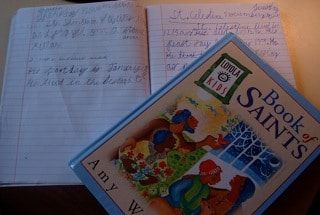
Amy Welborn’s Book of Saints is a good choice for a living book about the lives of saints. My twelve year old son reads the four page stories independently at a rate of two per week. He then narrates in writing, often draws a picture or sometimes journals after each reading. When asked what he likes best about the stories he says, “I like reading about the lives of individual people, not that I don’t like bible stories, I just like this too.”

The book is divided into fifteen parts by theme. Themes include: saints are people who love children, saints are people who love their families, saints are people who surprise others, saints are people who create, saints are people who teach us new ways to pray and ten others. Each story tells us where the saint is from, great for matching up saints to geography studies,  and includes the saints feast day and a well told story about the saints life. Welborn defines saint and reminds us saints are heroes who are honored by the church.

I especially like how Welborn asks her readers to think about how their own actions and experiences relate to the lives of saints. She tells us Saint Nicholas gave to others and asks us what gifts can we share?  After the story of St. Patrick, she asks us to think about our great teachers and offer a prayer of thanks for them. And after St. Christopher, we are asked to think of simple things we can do to make the lives of others easier. These thoughtful prompts make great discussion starters or journal entries.

If you are looking for wholesome yet true saint stories, for a family read aloud or for independent study consider Amy Welborn’s Book of Saints with over sixty inspirational stories about saints from around the world. These saint stories are sure to get your upper elementary and preteen children thinking about how they too can let God help them do amazing things.

Susan, who lives in the heart of Dixie with her husband and three school age children, blogs about quilting and homeschooling at Stitchin’ Life.

Jan 202010
 

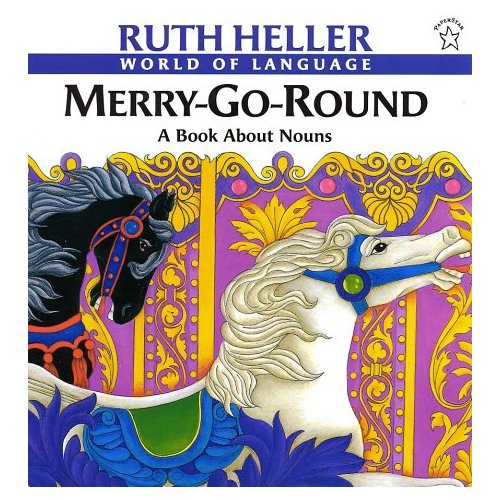
worldoflanguageWe chose Jessie Wise’s First Language Lessons to introduce our daughter to all things grammar. I like the gentle, but persistent approach and the systematic introduction of grammar topics. But the truth is that I wanted more. I wanted to incorporate the living books philosophy that was so much a part of our other subjects. Happily, I stumbled upon a lovely collection of books by Ruth Heller. Called the World of Language, Heller’s series is a delightful treasure trove of the parts of speech hidden in picture book form.

There are eight titles:

●Merry-Go-Round A Book About Nouns

●A Cache of Jewels and Other Collective Nouns

●Mine, All Mine A Book About Pronouns

●Kites Sail High A Book About Verbs

●Many Luscious Lollipops A Book About Adjectives

●Up, Up, and Away A Book About Adverbs

●Behind the Mask A Book About Prepositions

●Fantastic! Wow! And Unreal! A Book About Interjections and Conjunctions

Each book defines the part of speech, discusses its parts and intricacies, and provides examples in a poetic, rhyming text. Beautiful artwork graces the pages, bringing the ideas to life. Merry-Go-Round, for example, begins by defining the word noun.

“NOUNS name a person, place or thing . . . a damsel, a forest, a dragon, a king. These NOUNS are all COMMON, and they’re very nice, but PROPER NOUNS are more precise. King Arthur is this person. This place is Camelot. PROPER NOUNS are capitalized. COMMON NOUNS are not.”

This particular passage covers two two-page spreads and includes illustrations of a dragon in a forest with a damsel and another of a king inside a castle. The book next discusses abstract nouns, concrete nouns, compound nouns, and collective nouns. Singular and plural nouns and the methods of forming them follow, along with possessives and determiners (articles).

We are thoroughly enjoying the rhyming, lyrical text and the beautiful illustrations. As we read each book, my daughter makes her own pages to illustrate the elements of each part of speech. This method has complemented and extended the systematic introduction of the parts of speech offered by First Language Lessons.

The lovely pictures alone are enough reason to read this series, but the information in them provides an excellent, living supplement to any grammar study. Enjoy Ruth Heller’s World of Language!

Susan is a homeschooling mom of three—a preschooler, an almost kindergartner, and a first grader. They spend their days reading on the couch, playing with numbers, and making big, fun messes in a Spirit-led, Well-Trained Mind-inspired classical-Charlotte Mason-traditional model of home education.