Jun 302009
 

This is the third of a three part series to answer why, how, and what in regards to Principle Approach education.

We often start our search for education looking for curriculum. What will we teach? What do our children need to know? The mounds of resources quickly become overwhelming. That is why I started this series discussing philosophy. Examining the reason I homeschool gives me a filter to sift the piles of books.

This universe is an amazing place. There is no way we can teach our children everything they need to know or even want to know. So how do we decide what is most important?

Curriculum shelf

Photo by Barbara L. Slavin

I propose that rather than teaching little bits here and there, we teach the whole subject by teaching its principles first. Five-year-old Sunshine can understand that letters create words and words combine into sentences and sentences become whole paragraphs. We discuss the gift of language. We look in the Bible to see how God communicates with us. We are inspired to communicate with Him and with each other.

It is simple to break down the subject to its rudiments, but it is so empowering. It gives the child a foundation with which to build upon.

Principle Approach philosophy is just beginning to have curriculum, but the idea of individualized education encourages parents and teachers to create their own using the 4R method. Rather than creating all my own lessons, I add these ideas to the books that fills our shelves.

Some curricula does a good job of systematically building upon the principles of a subject and studying the unique vocabulary of each; not every one looks at the source and origin. It requires some thought and study, but each subject has it’s source in either the nature or character of God.

  • Science is the study of His creation.
  • Math is the knowledge He used to create.
  • Art is the expression of that creativity.

When we begin to see the Creator behind each subject opening our understanding, His purpose is revealed: the increase of His kingdom in the hearts of men. The history of science and math display advancements for safety and even liberty.

Nathaniel Bowditch’s dedication to the study of navigation gave men greater freedom to sail without fear of getting lost and perishing at sea. Johann Gutengerg’s printing press gave wings to ideas and individuals reached up to grasp them by learning to read.

According to Noah Webster, curriculum is

the course of study…a stated or orderly method of proceeding…the way of life or conduct.

Studying for life, step by step, building upon the foundation idea by idea, year by year. Growing in understanding of how individual hearts are woven into a providential metanarrative. Life inspired. Hope restored. An effect of biblical education.

Written by Renae Deckard, Biblical Principled mother of 3. Find Renae’s reflections about homeschool and family life at Life Nurturing Education.

Jun 282009
 

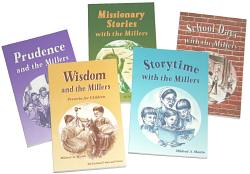
millersFrom the time my children were preschoolers, and even now, we have enjoyed the Miller Stories by Mildred A. Martin over and over again!

 
We started our journey with the Miller books by reading Storytime with the Millers. After gobbling up each and every story several times, we realized that the entire set would eventually sit on our bookshelf. And so it does.

 
Each book, besides Missionary Stories with the Millers, is filled with short stories about the fictional Miller family and the Biblical lessons they learn through everyday occurrences. A Bible verse is tied into each story and is used to help convey the moral message. Mom and Dad Miller are very good examples of parents who teach, rebuke, discipline and mold their children in a loving and kind manner. Older siblings, for the most part, are also characterized as good role models for their younger brothers and sisters. Of course, everyone makes mistakes, and the stories are very good at showing an attitude of repentance and forgiveness by each of the characters.

 
Even though the books come from a very conservative Amish-Mennonite perspective, I’ve found them to be very useful in teaching topics like trusting God, manners, friendship, obedience, respect, forgiveness, self-sacrifice and much, much more! Many of the stories are full of some excitement, too, which keeps the attention of my boys.

 
*In Storytime with the Millers the stories are focused a bit more on the younger child with lessons such as the importance of obeying your parents, how to gain friends, and learning to be responsible. We started reading this when my now twelve-year-old was three. (She still enjoys it!)

 
*In School Days with the Millers there are many lessons on friendship, obedience to adults, peer pressure, and other social situations children might face. Even though we don’t attend a traditional school, our family very much enjoyed this book. There are many lessons for us to learn in spite of the schooling difference.

 
*In Wisdom and the Millers: Proverbs for Children you find stories that bring the Proverbs to real life. My children have always enjoyed relating the Bible to real events. Although the stories in these books are fictional, they give my children a realistic situation to see how the Bible relates. Proverbs is such a rich book of the Bible, and we found these stories to be rich, too.

 
*In Prudence and the Millers the family learns about making prudent, or wise, decisions. Of course, they often have to learn to make wise decisions the hard way (just like most of us!) These stories have led to some wonderful discussions around the supper table!

 
My most favorite of all the Miller series is Missionary Stories with the Millers. This book is written differently than the rest as it tells wonderfully exciting and REAL stories about missionaries. Some of the stories are courageous, some of them are sad, some of them are victorious – but all of them show God’s power and work through the lives of past missionaries all over the world. This book is so good, I have even used it many times with children’s classes at church. The children are always completely mesmerized from start to finish.

 
Although any age child will probably enjoy these, they are probably most appropriate for the K-5th crowd. The missionary stories can be rather intense at times, so use caution when reading to a sensitive child.
With prices ranging from $6.50-$10.50, depending on whether you prefer a softcover or hardcover, I believe the prices to be extremely fair. You can purchase them from many sources, but my favorite is Rod and Staff.

Written by Cindy, Eclectic Charlotte Mason Mom of Three.  You can find

her blogging at Our Journey Westward.

Jun 262009
 

If you are going to the 2009 Southeast Homeschool Expo, raise your hand!

I’m going and I can’t wait! I love conventions and expos, especially the vendors and freebies. At my last convention (NECC ’07), I won a bundle of fabulous software. I also came home with enough free pens, notepads, and post-it notes to stock our school closet for the year.

If you have never been to a convention before, it is best that you plan your trip. The Southeast Homeschool Expo is going to be huge. No matter the convention, you should plan your trip. How am I planning for my trip?

  • I am making business cards. I might be given a badge with a bar code on it that will be scanned at each vendor to enter me in contests and sign up for mail. If they don’t, I want to be prepared. Instead of filling out contest entry forms, I can just drop my card in the fish bowl. This will also be great for me to hand out if I need to share about my blog or meet new friends. Do you like this business card design?
  • I am going to get a map of the vendor layout and will highlight my “must visit” booths. I don’t see this on the website yet, so I will have to get this when I get there.
  • I will be packing a bookbag of snacks, water, pen/paper and my laptop. The venue will have Wi-Fi available and if I have my laptop, I can check product prices to make sure I am getting a good deal, can look at all of my notes on our curriculum choices, and blog about it while I am there.
  • I will have a rolling cart. These are a must because I plan on doing a lot of shopping. Hopefully the Dairy Queen can teach me how to make this (hint-hint).
  • I am picking my workshops now. I don’t want to take classes that are just “infomercials” for a product. I also don’t want to take a class that is full of information that I can find free on the internet. If you are going with friends to the convention, split up and don’t go to the same workshop. This way, you can get more information. Here are the workshops that I want to check out:
How to Teach Geography in a Way that Has Your Kids Asking for More
Writing Made Simple
LEGO Robotics: Programmed to LearnART – It’s Essential!
The Human Calculator in You
Homeschooling Your Gifted Child
Creating Your Own Unit Study
Get Organized and Get Relief from Homeschool Chaos!
How to Help Gifted Students More Effectively
Mom’s Book: The Best Organization Tool
  • I will pre-register so that I don’t have to stand in line.
  • I will wear a badge necklace. You know, that clear plastic thing you wear around your neck that holds your Expo id? I will also put my business cards, convention hall map, and my shopping list inside of it. You’d be surprised how much you can cram into that little thing.
  • I will use the coat and baggage check at the venue (Cobb Galleria). I don’t want to have to lug my stuff all day!
  • I will have my cell phone with me so I can call the Dairy Queen , and all my other peeps, from across the convention hall to tell her she has to “come here right now so she doesn’t miss this a)presentation, b)product demonstration, c)giveaway, or d)let’s get lunch.
  • I am planning my budget for shopping and looking for some “homeschool sponsors” (A.K.A. grandparents) to help purchase curriculum for next year. (*hint hint*)
  • I am window shopping before the convention and making a “to buy” list.

I got the vendor list from the website, and I am visiting each vendor’s website (even if it is not linked there, Google the company name. Almost all of them have websites). I have created a spreadsheet of the Vendor, their website, the item that I want to check out, and the regular price listed on the internet. This is really going to help me create and stick to a budget, help me make sure I am getting a good deal on a product, will help me organize my shopping and make better use of my time, and I will make sure I don’t miss any products that I want to miss. Most companies are not going to have all of their products, but I at least have something to guide me in my decisions.

Here is a small snapshot of my spreadsheet: (the products in teal are ones that I am pretty sure I want to buy if I see it)

If you are going to the Expo, let me know! I’d love to meet you!
Written by Kari, Momma Snail.  She also blogs at http://thesnailstrail.blogspot.com

 Posted by at 1:00 am
Jun 252009
 
St Georges Dragon

St George's Dragon

For families with children in high school that are looking for a high quality, easy to implement art appreciation and art skills plan all in one book, Artistic Pursuits Senior High, Books 1 and 2 may be a good fit. Using great art and solid teaching of the basic art elements, your child will be able to work through the two high school level Artist Pursuits books independently.

Each of the sixteen units starts with an art element that is featured in a painting presented in the unit. The book neatly ties together the observing of a work of art and then applying the art elements  in a clearly explained assignment. Your child is given specific instruction for creating a piece of artwork that illustrates their understanding of the focus of the unit.

Working on perspective

Working on perspective

The book not only introduces great art, it also gives step by step instructions on how to get started with the art medium being used. Even if your child has never picked up a drawing pencil, charcoal, or a brush and tube of watercolors, they will find that Artistic Pursuits will give them the steps necessary to get going and to feel confident that they are not going to be in over their heads.

There are three elements to each lesson:

*Challenge Your Vision-These creative assignments jump start the learning of the featured art element.

*How To-The student practices with the art medium, using techniques outlined in the assignment.

*Project-The student shows their interpretation of the art element by completing a final project outlined at the

Charcoal project-figure proportion

Charcoal project-figure proportion

end of the unit.

The biggest complaint that I hear about Artistic Pursuits in our family is that you are working on one or perhaps two kinds of art materials per year. Book One uses drawing pencils and charcoal and Book Two uses watercolors all year. We worked around this with our boys by supplementing with additional time each week for “free art” with a variety of art materials.

Grading art projects can be tricky so I appreciate having the evaluation sheets in the back of the book to copy for each unit. It gives me a more objective way to determine if the boys have accomplished the lesson and its assignment. It assigns a certain point value to three different aspects of the lesson. The projects are not graded on ability but rather by having us look at the finished projects together and using the “Looking Back” questions at the end of the unit, the boys help me to determine if they accomplished the assignment as stated.Artistic Pursuits Watercolor

In addition, each high school level book gives you information on how to record your child’s work on their high school transcript. The author breaks each high school level book down for you: Book 1-Studio Art and Book 2-Painting.  The book also helps you to put together an art portfolio for your child if they wish to use it as part of their college entrance materials.

We have been very happy with the Artistic Pursuits books over the years and the high school level plans have lived up to our very high expectations. The lessons we have learned through the pages of these books will carry on throughout a lifetime. Thanks Artistic Pursuits.

If you have younger children, you may be interested in reading my review of the Jr. High level of Artistic Pursuits and a few thoughts on the K-3 Book.

Watercolor project

Written by Barb-Harmony Art mom.  She also blogs at http://www.harmonyartmom.blogspot.com/

Jun 242009
 
sketching horse Black Beauty

Books from Beautiful Feet History of the Horse

The History of the Horse is a Christian, living books based unit study published by Beautiful Feet (BF) Books.  I bought History of the Horse for my fourth grade daughter, and I am so pleased with my choice! It was a huge hit with her! She mostly loved the great stories and the drawing assignments integrated into the lessons. I felt it was a great curriculum for introducing her to more independent learning and research skills.

The term “history” in the title is a bit misleading. The teaching guide does order the books in chronological order, and there is information about horse breeds and the history of them. However, BF History of the Horse is not truly a history program. Since the bulk of the work is reading novels, answering questions, notebooking, sketching, researching, and writing reports, I consider this better classified as a language arts program.

sketching horse

Sketching Horses

The course is organized into 91 lessons. The guide recommends the student cover  three to five lessons each week. However, I found that the assignments for one lesson were actually quite short. So I generally assigned my daughter Sprite two lessons each day. Doing eight lessons per week, we completed the program in about four months.

Each lesson includes a reading assignment and an activity related to it. The activity may be sketching a horse, answering some comprehension questions, researching something that was mentioned in the reading, writing a report on a famous person or event, copying a Bible memory verse, or mapping the location of the novel.  Usually all of the assignments are put into a History of the Horse notebook. You do need to know that History of the Horse is a very Christian program. Besides the Bible memory verses and copywork, many of the discussion questions are written from a Christian perspective.

horse books

Beautiful Feet History of the Horse Books

The core of the program is a set of horse novels written by Marguerite Henry:  King of the Wind; White Stallion of Lipizza;  Justin Morgan Had a Horse;  Misty of Chinocoteague;  Brighty of the Grand Canyon; and Mustang, Wild Spirit of the West. In addition, there are Black Beauty and Black Stallion as well as three non-fiction books: Album of HorsesSmithsonian Handbooks: Horses a DK book by Elwyn H. Edwards, and How to Draw 50 Horses by Lee J. Ames. There is also a set of regular playing cards that feature images of various horse breeds. The idea is that as you play other card games, you will learn some of the names of horses and be able to identify them by sight.

BF  recommends this unit study for 3rd through 7th grades, but actually most of the books are written at a 5th grade level. If your child is reading comfortably at that level, she could easily do the reading assignments independently. That’s how we chose to use this unit study, and it was a first for my fourth grader to read alone in her room and do her assignments by herself. You can see more images of my daughter’s History of the Horse notebook at this Flickr set.

Written by Jimmie, Charlotte Mason flavored mom of one.

Jun 232009
 

Biblical Principle Approach is big on reasoning, especially reasoning from God’s word. It can be a challenge to a home educating mom who was not taught this way. One resource to consider to help you on this journey is Walking with Jesus.

This is designed for fourth grade, but I believe a fifth or even sixth grader could glean a lot. It is a softcover book with beautiful Biblical illustrations sprinkled throughout. It comes with a teacher CD that breaks the year down into 4 nine week quarters, which of course you can modify to fit your home’s needs. I recommend the CD because it has the weekly lesson plans and also printable graphic organizers, which are used often in this book.

It is divided into four quarters: 1) The Immediacy of Christ, 2) Old Testament History, 3) Wisdom Literature and Prophecy and 4) New Testament History. At about $40 for the book and teacher CD, is affordable for most home educators.

Here’s how it works: your child reads the lesson, which will introduce a passage of scripture to read. After reading the scripture, there are several resoning questions to answer. Sometimes there are charts to make, organizers to complete and interpret or paraggraphs to write. There is always reasoning at the end of the lesson, that is, they interpret and glean form God’s word for themselves. No one in interpreting. There are no answers on the teacher CD. See sample pages of the book and teacher’s CD here.

Pros:

  • Planned weekly lessons give structure but freedom to do your own thing.
  • Teaching reasoning with a template is very helpful.
  • It improves comprehension and personal application of God’s Word.
  • It is not consumable, so it can be reused with your other children.
  • They practice map work and study skills.
  • It fosters Christian scholarship, which your kids may or may not like.
  • It is a notebook method resource, so your child creates their own Bible notebook to refer to.

Cons:

  • They require the NIV Adventure Bible, so if you don’t like that Bible you don’t want this resource.
  • It requires an investment on the teacher’s part. It’s not a totally independent resource.

This is actually one of my favorite resources from the Foundation for American Christian Education. My daughter used this in fourth grade and we took a two year plan with it. She balked sometimes because it required a lot of thinking on her part. I insisted because I believed so much in it and I was impressed by her reasoning the longer she stayed with it.

Written by Anna-Marie, Biblical Principled Mom

Jun 212009
 

mothBeing a mother of five, I am often asked how I manage our homeschooling day.  Some are just curious and others are hoping to see if there is anything that we do differently that might help them manage their day.  Each family functions differently, and each mother desires a smooth-running home.  But the consistant theme that I have seen with unhappy homeschool mothers is that they cant keep up with their work load.

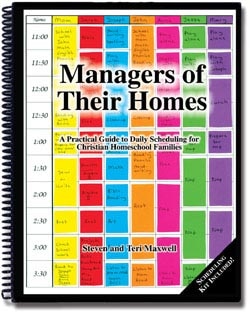
Managers of Their Homes is a time-proven method that helps homeschooling families schedule their God-given priorities so that they can accomplish all that they set out to.  It is particularly useful for larger families, but works with families of all sizes.

The first chapter tells you why you should have a schedule and it dispels the myth that you cannot gain a victory over your circumstances and time usage.  The next chapter is about how to have a successful schedule by planning a daily devotion and depending on the the Lord, while trying to accomplish the Lord’s agenda,  instead of on our own strength.  This chapter is followed by insructions on how to schedule:

  • children’s days
  • school
  • babies
  • chores
  • kitchen
  • priorities

After reading through these chapters you will begin to see the light and probably will be ready to get to work setting up a schedule with all the helpful ideas that are provided.

“My initial investment of time making my schedule has paid off with interest.”  Lorrie

“When we are on our schedule, there is much more peace; we get more done and I don’t feel stressed by making decisions all day.”  Pauline

The next chapter, Planning for the School Year, is especially helpful as it instructs you in prayerfully assessing each child’s strengths, weaknesses, and goals before you put the pieces of the schedule together.

There are a few chapters next on scheduling the summer, challenges you may face in your schedule and what do you do when you have the inevitable interruption.  The chapter on implementing the schedule helps you get it all together and encourages you to tweak it as necessary until it is comfortable.  Then there is a Question and Answer section where the families that tested this method asked questions and the answers for every question imaginable is provided.

My favorite part of this book is the section of actual schedules that moms have used. I personally used this section immensely when planning our schedule.  Also, another helpful component to this book is the worksheets that you fill out in order to visually see the hours in your day and how you are choosing to spend your time.  You quickly realize that there ARE enough hours in the day to accomplish everything that God has laid on your heart to implement in your family.

“It’s so pleasant and easy I find myself thinking, ‘What am I doing wrong; this is too easy!”  Robyn

“Making and using a schedule has helped me, and there were people who thought I was hopeless!”  Sherri

The final step is completing and displaying your family’s schedule and there is paper provided for you to make a chart with 30 – 60 min. time slots to proudly display on your wall in a central location so each child can see what they are expected to do next.

I look forward to creating my new schedule each year, as we add the next child and need major adjustments, or tweak it a little to add different responsibilities.  It always helps me begin school with a good attitude instead of beginning with the feeling of defeat before we even start.

Please visit the Titus 2  site to purchase Managers of Their Homes, and see the other products that Steve and Terri Maxwell have written.

Written by Brenda, Classically Eclectic mother of 5.  You can find her writing about her homeschooling journey at Tie That Binds Us.

Jun 202009
 

Do you enjoy unit studies?  Do you enjoy unit studies that are already prepared for you?  Do you enjoy unit studies that require little to no gathering of materials on your part?  Do your children enjoy learning on the computer?  Do you desire for your children to be able to learn independently?  If you answered ‘yes’ to one or more of my questions, then Brandenburg Unit Studies might be for your family.   

brandenburg_studies_150px
Visiting the Brandenburg Studies website  will lead you to more than 40 in-depth unit studies that can either be purchased on a CD or downloaded immediately to your computer as an e-book. 

Just what are Brandenburg Unit Studies? 

Very thorough, internet-linked lessons and activities, including quizzes, tests, notebooking, projects, literature and other media to help your child learn about a topic in as independent a way as possible.

What will you find in the unit?

  • A section of hints for the teacher                  
  • A daily lesson plan chart that you are encouraged to print for yourself and your child.  This chart tells you how long the unit lasts and what lessons to do each day.  Children who can read on their own are encouraged to do much of the learning themselves, with mom or dad being an overseer of the learning.  You’re encouraged to put a copy of the daily lesson chart in the front of a notebook for your child so they can take responsibility for doing the daily lessons.  
  • Suggestions for literature and videos that go with the theme.  Like me, Mrs. Brandenburg believes children retain knowledge better when additional books and videos are added to the unit.  “Living literature” lists include ideas for independent reading and family read-alouds.  Most units last anywhere from one to three months, which allows plenty of time for diving into some good literature.          
  • Daily lessons for children.  The units are in PDF format, so as you scroll through the book, you will find the daily lessons in order.  Much of the daily lesson time is spent reading information from the computer.  Some of the lesson is located in the PDF file, but your child will also leave the file sometimes as they click on safe internet links.  The internet links lead your child to internet pages with more information about the lesson’s subject, to quizzes and tests, to online games and other very safe pages that enhance the particular lesson.
    The daily lessons, even though often taking place in front of the computer, are filled with colorful pictures to give your child great visuals for understanding.  They are also varied.  In other words, the student won’t simply be reading information from the computer and taking a quiz everyday.  One day they might read and take a quiz.  The next day might be a video clip and an online game.  The next might be reading and labeling a diagram for their notebook.  And the next might be an art or craft project.
  • Worksheets, notebooking pages and other various printables.  Your child will be encouraged to learn information from the computer lessons and either add the information to a prepared notebook, complete and online activity or complete one of these pages.
  • An idea list for final unit projects.  This is a list of hands-on projects that your child can choose from in order to “show what they know” as the unit comes to a close.    
  • Based on the topic, the units might include vocabulary, map work, Bible references, and/or a final test.  Most tests and activities completed on the internet can be printed out to include in the student’s notebook. 
  • Since keeping a unit notebook is highly encouraged, each unit provides directions for creating one.

Ancient History

American History

G.A. Henty

Science

Each of the units is recommended for various age levels from Kindergarten through High School.  Be sure to check the suggested age before purchasing!

What if I don’t want to “set my child free”?  Even though the units encourage student independence, mom or dad can still be “hands-on” in the unit if they prefer.  Like any other unit study, these can be used in whatever way suits your family’s needs. 

Are the prices fair?  I believe the prices are very reasonable.  It won’t set you back too much to try at least one of the units to see if the style is a fit for your family. 

One more thing.  Struggling readers may have some difficulty since there is a lot of reading and writing necessary to complete each unit.  Children who prefer hands-on projects may not be a good fit for these units, either.  But with the variety of daily lessons, I think most students will find the studies to be interesting and enjoyable. 

Cindy, a unit-study, Charlotte Mason, Classical sort of mom who likes to surprise her children with varied ways of learning.  These units are one of those surprises!


Jun 192009
 

childs-book-of-character-buildingWe use a variety of resources during our morning Bible time, but this past year I purchased a book that has become a favorite in our home. A Child’s Book of Character Building by Ron and Rebekah Coriell is a compilation of short stories that highlight Christ-like character traits. It is designed for ages three to seven, but you could possibly use it with a slightly older child as well.

At the beginning of each chapter, you are presented with a particular character quality and a Scripture verse that applies to it. Following this are four separate, one-page stories which portray that particular trait in various contexts. The first story is from the Bible, and it shows how Jesus lived out the character quality in His life here on earth. The remaining three stories provide examples of real-life situations involving children in which the trait is demonstrated in the context of home, school, and play. At the end of each chapter are character development challenges that use activities and questions to help the child apply what he has learned from the stories.

The character traits covered in volume one are:

  • Attentiveness
  • Creativity
  • Faith
  • Diligence
  • Patience
  • Contentment
  • Obedience
  • Wisdom
  • Tenderheartedness
  • Thankfulness
  • Honesty
  • Joyfulness

These stories captivate my children and hold their interest so much that they always want me to read more than one story each day. I try to limit our reading to one or two though because I really want these concepts to sink in to their young hearts.

I have been pleasantly surprised at the number of times that my seven-year old has brought up one of the stories or character traits at a time other than our morning devotions. When helping my children work through difficult situations, I’ve been able to use these stories as reminders of the attitude Jesus would want us to have or how He would have us handle the problem.

These scripturally-based stories have proven to be a wonderful way to plant the seeds of godly virtues in my children as they grow in their relationships with Jesus.

Written by Shannon, Unit Study/Charlotte Mason mother of three, who counts it a joy and a privilege to point her little ones to Jesus.

You can also find Shannon at Song of My Heart.

Jun 182009
 

Many people today think that memorization is unimportant. They argue that anything that they need to know, they can look up on-line. But can a person be truly educated if he doesn’t “know” anything? I think not.

We need knowledge in order to understand new concepts. Critical thinking programs are wasted if there is no foundation of knowledge to build upon. The writer has nothing to write about if they know nothing. Truthfully, anything that we know, we have memorized. We may not have tried to memorize it, but if it is in our memory, we have memorized it.

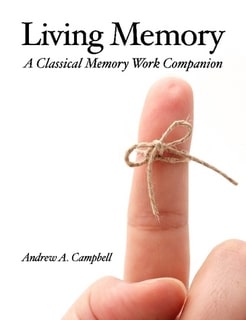
One of the key components of a classical education is memory work. Unfortunately in our home, it is an area that we have been sadly lacking. When my husband and I had our year-end homeschool evaluation, memory work was one of the major things we decided to work hard at implementing in our homeschool. As I began my search for help in doing memory work, I saw many references to Living Memory by Andrew Campbell on the Well-Trained Mind Forums.  (Andrew Campbell is also the author of The Latin-Centered Curriculum.) When The Curriculum Choice contacted Mr. Campbell, he graciously sent me a copy of Living Memory to review.

living-memoryLiving Memory is a substantial volume with 452 pages! The first section of the book explains the value of memory work and how to memorize. Mr. Campbell suggests that memorization is most effective when utilizing four basic language skills: listening, speaking, reading, and writing. Included are suggestions for incorporating each of these skills in your memory work program. In addition, there are instructions for preparing a memory work notebook. This information covers only the first 14 pages of the book. The remainder of the book is filled with suggested memory work. The selections are divided into the following categories:

  • Latin
    • Grammar and Vocabulary; Proverbs; Poetry and Prose;
      Scripture; Prayers; and Hymns and Carols.
  • Greek
    • Grammar and Vocabulary; Proverbs; Poetry and Prose; Scripture; and Prayers and Hymns.
  • Arithmetic and Mathematics
    • Addition and Subtraction Fact Families; Multiplication Tables; Euclid’s Definitions; and Area and Volume Formulas
  • Grammar and Composition
    • Grammar Poem, Grammar Catechism, and Common Misspelled words
  • Literature
    • Literary Facts and Lists; Sayings, Proverbs, and Famous Quotations; Teaching Rhymes; Poetry; and Dramatic Speeches from Shakespeare’s Plays
  • Religion
    • Scripture, Prayers, Catechism, Poetry, Hymns, and Carols
  • Geography
    • Continents; Oceans; States and Capitals; and Nations and Capitals
  • World History
    • Major People and Events from around the world
  • United States History and Civics
    • Key dates in American history; Founding Documents; and Patriotic songs, verse, and oratory
  • Natural Sciences
    • Lists and mnemonics for natural science
  • Reference Charts
    • Charts of Greek and Latin paradigms

Living Memory contains ample material for an entire school career of memory work! There is wonderful variety in the selections. It includes everything from “Twinkle, Twinkle Little Star” for my 2 year old, to the Gettysburg Address for my middle school son, plus more advanced material to use in the future.  I am so excited about setting up notebooks for my kids for next school year. The hard tasks of narrowing down things to memorize and compiling the material has been done for me in Living Memory. Now I can customize our memory work to correspond with our other school subjects. With a list, though long, of suggestions, I feel confident that I will be able to add valuable memory time to our daily schedule. I highly recommend Living Memory to anyone seeking ideas for classical memory work. It is available from Lulu.com.

Written by Kristen, Classical mom of 4