Jul 012011
 
At a Glance
Product: Considering God’s Creation published by Eagle’s Wings Educational Products
Age Level:  2nd thru 7th (adaptable curriculum)
Use:  Stand alone science curriculum (36 lessons) or a nice supplement for the notebooking side of science.
Teacher Prep: Minimum to Moderate/Cut and Paste
Format:  Workbook, Teacher’s Manual and CD (Workbook is filled with cut and paste notebook pages.)
Teaching Method: Notebooking approach
Cost:  $29.95 for the Teacher’s Manual, Student Workbook and audio CD
Quick Rating:  3 out of 4 Golden Apples

What is Considering God’s Creation?

Considering God’s Creation is a hands-on creation science curriculum adaptable for 2nd to 7th grade.  The method used is notebooking.
The curriculum covers:
  • Universe
  • Stars
  • Solar System
  • Earth
  • Light
  • Sound
  • Wind
  • Weather
  • Clouds
  • Rocks
  • Plants
  • Insects
  • Mammals
  • Reptiles
  • Birds
  • Fish
  • Amphibians
  • Food Chains
  • Reproduction and Genetics
  • Human
  • Animal Anatomy
  • Physiology

Each lesson covers:

  • Preparation
  • Vocabulary
  • Introduction
  • Song/Poem
  • Hands on Activity
  • Bible Reading
  • Notebook
  • Evolution Stumpers
  • Review
  • Digging Deeper
What did we think?
I love hands-on curriculum.  I am not in love with lapbooking or notebooking in practice but the concept gets me giddy.  Hence, I was hesitant about this curriculum for fear I would start strong and never finish.  Yet, I was pleased by the engaging lessons which were just the right length even for a short attention span notebooker as myself.  Since my 6 year old daughter loves notebooking and my 2 year old loves pasting it was a wonderful way to keep my younger children engaged while teaching my 5th and 7th grader.  The activities were fun, informative and well laid out.  It is rare to find a curriculum that truly fits on a multiple age level so this is a treasure indeed.  Since I must admit I get a bit tired of cutting, I delegated that responsibility to my oldest.  She enjoys the “teacher’s aide” type of work and prepping lessons.  Finding this method to be beneficial to everyone one involved, I use it quite a bit.  So, I especially loved that this curriculum served the whole family.  My 7th grader benefited more from “teaching” than being the student.  However, keep in mind that is not because the material is too young for her as much as we have studied the subject matter before.  Yet, I think it is a great idea to have the older teach the younger.  In conclusion, this curriculum and the format served our family well.  I would recommend it to any family with multiple ages or a child who enjoys notebooking.  Another plus is the low cost!

To view sample pages click HERE.

Richele is a happy wife and and grateful, Charlotte Mason addicted, history loving, eclectic homeschooling mom to four beautiful children. She believes education should foster creativity, critical thinking, and curiosity. She enjoys tailoring education to suit the needs of her children. She loves adding in touches of classical, traditional, and hands on methods to mix things up a bit. Her educational background is in philosophy and educational psychology. Find her blogging at Under the Golden Apple Tree.


Nov 122009
 
Learn N Folder Notebook

Learn N' Folder Notebook

Lapbook style learning in high school? Absolutely!

I have two very visual boys who tend to shy away from normal question and answer, fill-in-the-blanks style learning. When we started high school science with a “real” textbook, I was hesitant about using the review questions in the way they are presented.

Complex vocabulary included with flashcards the student makes himself.

Complex vocabulary included with flashcards the student makes himself.

After a little research, I found Live and Learn Press’ Learn N’ Folder Notebook specifically designed to follow the Apologia text Exploring Creation with Biology. I downloaded the free sample which gave me a complete unit to preview. I was impressed with the way they presented the On Your Own questions, the vocabulary, and then review questions into a lapbook sort of format and decided that we would give it a try.

The notebook uses a variety of study ideas.

The notebook uses a variety of study ideas.

I will admit that I print out the pages and do all the cutting and folding for their notebooks. I happen to enjoy that sort of work so it is not a burden to me at all. In fact, some evenings my husband and I will sit and make the notebooks together as we chat and enjoy each other’s company with our hands busy folding the various parts of the book.

The boys love all the fun graphics.

The boys love all the fun graphics.

As a learning tool, I am very pleased with this product. Filling in the little books and folds with information makes it much more palatable for my sons as we work through the modules. They seem to retain the information better and reviewing the information is much more productive in using the Learn N’ Folder Notebook. They can also quiz themselves before a test using the notebook pages.

The Live and Learn Press Learn N’ Folder Notebooks are not cheap, the biology notebook is $30 for the ebook version,  but in our family they have been worth every penny we spent. Sure, they could write out their answers on lined paper with a pencil, but using the Folder Notebooks has made the learning a little easier and definitely more fun.

Makes self-quizzing easy.

Makes self-quizzing easy.

I highly recommend the products from Live and Learn Press to go along with your Apologia texts. There are Folder Notebooks for the elementary level texts as well. We will be using their Chemistry Notebook next year to help us organize our study.

Helps with study techniques

Helps with study techniques

For more information on our biology study, please pop over to my Biology Squidoo lens for loads of ideas and suggestions.

Squidoo: Apologia Exploring Creation with Biology

Written by Barb-Harmony Art mom.  She also blogs at http://harmonyartmom.blogspot.com and her business is found at http://www.harmonyfinearts.com. I would love for you to join us for the Outdoor Hour Challenges: http://handbookofnaturestudy.blogspot.com.

Jun 132009
 

Our family enjoys lapbooking.  We don’t use lapbooks for every single unit we complete, but I like to find two or three really good lapbooking units to use throughout the school year.  I find my self going to Hands of a Child quite often when looking for the perfect fit for our lapbooking needs.  Their units are typically thorough, easy to implement and well organized.  I don’t usually struggle with figuring out what goes where, or how to fold the pieces – which means a lot to this busy momma!

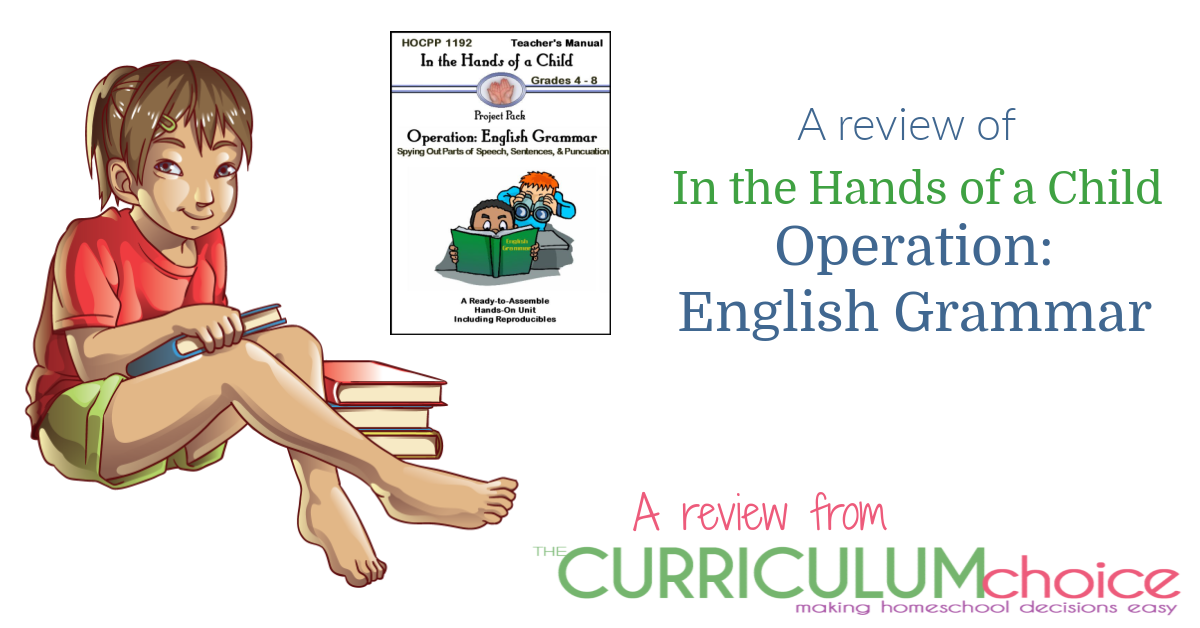
From Hands of a Child, I’ve chosen to review the Operation: English Grammar Project Pack. It was one of our very favorites this year and has not only provided my 6th grade daughter with a wonderful review/overview of grammar, but she now has an easy to file and find resource to pull out when she needs to remember about a particular part of speech or punctuation mark.

hoac Operation: English Grammar

Hands of a Child is a company that develops unit studies in which the activities are completed, for the most part, using mini-books.  All of these mini-books are meant to be contained in a series of file folders that are attached to one another so that you have a neat, complete and thorough record of the unit contained in one place.   All the background information, templates for mini-projects, and directions for completing the units are included.  Color pictures are also included to show what the final project should look like. 

You may purchase either a spiral-bound printed copy, an e-book, or a CD of the PDF file.  The company also offers an e-book version that allows your child to type information into the mini-books before printing and cutting.  You may choose to buy answer keys and pre-assembled kits, as well. 

The units begin with a table of contents, followed by a research guide.  This research guide is where you or your child will find the background information needed in order to complete the activities.  There’s no need to run to the library for further research, unless you desire to add books for supplemental reading.  Depending on the ability of your child, you may choose to read the information from the research guide to them, or have them read the information themselves. 

lapbook1Templates for the mini-books, graphic organizers and other activities are included with clear directions on what to do and how to put together the pieces if necessary.  Each of the activities asks your child to take something they read from the research guide and show what they learned.  They might be asked to cut out a series of cards on which to write definitions then create a pocket in which to store the cards.  They might be asked to cut out pages that will be stapled into a little book where the steps of a certain procedure are to be written.  The activity ideas are varied and almost endless.

Many of the templates include little pictures that add visual interest to the activity.  You can also often find extra clip art that your child might use for decorating their file folders.  The templates are made so that it’s very clear what is to be cut and what is to be folded so no (or few) cutting mistakes are made. 

You are expected to copy the activity templates, so a copier, printer or copy shop is necessary – unless, of course you choose to buy the pre-assembled unit.  It is suggested the copies be made on 24# weight paper or cardstock for more durability.  You’ll find having lots of colored paper on hand enhances the look of the projects, too.  Other supplies needed to complete the unit packs include file folders, coloring tools, tape, glue, a stapler and scissors. 

At the end of the book, you will find directions for putting together the folders that will house all the projects.  The units are very thorough, but you may occasionally decide you’d like to add something yourself or even take away one or more of the activities.  Just as with any unit study, these are very adaptable to whatever suits your family’s needs.

Geared for children in 3rd grade and higher, the English Grammar Pack is very unique.  The student becomes “Special Agent Art Lang” from Planet Gabgone.  He or she goes on an undercover mission to Earth in order to bring English grammar and sentence structure to Planet Gabgone.  Through the various missions, your “special agent” child will have completed such a thorough portfolio of English grammar research that Planet Gabgone will easily be able to adopt the English language.  Then the mission will be completed!

lapbook2Each grammar or punctuation topic is covered in-depth.  For example, when learning about nouns, the following types of nouns will be explained:  common, proper, concrete, abstract, collective, singular, plural, compound and possessive.  In order to cover all of these types of nouns, your child will go on four separate missions.  As another example, when learning about conjunctions, the following types of conjunctions will be covered:  coordinating, subordinating, correlative and adverbial.  This is no simple jaunt through grammarland!  In 28 different missions, your child will have covered nouns, pronouns, adjectives, prepositions, verbs, conjunctions, phrases, clauses, sentences and punctuation. 

A long list of related books is included that might help cement the various parts of speech.  Personally, I believe adding at least some of these related books and some worksheets to go along with each topic is a good idea.  As much as a child will learn from the Project Pack, a bit of additional practice using each part of speech or punctuation is beneficial.

This Project Pack is recommended for 3rd grade and higher, but I feel like a 3rd grader, and maybe even a 4th grader, would need to be pretty advanced in order to completely understand everything covered.   Whenever your child is ready to tackle these topics, though, I highly recommend this Project Pack for a “whole picture” of English grammar.

If you’d like to find other Hands of a Child Project Packs, please visit their site at www.handsofachild.com.  You can even find semi-annual freebies here!

Written by Cindy, she also blogs at Our Journey Westward.