Dec 312009
 

He’s such a wonderful person, along with his wife, Lady Di, and son, Radius.   His friends can’t be beat either -King Arthur,  Geo of Metry, Sym, Sir D’Grees, King Lell, Per, Countess Areana, Vertex, Sir Tangent, Sir Lionel Segment and others.

Living in Camelot under King Arthur, Sir Cumference and his buddies must work through many complications that require mathematical and logical thinking.  During visits to such places as the Mountains of Obtuse, Angleland and the Isle of Immeter, people must be rescued, clues must be found and problems must be solved!

The stories are full of action and suspense that have kept my children enthralled time and time again.  The author, Cindy Neuschwander, is an absolute genius in the creativity of these books!  It’s beyond me how the books not only have a great plot, but teach math concepts within the storyline – and don’t lose any qualities of living literature in the process!

Depending on the book(s) you read, the following concepts are covered:

  • Circumference
  • Diameter
  • Radius
  • Pi
  • Angles
  • Lines
  • Measurement
  • Perimeter
  • Area
  • 3-D shapes
  • Counting by 10′s, 100′s, 1,000′s

Any child 1st grade and above will enjoy listening to the stories, but older children (4th grade and higher) will most likely grasp the math concepts best.  I used to check the books out from the library until I almost wore my card out rechecking them!  Now, I’m the proud owner of each and every one.  (A CM homeschool can never have enough living literature on the bookshelves, can it?)

-Written by Cindy, an eclectically Charlotte Mason mom of three.

Dec 302009


I’m sure many of you will agree with me that spelling is just one of the those subjects that’s just not that exciting to teach but we know our children need to be taught it. I’ll admit that I have tried a few spelling programs but none has made our family as happy as Spellingtime.com

What is Spellingtime.com? It is an online spelling program that allows your child to work independently. Every week the parent enters the child’s spelling words. On Monday your child logs in and is able to learn her spelling words in a way that is fun and interactive. 

How does it work? The program is broken down into five easy steps for your child.

1.     On Monday your child is introduced to their words with the online host “Jake” who is a cartoon type person. “Jake” will say the word and then say it in a sentence. He will then ask your child to say the word and spell it by typing it in.

2.     On Tuesday your child has a choice of two different types of lessons. He can play “pie time” which is a game similar to hangman or they can play “spelling bee” which simulates a live spelling bee.

3.     On Wednesday the child can again choose between two different lessons. They can do a “spelling bee” or do “word scramble” with their spelling words.

4.     On Thursday “Jake” will do a “pop quiz”. The child receives a grade that is emailed to the parent. The email contains a grade and the words that were misspelled.

5.     On Friday the host “Jake” gives a spelling test to your child. The grade is emailed to the parent with the misspelled words.

6.     You also have the option to have your child review past words on the weekend. “Jake” the host reviews past spelling words.

7.     After a lesson is completed the child is rewarded with game coins that can be used to play one of the games on the website.


What are the benefits? Spellingtime.com is a fun and interactive way for your child to learn his spelling words. It is a program designed to be self-taught and independent. The parent can enter the child’s spelling list or you can use the word lists created by spellingtime.com. The spelling lists are for grades 1st though 7th.

The child can see and hear how a word is spoken with phonetically correct avatars.  Definitions, synonyms, and spelling rules are taught.

A great way to improve your child’s keyboarding skills.

Reports are sent to the parent after each quiz.

Lessons are printable for those days you need to do lessons on the go.

Here is a link to the program:

http://www.bigiqkids.com/SpellingTest/FreeSpellingProgram.html

What are the cons?  There are hardly any cons I can even mention because we love this program. The biggest con is if your computer is down then you don’t have access to the program.

Cost: There are 2 options to the program. There is the free version, which is limited, and then there is the full program at a cost. To purchase the full program you can pay monthly at $7.99 or a whole year for $39.99.  

This link lists all the benefits of the free program and the paid program: 

http://www.bigiqkids.com/SpellingTest/FreeVSPaid.html

The program is developed by “Big IQ Kids”. They have other programs also available for math, vocabulary, and learning states. I will be giving reviews on these programs soon.


Dec 302009
 

I have been homeschooling for almost 7 years now and for most of those years, I felt guilty about the lack of a structured art program within our homeschool.  Now, we did lots of art projects and the children took art classes outside our home but I always wanted a structured art program that we could do at home on a regular basis.  I wanted an art program that would be easy for a non-artist to teach (me) and I could use with all three of my children together (13, 11, and 8).  I also wanted a program that would not require me to scour the edges of the art supply store every week to find the obscure materials needed for that week’s lesson.  Finally, I wanted integration of art appreciation within the art program.

Last year at the Cincinnati Homeschool Convention, I found exactly what I was looking for with Atelier Art, The Video-Based Art Program.  We have been using Level 5 in this program since August and absolutely love it!

After talking with the representative at the company extensively at the conference, I decided to purchase Level 5 for my children. There is a very helpful chart to help determine which level would be most appropriate for the age span of the children you are teaching on their website.  Having used the program for several months, I would agree that Level 5 was a good choice.  My youngest child (8) has only struggled with one of the projects which was a drawing project.  So, while all three of my children are working to their individual abilities, they have been able to complete all of the projects at a level that was satisfactory to them.

I purchased the complete kit for Level 5 which includes the DVDs for all three Level 5 modules (A, B, and C), the Parents’ Manual (one time purchase), the lesson plans for all three Level 5 modules, and GA-M1 Art Print Guides and Art Prints.  I did not purchase the art supplies kit as I already had the majority of the art supplies that were included in the kit.

One of the things I love about Atelier Art is that even though a wide variety of art media are used, most of the supplies are items that I already had purchased.  The Parents’ Manual includes a full list of all of the art supplies required for each level and module.  I always preview the DVD lesson the week before to make sure that we have everything we need – usually we do.

The Parents’ Manual contains a wealth of information including the art concepts taught in Atelier Art (line, color, shape/form, pattern, texture, space, and composition), artists studied, how to visit an art museum, a complete scope and sequence for all 8 levels, how to teach the program, how to use the art appreciation program, how to evaluate art projects, how to give an art show, lesson objectives for every lesson in every level, and a glossary of terms. The Parents’ Manual is a one-time purchase as it is used for every level.

The lesson plans for each module are quite detailed and correspond exactly with the DVD lesson. I especially like the DVD portion of the lessons.  At the beginning, the teacher goes over exactly what art supplies will be needed for the lesson.  After that, she teaches the lesson in a slow, clear manner.  Then, various children of different ages are shown working on the art project.  Finally, the teacher highlights a few of the completed art projects.  We usually watch the entire video before starting our own art projects.  The videos usually run about 15 minutes.  I particularly appreciate seeing a wide variety of completed art projects of various abilities.

http://1.bp.blogspot.com/_Lv9mc6YRX9Q/Sq8B3vcR6ZI/AAAAAAAAApY/aMW_XNLN7oE/s320/IMG_0657.JPGEach module has 6 lessons but some of the lessons are quite long and are completed over a two to three week period.  So, the first module in Level 5 took us 8 weeks to complete.  All of the children have been particularly pleased with the art projects they have completed thus far. To end this review, I will share examples of each of the projects my children completed from Level 5, Module A. The very first lesson hooked us all with a focus on Line. My boys enjoyed the lesson so much they completed several more projects on their own time!

We have completed lessons on Composition with Cat Contour Drawings…

http://4.bp.blogspot.com/_Lv9mc6YRX9Q/SqRoUq-XZhI/AAAAAAAAAoI/tqjvH4uweYs/s320/IMG_0730.JPG

Lessons on Color with Horizon Line and Expressionism…

http://3.bp.blogspot.com/_Lv9mc6YRX9Q/SrKZalJAt9I/AAAAAAAAAsw/tquJJ38SGoc/s320/IMG_0790.JPG

Lessons on Composition with Still Life paintings…

http://3.bp.blogspot.com/_Lv9mc6YRX9Q/SsdF4n_XpBI/AAAAAAAAAwo/zTDM9gSchAM/s320/IMG_0879.JPG

Lessons on Color Value with a fabulous Wild Things Collage…If you would like to see detailed pictures of this art project, go here.

http://3.bp.blogspot.com/_Lv9mc6YRX9Q/SuI4YC2itYI/AAAAAAAAA3I/f3eOHk78h0Y/s320/IMG_0974.JPG

And Self-Expression with a My Happiest Memory painting…

http://1.bp.blogspot.com/_Lv9mc6YRX9Q/SuI2yetrRGI/AAAAAAAAA2w/ltkJoUfZktU/s320/IMG_0971.JPG

The Atelier Art website contains a treasure trove of information with lots of examples of children’s art from all of the different levels.  If you are interested in learning more about Atelier Art, I would encourage you to spend some time on their website.  For us, the program has been a great fit – I just wish I had discovered Atelier Art 7 years ago!


Samantha has homeschooled her three children (13, 11, and 8) since her oldest was in first grade.  She is an eclectic homeschooler and loves to use unit studies, lapbooking, and hands-on-projects.  She blogs about family life and homeschooling at http://tobebusyathome.blogspot.com.

 Posted by at 7:00 am
Dec 292009
 

currchoicereviewscientistsIn my years of homeschooling, one of the most asked questions is, “Which science curriculum should I use?”  I know I have asked that same question many times.  Then one day I asked that question to a physicist friend of mine.  I was very curious what a homeschooling physicist thought was important to teach his children about science and what curriculum he used.  His answer was surprisingly simple.  

He suggested to start out teaching science on the foundation of history.  The explanation was that children will learn equations and the periodic table for many years and still may not have developed an appreciation for science.   The curiosity a child needs to enhance his learning experience comes from people and connections and not from diagrams and equations.  Science is about sparking imagination and exploring the world around you.

In my quest to find a curriculum to fit this concept I discovered, Great Scientists in Action: Early Life, Discoveries, and Experiments.  This is a fun book that you can easily download from CurrClick for under $10.  It’s perfect for one term or semester of school.  The book is divided into chapters that center on different scientists and their discoveries from the past.  At the end of every chapter there are simple experiments to reinforce what was learned.  Your student will learn about Aristotle to Benjamin Franklin to George Washington Carver.  There are currchoicereviewscientists1additional chapters on Nobel Prize Winners, Women Scientists, Young Scientists, and a research project. 

My children finished this book in one term that lasts 12 weeks.  You can easily tailor this to your needs.  You add this into your normal science curriculum by just bringing out a relevant chapter as needed.  You can focus on one scientista month and use the chapter as a spring board to more in depth assignments.  We used this book twice a week as a crash course into the history of science.  My kids loved this book and looked forward to the assignments.  I felt it inspired a sense of curiosity and enhanced their current studies in history and science.  My daughter is 11, and she used this book as an independent study. 

currchoicereviewscientists2However you decide to teach science this book can enhance your study of both science and history.  It was very interesting for my kids to learn how scientists questioned the world around them to come up with amazing theories and beliefs.  The book challenged them to look closer at the world and with an eye to see beyond the surface and a mind to ask “why?”.  This is a fairly short book  of 64 pages and easily written for elementary students.  Yet, it does help the student visualize the person behind the discoveries which in turn humanizes science for them.  This set the road for an interest that may not have been there otherwise.  This simple and unassuming workbook is a great addition to your regular history and science curriculum or as a stand alone if used for only a term.  If you want to extend the lessons you will need supplementation and use this book as an outline rather than your main course of study.

Dec 282009
 

When I first started homeschooling, I knew I wanted to make school part of our real life.  I knew my children would be involved in more than just textbook learning.  We were already spending so much time doing “non-traditional” learning like 4-H Clover Buds, service projects, field trips, plays, church choir, making meals for ourselves and others, and working on the farm.  I never knew exactly what to call this type of learning until I ran across a wonderfully encouraging website called The Homeschool Oasis that taught me the term “Lifestyle of Learning“.  Yes!  That’s exactly the kind of school I wanted – a school where learning was our lifestyle and our life was learning!

Barb Shelton and her husband, Dave, are the very passionate owners of The Homeschool Oasis where they strive to support you on all levels in a mission to re-educate yourself about education.  The website alone offers many, many articles that guide you along a journey of making your homeschool a lifestyle.  As I settled into an eclectic Charlotte Mason style for our homeschool, I found Barb’s articles helped cement the idea that school should be a loving, natural atmosphere.  Not that she claims to be a CMer – but her vision is usually not contrary to a CM style education.

Like many homeschoolers out there, as my daughter approaches high school, I’m beginning to get a little panicky thinking that the only way to make it through is a strict textbook curriculum.  Even though I’m not totally against textbooks, a strict textbook curriculum goes against the lifestyle of learning style we’ve had in our home for the last eight years.  As I was thinking about high school one day, I remembered Barb has authored several books and other products.  Upon finding Senior High: A Home Designed Form+U+la on her website, I literally begged her for a review copy.  I’m SO thankful she said yes!

This HUGE book, written in conversational style, contains eight sections with a couple of introduction chapters.

  • Front Stuff includes a few messages about the book, acknowledgments and a very detailed table of contents.
  • Jumpstart Plan gives you a brief overview or sneak preview of what you can expect from the book.  This section gives you a feel for what you will be learning in the upcoming chapters and the outcomes you will produce.
  • Section 1: Out of Fear and Into Freedom takes you through a re-education of sorts and challenges you to think of high school as a lifestyle of learning.  A question and answer section greatly encourages you in some of the most frequent fears such as, “I truly want to enjoy being with my kids again, but I feel the pressure everywhere for doing grades, following scope-and-sequences, etc.  And even at that, don’t feel I’m doing a good job…”  This section is a great encouragement for setting goals for your children, with knowing God being #1.
  • Section 2: Requirements, College, Promotion & Graduation answers several questions about graduation requirements, giving credits, figuring hours earned and making college plans.  There’s even a very nice section about planning a meaningful graduation ceremony for your child.
  • Section 3: Record Keeping System provides you with reproducible record keeping sheets, and directions and samples showing you how to use them.  I think I counted 11 sheets that cover everything from overall plans to weekly plans to transcripts.
  • Section 4: Potpourri of Curriculum Supplements teaches you how think about curriculum in terms of “non traditional” education.  In other words, you’ll learn how to turn things like performances, cooking, home repair, and other activities that may not fit into a particular curriculum – but are definitely learning opportunities – and find a place for them on the transcript.  Several worksheets are included in this section that will allow your high schooler to document activities as learning.  There a A LOT of worksheets provided, but some topics include: a movie critique and analysis, occupational skills interview, healthful living planning, play critique, poet synopsis and much more.  My favorite is the home report where the child reviews their learning opportunities from the previous month.
  • Section 5: Grading and Portfolio Guidelines teaches you how to determine grades outside of the traditional curriculum and how to prepare a top-notch high school portfolio.  A reproducible is included that helps you create a rubric (or scoring guide) for your child to let them know what is expected in order to receive certain grades.
  • Section 6: Personalizing all this Stuff is the nitty-gritty chapter.  It teaches you step-by-step, with lots of examples, HOW to design your high school framework AND how to design your classes.  Barb knows that everyone (children and moms) have their own learning style, so she introduces you to varied approaches for designing the framework and classes so they meet the needs of both the child’s learning style and the mom’s organizational style.  In this section, Barb even gives you ideas for how to organize yourself and your materials!  Chapter 6 is so big and full of reproducibles and great information, Barb has split it into four distinct categories to make it easier to find what you need.
  • Section 7: Lifestyle of Learning Applications brings it all together again encouraging you to make high school as natural and wonderful as the rest of the school years have been.
  • Section 8: Resources, Reviews & Glossary is just what it says.  You’ll find a list of other resources Barb suggests, as well as some reviews of the book and a glossary of terms that might be unfamiliar to you as she uses them in the book.

I could keep writing my praises about this book, but this is quickly turning into one of the longest reviews I’ve written!  Just know that I LOVE the information shared and feel so much better about continuing our lifestyle of learning homeschool on into high school.  Thanks for the encouragement, Barb!

-Written by Cindy, an eclectically Charlotte Mason mom of three.

Dec 252009
 
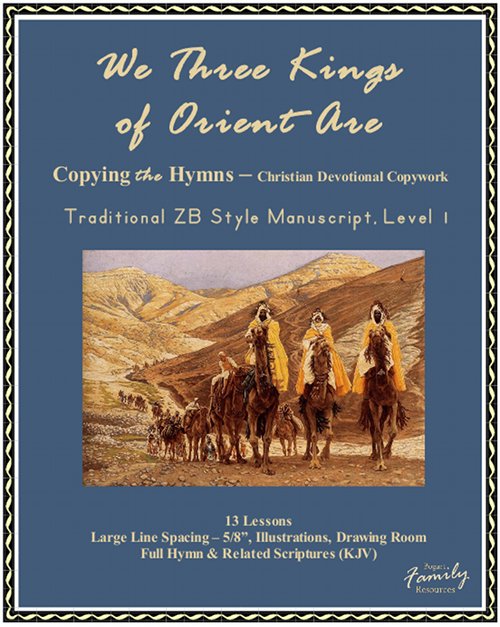
CHWTK-ZBML1C
We use copywork in our home since I have two boys that don’t like to write. I try to find many ways to enhance their writing experience and help with their penmanship.
 
I am picky though on what I will allow them to use. I don’t just want them to copy words on a paper. I want them to learn something as they learn to write and read better. 
 
When I looked through this wonderful curriculum by Bogart Family Resources-called ‘We Three Kings of Orient Are – Traditional ZB Style Manuscript Level 1′, I knew this would be a wonderful addition to our homeschooling. Anything that glorifies the Lord, and helps my children learn more about Him, is a winner in my house. 
 
Bogart Family Resources uses ‘We Three Kings’ by John H. Hopkins Jr. to help enhance our son’s handwriting skills while building a foundation in our Faith. This curriculum includes the full text of the classic hymn and scripture (KJV) which highlight the spiritual themes of the hymn. 
 
One sentence is introduced per lesson, totalling 13 lessons. I love how they use the same approach to handwriting as does Peterson Handwriting, which we’ve had the opportunity to use in our homeschooling this year to teach cursive to both of my boys.
 
This curriculum is written for the beginning writer that is familiar with forming the alphabet letters. Line spacing of 5/8”, and a traditional-style Zaner Bloser manuscript font is used. 

Copywork Lessons 1 and 2 are opening verses that focus on the
account of the wise men coming to visit Jesus, while Lesson 13 provides the closing scripture verse that shows the spiritual truth of the hymn. Lessons 3 – 12 include the entire text of the hymn and is set up for easy copying. 

At the beginning of the lesson there is a copy of the Manuscript upper and lower case alphabet chart as well as a number chart for easy reference for the beginning writer.
 
What I loved about each lesson is the empty frames for my boys to draw and illustrate what they’ve learned in that days lesson. My children are very hands on and this will help them to enjoy their writing experience and encourage their creativity.  
 
This wonderful product and handwriting resource is only $2.95 and available as an instant download. 
 
Check out their website @ Bogart Family Resources.
Written by Lynn Pitts, mom of 3, from Big Sky Country Montana. You can read more about her life at Learning by Living and Ladybug Chronicles.
Dec 172009
 
photo by allyrose18

photo by allyrose18

After my recent post on thinking games, I felt that this post on word games would be appropriate since our family enjoys several word games that are both fun and educational.  One challenge about playing word games with the whole family is that it is necessary for children to be able to read, unless, of course, they are playing an introductory child’s word game (which are usually not that fun for the older members of the family). We typically relax the rules of the more advanced word games that we play in order to level the playing field.  We often assist the children in finding and/or spelling words.

The great thing about playing word games is that children get spelling practice and an introduction to new vocabulary words within a fun, game-playing context.  As an older player uses a word unfamiliar to some of the others playing, the meaning can be discussed, the spelling clearly seen, and new knowledge is gained by all.  It seems that we are more likely to remember things that we have learned within the context of having fun.

A final educational benefit that word games provide for children is practice using the dictionary. Not many people find it particularly fun to look up words in the dictionary as part of an assignment.  But when kids are trying to score points in a game, looking up words becomes much more motivating.  In addition, the children are usually seeking these words secretively (so they don’t give parents an advantage in the game).  In other words, they are motivated to act and learn independently (which is sometimes a struggle during the school day for some members of our family).  So find a word game and gather your family together for a fun and educational experience.

If you don’t already have a favorite word game, here are a few suggestions from our list of family favorites.

Bananagrams:

This game consists of letter tiles, packaged in a zippered banana pouch. There is no board, so this game is very portable. Each player draws tiles and makes words using only their own tiles. They join other words like a crossword puzzle. My favorite part is that everyone plays at once. It is fast-paced and no one has to wait for someone to take a turn. Call me impatient, but it does get boring waiting too long for the other players to take their turns in certain games.

Boggle:

This is another compact game where all the players play at the same time. The game consist of letter cubes and a small case to hold the cubes and shake them. For each round the case is shaken and the 25 cubes allowed to rest in the bottom of the case. Players then look for words by connecting the letters. After the set time has passed, players take turns calling out the words that they have found. You only get points for those words that no one else has found, so it is good to write down unusual words. There are points awarded for each unique word with longer words scoring more points.

Quiddler:

This great card game is from the makers of The Set Game. Each card has a letter or a blend of letters on it. For the first hand, each player is dealt 3 cards. Each subsequent hand the number of cards is increased by one, until the last hand where each player is dealt ten cards. Each player tries to use all their cards to spell one or more words. Each turn they must draw one card and discard one card. After the first player is able to use all their cards, all the other players get one more turn and must make whatever words they can from the letters in their hand. The points from unused cards are deducted from their scores. This game lasts longer than the other ones, but it provides more opportunity to help the children find words.

As we homeschool our children, let’s not forget about the natural opportunities that arise for educating our children within our everyday activities.

Written by Kristen, Relaxed Classical Homeschool Mom of 4. Kristen blogs at A Day in the Life.

Dec 152009
 

Growing up I read book after book. However, very few of the volumes I read are remembered or revisited.

At the library I checked out whatever looked interesting: Nancy Drew mysteries, Grace Livingston Hill romance novels, or historical fiction. My random searches hid some amazing authors. Now I get to discover these imaginative writers with my children.

14858: Brighty of the Grand CanyonAfter lunch I read aloud Brighty of the Grand Canyon.

“One more chapter please!” begs my three-year-old.

Her five-year-old sister crowds close and grins widening bright blue eyes. Eleven-year-old brother peeks in almost every chapter. As the verbs bounce off my tongue, the suspense of the story pulls him away from Lego.

Our collection of Marguerite Henry’s horse books was rescued from the trash. Library books thrown out to make room for new stories. Brighty of the Grand Canyon taken home only once in eight years. Was this spirited burro on the shelf at my school library? If he was, I didn’t take him home either.

Marguerite Henry was not introduced to me in my youth. But I know her now.

Her stories are revisited often in this home. Benjamin West and his Cat Grimalkin roam the house resting next to Father’s side of the bed, then Mother’s. Justin Morgan Had a Horse cracks my voice and spills tears over my eyelids. Children gasp, “Why are you crying?”

For many reasons, I’m sure. Because life is full. Because ideas are powerful. Because children crowd around me to enjoy the lacing of words. Stories crafted to communicate ideas of liberty, hope, and faith. Morsels I want to savor together as we read book after book…

Written by Renae Deckard, Biblical Principled mother of 3. Find Renae’s reflections about homeschool and family life at Life Nurturing Education.

_________

If you subscribe to The Curriculum Choice, I apologize for the lack of updates lately. Our feed was not being sent out. That has hopefully been rectified. Thank you for your patience.

Dec 142009
 

Rather than focus on one product this time around, I’d like to highlight an entire area of products from one company.  Prufrock Press puts out super logic resources! I’ve had the pleasure of using five of their logic/critical thinking books for elementary children and would recommend them to anyone.

Logic Safari Books are leveled for 2nd/3rd, 3rd/4th and 5th/6th grades.  They include traditional logic puzzles that use clues and grids to answer questions like the following:

Four friends went to the barber shop and had their hair cut by four different barbers.  Use the clues and grid to determine which barber cut each friend’s hair.

I’ve used logic puzzlers such as these with my children since they were in the 1st grade.  My kids LOVE these.  We typically take one day a week during math time as a logic day.  Puzzlers like these are some of the resources I’ll use and they literally beg me for logic days.

The Logic Safari books are progressive in that they start out simply and move to harder puzzles within and throughout the books.  Black and white illustrations make the pages attractive to my children, while thorough, but uncomplicated explanations and clues are attractive to me.

You can see sample pages for each book by clicking on the graphic of your choice above.  At $8.95 each, I feel like these are a bargain!

Lollipop Logic for grades K-2 and Primarily Logic for grade 2-4 are critical thinking resources.  They provide worksheets that introduce and reinforce skills such as analogies, syllogisms, relationships, sequencing, deduction, inference, and others.

Again, the pages are clean and attractive to make these high-level thinking skills seem like fun.  You’ll be pleased with the connections your child makes and the excitement that these books produce.  These, too, are resources I might pull out on our logic days, and my children haven’t complained yet.

Again, you can find sample pages by clicking on the graphics above.  With 64 jam-packed pages, the price of $11.95 each is very fair!

Prufrock Press products focus on gifted learners.  Don’t let that scare you!  As homeschool teachers, we have the awesome opportunity to introduce our children to all sorts of studies one on one.  This means that what might be considered gifted in public schools will easily be grasped by our children simply because we get to sit with them and make sure they “get it”.  Another awesome opportunity we have is presenting our children with lessons on their level – no matter the age or “grade”.  If after looking at some of the sample pages, you feel like a particular book might be too hard – go down a level or two.  Who cares?  Don’t miss the chance to open your children’s eyes to the wonderful world of logic!

-Written by Cindy, an eclectically Charlotte Mason mom of 3.  You can find her blogging at Our Journey Westward and Shining Dawn Books.