There are actually two Mathematicians are People, Too books – a volume one and a volume two. They both have the same format and style and are written by Luetta Reimer and Wilbert Reimer.

Affiliate links are used in this post and on this website. Please see our disclosure policy for more details.
Mathematicians Are People Too – Math or History?
Recently on a forum, someone asked if these books are math books or history books. Well, that’s a great question. They are living books for sure. And because they are living, they are multi-faceted. They are math and history; you can certainly call them math history. But they also are good biographies. And they incorporate science and geography as well. So like any quality living book, they are hard to pin down to one particular label. This is the kind of book a Charlotte Mason educator loves – a book full of ideas to digest.
Inside Mathematicians Are People Too
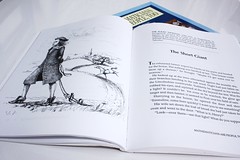
Each book has 15 chapters, and each chapter is a biographical sketch of a mathematician. Where each chapter begins, there is a full page black and white illustration on the left. Those images are great for photocopying onto notebooking pages for your math journal.
The mathematicians are arranged chronologically within each book and include men and women from many nations. The chapters don’t try to capture every detail about the mathematician, running from birth to death in a boring list of facts. Instead they focus on one or more key narratives from that person’s life which illustrate his discoveries or his character. A real effort has been made to select humorous, exciting, and inspiring stories.
Mathematicians in Volume 1
Thales, Pythagoras, Archimedes, Hypatia, Napier, Galileo, Pascal, Newton, Euler, Lagrange, Germain, Gauss, Galois, Noether, and Ramanujan
You can find notebooking pages for this book here.
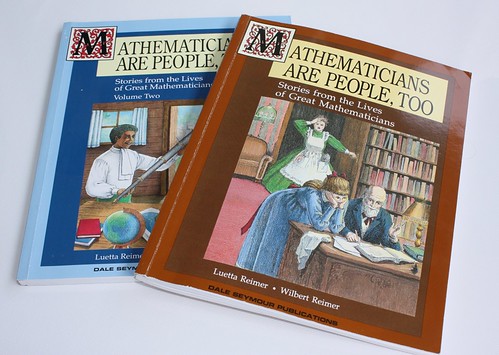
Mathematicians in Volume 2
Euclid, Khayyam, Fibonacci, Cardano, Descartes, Fermat, Agnesi, Banneker, Babbage, Somerville, Abel, Lovelace, Kovalevsky, Einstein, and Polya
You can find notebooking pages for this book here.
How to Use These in Your Homeschool
These are math books with words, not numbers. So math concepts are the focus, not arithmetic functions. Of course, if you want to use Mathematicians are People, Too as a jumping off point for a study of geometry or algebra, for example, you certainly could! In fact, that’s exactly how I see these books. They are engaging narratives that encourage further investigation. As you read, you’ll see lots of tangents you can choose to explore.
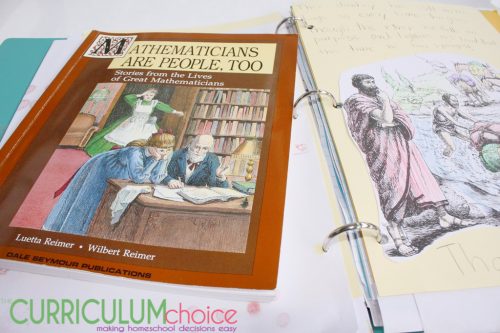
How can you use these books? Well, if you’re already using a living approach to math, these volumes fit perfectly with a study of math history.
If you desire to shift towards a living math approach but aren’t there yet, this book is also a good choice. You could choose any mathematician and read just one chapter. Your children could see that mathematicians really aren’t boring guys and gals! And math is actually much more than multiplying and dividing.
Or these books could add a mathematical facet to a history study. Just read the chapters as you reach the time periods in your history lessons. If you need biography genre for literature, these short one chapter stories will serve you well.
More Charlotte Mason Style Learning
The Ultimate Guide to Charlotte Mason Curriculum for Your Homeschool – This Ultimate Guide to Charlotte Mason Curriculum for Your Homeschool is a comprehensive collection of resources for homeschooling in the Charlotte Mason style. Find out what exactly it is. See how you can infuse the Charlotte Mason style into your homeschool. Read tons of reviews for Charlotte Mason Curriculum and Charlotte Mason inspired resources.
~ Originally published September 2009, written by Jimmie

What a great review! However, now I have to have them, so I’m not sure the hubster is going to think it’s so great! 😉
I guess we don’t really use a “living math” approach, because one uses Saxon and one uses Abeka math. However, I do like to incorporate books about math, like the Penrose the Mathematical Cat books and the I Love Math series. Very fun!
.-= Mia´s last blog ..Design a building with Frank Lloyd Wright! =-.
I think these books would be great!
My kids would much rather read about math than actually do it!! I find that the living math is a bit too time consuming. But, I do like to add Living math books (such as this type) to their regular math program (Teaching Textbooks.)