Jul 312009
 

homeschoolgadgetIf you haven’t downloaded the Homeschool Gadget Toolbar yet, there are now 2 more reasons to have this toolbar on your computer.  The first is a facebook application that allows you instant access to our Curriculum Choice facebook page and a personal facebook gadget.  

The second new reason to download this amazing toolbar to your computer is that we now have a gadgets menu that has things such as a calorie calculator, Sudoko, unit converter, Wikipedia search, Travelocity, and a handful of other gadgets right at your fingertips.

Of course, we still have these outstanding features on our toolbar:

  • 100 Top Homeschooling Sites
  • Popular homeschooling blogs
  • Built in Google search engine
  • Searches by specific categories helpful to moms and homeschoolers
  • One click access to homeschool communities and forums
  • RSS feeds
  • Email notifier that manages all your email accounts
  • Tools such as the weather forecast, To Do list and a radio player
  • Pop up blocker
  • And more…


Visit our toolbar page for more info.
 Posted by at 6:00 am
Jul 302009
 

Sometimes it seems like curricula create confusion. Brightly colored texts, songs, jingles, computer programs, and educational games can all be useful learning tools, but perhaps we think that learning always has to be fun and exciting.  Do all the extras really help, or could they actually be a detriment?

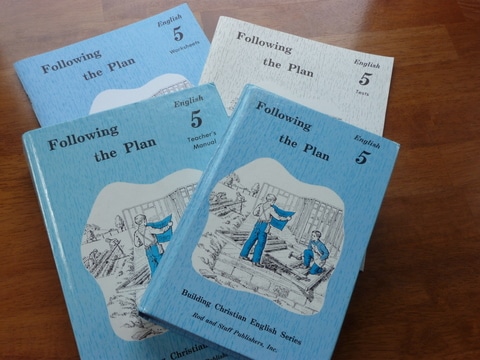
Simple, systematic, and effective. These are all words that describe Rod & Staff’s English curriculum. Rod & Staff is a Mennonite company, and the unhurried simplicity of the Mennonite lifestyle shines through in their curriculum. Scripture, family, community, and agriculture are prominent themes in the exercises included in the texts.

Rod & Staff EnglishSimple

Rod & Staff teaches:

  • Sentences
  • Parts of Speech (Each part of speech is studied separately)
  • Punctuation
  • Capitalization
  • Reference Books

The text is written with excellent explanations and examples. It can be read to the student by the teacher, or read independently by the student.

Systematic

Beginning in 2nd grade, with texts available through 10th grade, each year of Rod & Staff English builds on the skills learned in the previous one. The format of each text is similar. There is a short lesson which is found in both the student and teacher texts. Following the lesson, there is first a section of oral drill, then written exercises. The exercises progress from simple to more challenging.By simple, I do not mean it is not a rigorous program. We have currently completed years 3 through 6 of the program, and I have already seen topics that I don’t remember studying in school.

Effective
Its simple instruction and systematic review make Rod & Staff a very effective grammar program. One of my favorite features of Rod & Staff English is its use of sentence diagramming. The process of dissecting a sentence and rearranging it is wonderful for gaining understanding of the sentence structure. In addition to a student text and a teacher text, optional workbooks and tests are available. The worksheets allow for extra practice if necessary, and the tests are a great assessment if desired.

Not only is Rod & Staff effective at teaching English, it is also a cost-effective program. The exercises are written on separate paper, making the texts entirely non-consumable. Included throughout each text are writing lessons and practice, so no additional composition program is necessary. Each entire year set can be purchased for under $50.

I have been extremely pleased with my students’ understanding of English grammar after using Rod & Staff. I highly recommend it. Being a Mennonite company, Rod & Staff does not have an official website. Free catalogs are available by calling 606-522-4348.

Written by Kristen, Neo-Classical Mom of 4

Jul 292009
 
The Ordinary Parent’s Guide to Teaching Reading  
As homeschool moms we will have to consider how we will teach our children to read. Teaching our little ones to read may seem intimidating to many of us. Many of us will read all kinds of theories on how to teach phonics. I also made this journey as a homeschool mom and yes, it is intimidating! You don’t want to mess your kids up and you especially want to teach phonics the right way the first time. One thing you have to consider is your children’s learning styles. My children are not big fans of workbooks especially my daughter. I tried to teach her phonics with a well respected workbook program but it was just not a fit for her. So I was one of those parents who didn’t get it completely right the first time but I am pleased to say she has turned out to be a great reader. I will give credit to the wonderful phonics program we used. It was “The Ordinary Parent’s Guide to Teaching Reading”.
 
“The Ordinary Parents Guide To Teaching Reading” is a phonics program written by Jessie Wise and Sara Buffington. Jessie Wise also co-wrote “The Well Trained Mind with her daughter Susan Wise Bauer.
 
I love this program for its simplicity and effectiveness! It doesn’t have any fancy gimmicks or far-out theories that nobody understands. In my opinion, it has an old fashion approach to teaching phonics. 
 
What do you need for the program? All you need for this program is the book, “The Ordinary Parents Guide to Teaching Reading” and some simple supplies such as index cards. That’s it! No fancy materials to purchase! There is a combo pack avaiable that has all the letter cards, magnetic letter boards, and an audio CD for an additional price.  These additional materials are not required but it does save you time from making your own letter cards.
 
The Ordinary Parent's Guide Combo Pack
 
The Ordinary Parents Guide to Teaching Reading Combo Pack
 
 
How is it taught? The authors believe you can teach reading to a child as young as three years old. They believe reading is a separate subject to be taught from writing and spelling. Even though your child may not be able to write at such a young age, they may be able to start understanding some basic concepts of learning how to read. This program can be started whenever you think your child is ready to start learning how to read. As I always say the beauty of homeschooling is knowing when your child is ready to learn. The lessons are completely scripted for the parent. You read the lesson out loud to your child and you teach her new concepts every day. You will have to make some simple letter cards on index cards if you choose not to buy the pre-made ones offered for this program. Each day you will sit with your child (we love to cuddle on the couch for this), you will read the scripted lesson and your child will listen. During the lesson you will ask your child to practice her new skills she is learning. You may either use a marker board or index cards for each lesson. As the lessons progress your child will start to read sentences with all the letter sounds they have learned from previous lessons. The reading exercises are in the book. Ms. Wise truly made this so easy to use. There is plenty of review for each lesson. There is very little preparation needed. On some days your child may play a game to reinforce their new skills. Most games require some simple index cards with letters written on them or simple household items.
 
There are 196 lessons in this book! So there is more than enough material to teach your child to read. We took over a year to go through the book. The book starts with simple vowel sounds and then progresses to single consonant sounds. From there the lesson progress to consonant diagraghs, long vowel sounds, silent letters, consonant blends, r-changed vowels, two syllable words, contractions, plurals, three syllable words, suffixes, prefixes, and more!
 
A daily lesson will take less than 30 minutes. There is not any writing involved. Again, the author believes writing is a separate subject and should not be taught with reading. This makes it simpler and easier for the child to learn to read. They are not having to focus on their reading and writing skills at the same time. It is not necessary to supplement any readers, there are plenty of reading exercises with each lesson. We did use the “Bob Books” with the program to help my daughter gain confidence in her reading skills.
 
The book is very affordable, generally priced at $30.00 or less. The combo pack is available from Peacehill Press at $55.00
Click on link below for Peace Hill Press:
 
 
What are the cons? It is a simple program so if you prefer a phonics program with more “bells and whistles” then you may not like this book.
 
My daughter did wonderfully with this program. She was reading with ease within a few months. I highly recommend this program.
 
Click on the link below to find out more about “The Ordinary Parents Guide to Teaching Reading.”
 
Written By Korey
Jul 272009
 

Okay, I have to admit that I’m not the best teacher when it comes to handwriting.  I buy a book here and I buy a book there, but we never seem to finish any of them.  That’s mostly my fault because there are so many more exciting things to do than handwriting practice!  Then, well,  I find that I have a fourth grader who doesn’t write neatly – and now I’m really up a creek without a paddle because all the handwriting workbooks are way too young for fourth graders.

Imagine my excitement upon browsing booths at the CHEK Convention this summer when I found a handwriting workbook that isn’t babyish!  Not only that, it quickly reviews letter placement and all manuscript letters before moving into cursive.  The pages are short and sweet, the directions are clear and easy enough for my son to do the assignments on his own, and the vocabulary words used for practice are appropriate for his age level.  Finally, I’ve found a program we can stick with!

Conquering Cursive from Write-On Handwriting is a simple, yet effective handwriting curriculum that doesn’t bother with the distractions of cutesy pictures or difficult sentences to copy.  Quite plainly, its purpose it to teach your child to write correctly and neatly.  Skills include not only proper letter structure, but proper posture, holding the pencil correctly, word and letter spacing, and understanding the concept of right and left.

They offer the curriculum in printed form (which is what I have) for $10 and you can choose from a left-handed workbook or a right-handed workbook.  (They offer a digital version, too, but I haven’t had experience with that so I won’t comment on it.)  Both the left and right-handed workbooks are spiral bound at the top of the page, so no bindings get in the way of writing.  Words in the left-handed workbook are situated on the right side of the page so the child is able to see the copy words clearly.

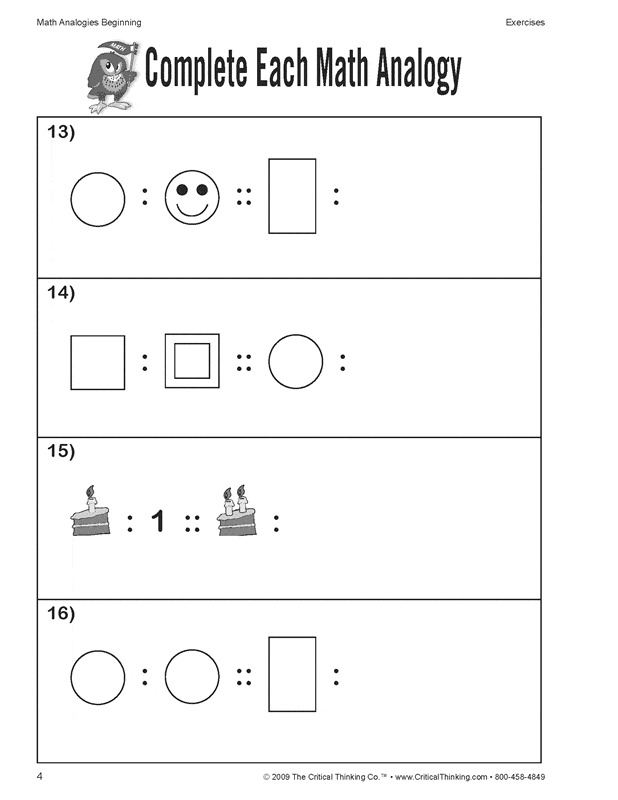
There are 96 pages worth of lessons that will reinforce not only letter and word formation, but capitalization rules, cities, states, months, number words and much more.  I have included a sample page below, but other sample worksheets can be found here.

Normally, I wouldn’t post about a product I haven’t had tons of experience with, but my son and I are both so excited about this handwriting program that I couldn’t resist!

Written by Cindy – Eclectically Charlotte Mason Mom of 3.  You can find Cindy blogging at Our Journey Westward and find her NaturExplorer units at Shining Dawn Books.

Jul 252009
 

eva21 Shortly after I started homeschooling, I came across a wonderful activity that we now incorporate into our curriculum regularly.  With the popularity of new technological gadgets, many people are familiar (to varying degrees) with Geocaching.  Fewer, however, are familiar with Letterboxing.

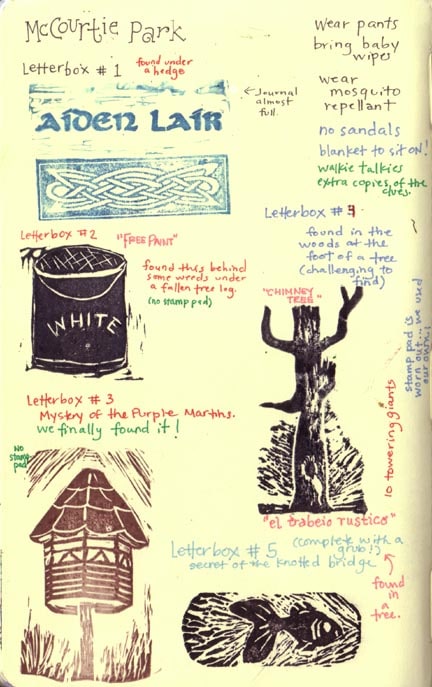
      Letterboxing is an intriguing pastime that combines navigational skills and rubber stamp artistry in a fun outdoor quest. Letterboxers hide small, weatherproof boxes in publicly-accessible places and post clues to finding the box online. There are over 20,000 letterboxes hidden in North America alone. Individual letterboxes usually contain a log book, an often hand-carved rubber stamp and may contain an ink pad. Finders make an imprint of the letterbox’s stamp on their personal log book or nature journal, and leave an imprint of their personal stamp which they carry with them in the letterbox’s logbook .

      As explained on the website Letterboxing North America, “Letterboxing is said to have started in England in 1854 when a Dartmoor National Park guide, James Perrott of Chagford, left a bottle by Cranmere Pool with his calling card in it as an invitation to those who found the bottle to add theirs. Eventually, visitors began leaving a self-addressed post card or note in the jar, hoping for them to be returned by mail by the next visitor (thus the origin of the term letterboxing; letterbox is a British term for a mailbox). This practice ended in time, however, and the current custom of using rubber stamps and visitor’s log books came into use. It caught on in the US in 1998 after an article in Smithsonian magazine.”letterbox-journal-page

      Letterboxing is intended to be an environmentally friendly activity, with as little impact as possible on the environment involved in hunting for letterboxes.  As we hunt for letterboxes, we always pick up any litter or debris that was left behind by people who care less for the land than we do.  The most important things to remember when letterboxing are respect and safety. Respect for the environment and for the letterbox that someone has created and your personal safety.  

      Sometimes we’ve searched for the letterbox and have not been able to find it. This could be because it was simply too difficult or because the box is in fact missing. Although this can sometimes be frustrating, we always remember the great time we had with the hike and the hunt, even if we are not successful.  After all, it provides us with an opportunity to observe nature and occasionally catch glimpses of wildlife (elk, ground squirrels, birds of prey, etc.). 

      Several of the letterbox quests require the use of a traditional compass.  This provides a great opportunity to introduce orienteering to children.  Most, however, rely upon simple written instructions.  In Ashland, Oregon, home of the renowned Ashland Shakespeare Festival, many of the hidden boxes are inspired by William Shakespeare and the clues incorporate passages from his many theatre plays.

      In spite of often rainy, inclement weather, Charlotte Mason insisted on going out once-a-week for an official Nature Walk, allowing the children to experience and observe the natural environment firsthand. These excursions should be nature walks, not nature talks, explains.  Letterboxing has always provided us with the incentive to get out there when we may otherwise feel inclined to stay indoors.

      Not only can a wide variety of adventures be found to suit all ages and experience levels, but letterboxing can also be done year-round in most areas.  Only those boxes that may be concealed beneath the snowfall would be unobtainable.  One of the unexpected challenges that can arise during the winter months, however, is that many of the clues relate to plants and trees in full foliage. This provides the perfect opportunity to learn about plant identification in the winter.

      On of our most memorable quests was in February.  Though it was chilly at the start, we didn’t expect the surprise that nature provided us…snow!  Charlotte Mason would have been proud of our enthusiasm and commitment to learning about nature in all its glory. She believed that bad weather was no excuse for not having the daily outing and the weekly nature study. As long as the children are dressed adequately to protect them from the cold or rain, the nature study can still proceed in the same way as on clear, lovely days. Winter or wet days will each offer their own variety of nature to experience.

      Frequently, upon our return home following a letterbox quest, the children will illustrate their favorite discovery (a new wildflower or an interesting cloud they observed).  They are beginning to also include questions and to occasionally include poetry.  As interest develops, creating a letterbox of their own would provide children with additional opportunities for writing, orienteering or navigating practice, and expressing themselves (carving the stamps). 


Written by Makita, an eclectic homeschool mother of two.


For more information: 

Letterboxing North America.  http://www.letterboxing.org 

The Letterboxer’s Companion

by Randy Hall 

It’s a Treasure Hunt! Geocaching & Letterboxing

by G & R Publishing

 Posted by at 6:04 am
Jul 232009
 
Literature

Literature

Finding a language arts curriculum is a lot like finding a good bathing suit –getting that perfect fit is really tough! Here’s a review to help you “try on” one more curriculum.

Learning Language Arts Through Literature (LLATL) is a gentle approach to language arts study that works best for homeschoolers who use a living books approach to learning

[I am basing this review on our use of LLATL Yellow (grade 3). Other levels may vary.]

The literature part of LLATL is covered in two ways:

1. Four novels are assigned through the year.

2. Each weekly lesson begins with a literature passage (either poetry or prose).

Most lessons include copying the literature passage, learning a short (5-6 words) spelling list of a word family represented in the passage, writing the passage from dictation, and practicing cursive handwriting. The other activities vary and include basic language arts skills – alphabetizing, analogies, parts of speech, plurals, punctuation, etc. The writing tasks are few – just a handful of narrative, descriptive, or how-to topics throughout the year. The nitty-gritty of paragraph structure is not covered at all.

LLATL publishes a teacher’s book and a student book. I rarely used my teacher’s book because most of the student activities are clearly described in the student’s book. But there are a few exercises that say only “follow your teacher’s directions.” Actually, for this program you can use the teacher’s book only and have your child write on paper.

The big question about LLATL is, “Is this a complete language arts curriculum?”

Yes and no. Everything (except vocabulary) is touched on but not necessarily covered in depth. That’s probably why LLATL is considered a gentle curriculum. (I supplemented LLATL Yellow with additional grammar, spelling, writing assignments, extra readers, and vocabulary.)

The daily assignments are not long and can be completed in 10-15 minutes.  And of course, reading only four books in a year is not enough. There is certainly an assumption that your children are reading other books besides the four titles included in this curriculum.

If you want something light that touches on lots of language arts topics while giving you time to select your own tangents, LLATL may be a good fit. If you want a rigorous program that includes all you need for language arts, LLATL may be a disappointment.

My Own Take on LLATL

Personally I think LLATL works best for those homeschoolers who already incorporate a lot of language arts across the curriculum. If you use a living books approach, your children are already reading a lot of good books. Similarly, if your children write about their history and science readings, then they don’t need extra writing assignments as part of a language arts program. Assuming that your children already do reading and writing tasks in other subjects, LLATL can be a nice “icing on the cake,” pulling together some topics you may otherwise miss or reviewing others that you did study. For more about this approach to language arts, read Ruth Beechick’s short advice (scroll down to It’s Just Common Sense).

photo credit

Written by Jimmie, Charlotte Mason flavored mom of one.

Jul 232009
 

We have one son who is a visual-spatial learner. He always does much better learning a new concept when he can actually see and touch and manipulate an idea. This was an easier task when the math were were learning was addition, subtraction, multiplication, and division. Once we hit algebra, I had a hard time coming up with ideas to show algebra principles in a visual-spatial way.

At a home school convention, I visited the Math-U-See booth and posed the question to them. They had an answer. They showed me their math manipulative blocks along with their text and DVD. They could show me ways to offer algebra that made it fit my visual-spatial learner.

One day's lesson in Math-U-See Algebra

One day's lesson in Math-U-See Algebra

The Math-U-See system starts out with watching the DVD lesson and then moving to the text. Everything that is in the video is in the Teacher’s Guide so the parent can follow along with the DVD lesson if they want to. Not all lessons use the blocks but the DVD lessons that show author Steve Demme illustrating the algebra concepts convinced me that my son would benefit from this program. My son enjoyed Steve Demme’s casual style and the fact that he could watch any of the short video lessons over again if he didn’t get the concept the first time through.

Although I am what some people would call a “math person” and algebra came easily to me, I learned by following along with the lessons *how* algebra works.

For instance, we could visualize what it meant to factor an equation.

x² + 3x + 2 = (x +2)(x+1)

Math-U-See showed us how to factor equations with the manipulative blocks. We could see with our own eyes how this looks and understand it on a different level. We now understood the “why” and not just the mechanics of more abstract math concepts. Many of the lessons will instruct the student to “build with blocks” the equations that are in that particular lesson. After watching the short video, my son would be able to quickly apply the patterns and ideas to his set of blocks and then to the daily lesson. The lessons with the blocks are self-correcting since the student is instructed to build the equation and then check it by multiplying. This was a great way for my visual-spatial learner to teach himself how algebra works.

There is a sample video about factoring at this link that will illustrate how the system works. You will also get a feel for how Steve Demme teaches all the lessons and how he teaches math using patterns. This system also worked well for my visual-spatial learner.

There are sample pages at this link that I recommend that you look at so you can see what the teacher’s guide includes and how the student pages are set up. You might want to note too that the tests are multiple choice. At first I did not like having the multiple choice test, but I required my son to show *all* his work to substantiate his choices.

My son's well-loved Math-U-See Algebra Text. (Yes we still do stickers.)

My son's well-loved Math-U-See Algebra Text. (Yes we still do stickers.)

My son has since told me that this approach to learning algebra  helped him to understand things like squares of numbers, square roots, and equations in a way that has stuck in his brain. Math-U-See helped us over the bumps and set the stage for a lot of math successes since.

Math-U-See is reasonably priced for the quality DVD and textbook.  (see the price list) My son loved the ability to write in the text and the spiral binding made the actual book easy to work with. The DVD makes algebra an independently learned subject if need be, but I enjoyed following along with each lesson.

We did use the Honors Book in addition to the student text but really it was not necessary.  There are nineteen additional practice pages available online at their website as well.

Do not skip using the manipulative blocks because you think they are too expensive. They are the backbone of this program.

Math-U-See was painless algebra for my visual-spatial learner.

Written by Barb-Harmony Art mom.  She also blogs at http://www.harmonyartmom.blogspot.com/

Jul 212009
 

Mrs. Ruth Smith is well known in Biblical Principle Approach circles as a mentor and Master Teacher of the Rudiments of America’s Christian History (among many other topics). She saw a need for a Providential history text and thankfully she wrote it. There are to be 7 volumes in all, an this is the third. (The fourth is slated for release later this year or early next.)

This volume is written for 2nd graders but is easily adaptable to multiple elementary grades for home educators. The book set includes a textbook and a teacher’s book (with CD-ROM) for $55. The textbook is 25 chapters in length and is simple to read aloud and nothing is consumable, so you can reuse the book as needed.

Although it is American History it is true to the Biblical Principle Approach to America’s Christian History—it follows the Chain of Christianity from creation to modern day. So it is not a year of the Revolutionary War, but rather an overview of the Gospel moving Westward. It takes a Providential approach to history, meaning the worldview is one that believes God moves in the affairs of men and nations.

The teacher’s book prepares you for teaching with Biblical principles and leading ideas for each lesson. There are reasoning questions at the end of each lesson and suggested notebook work.

The Teacher’s Guide also includes fundamental information on BPA basics like expanding the principles and links through the grades, developing a course overview, developing lesson plans, sample lesson plans, map work and more. The CD-ROM includes several notebook pages for the child to complete.

There are more lessons than you will cover in an average year—150 in all. You can choose what to cover for your family, and for older children you can add extra lessons or you can have them do some of the supplemental activities listed at the end of the chapters (writing papers and other 4-R activities).

Drawbacks to this series for some families may be the cost, the Providential view, lack of step-by-step lesson plans and the focus on American history. For me none of these things are a minus.

If you are new to BPA or are just looking for excellent lessons without reinventing the wheel, Mrs. Smith’s books may be just what you are looking for: enough hand holding to help you along your BPA journey but still enough flexibility to chart your own course.

Jul 202009
 

triviummastery_frontcoverYou can’t teach an old dog new tricks.  Or, so they say.  I’m not an old dog but after homeschooling for a number of years I felt like I’d heard and seen it all.  This is especially the case with a classical education, because I’ve been around since the beginning of the resurgence of the ever-so-popular The Well Trained Mind by Susan and Jesse Wise Bauer.  This book was the inspiration for me to research further and find the right balance for our classical Christian homeschool. 

 A Missing Inheritance

The book, Trivium Mastery by Diane Lockman, is the first classical education book to challenge my way of thinking in 9 years.  I mean really challenge it.  Diane has some historic proof of a real classical education and she challenges this new movement that we all have been drawn to.

What I like about this book is that she makes a classical education more palatable.  It’s not as hard as us “die-hards” can make it seem sometimes.  A true classical education can be reduced to concurrently teaching three primary skills to substantial mastery: language, thought, and speech. 

I do not believe this book would be easy for new classical home-educators.  It is assumed that you know certain things about the classical resurgence.  It is almost as if this book is written as an intervention.  The fact is, that is why she wrote it.  She discovered a classical education and followed the trail back in time.  She traced back the history of a classical education, past the popular names such as  Susan Wise Bauer, past the Bluedorns andWilsons, past Dorothy Sayers and on to the original Greeks and their methods.  You should almost read the Sayers text or The Well Trained Mind first to better understand her points. 

12 Classical Makeovers

The second half of the book is several test families, that she has done a classical make-over on.  She gives lots of examples and innovative ideas.  I had to keep a running list of these ideas for each of my school-aged children.  You really should read each family’s make-over to gain all the helpful information that is in this book.

I’ll be honest, I have struggled with the suggestions in this book because it almost seems too easy.  I appreciate the research behind Trivium Mastery and I am really anticipating her sequel that will be geared toward the rhetoric years.

This old dog has learned a few new tricks and I encourage you to read this book if you have been wondering how you could simplify your homeschool by creating an authentic classical home school.

One further note:  the assessment tools that are included in the back of this book are worth their weight in gold.  They have helped me clearly understand some of our needs that need to be met this coming year.  And, I see myself using this handy reference throughout the year as we assess our goals.

Please visit Trivium Mastery for more information about Diane and her book.

Written by Brenda, a classical eclectic mother of 5.  You can find her blogging regularly about family traditions and their homeschool journey at Tie That Binds Us, after their summer vacation has come to an end.

Jul 182009
 

 AAS.jpg picture by learningbyliving


When I received this curriculum in the mail I was overjoyed. First off I would like to add that I have a reluctant speller and reader in our home and we’ve struggled and struggled to find something that would work for him. We were getting rather discouraged with what we found and what was NOT working. I pretty much gave up until I got this.


WOW! I fell in love with. It was exactly what we needed for my oldest son who just didn’t have the need to learn to spell. We received Levels 1-4. Since I have a child that isn’t a great speller we started at the beginning of Level 1 and have been working on this slowly. I love that there is no set time limit on this curriculum or a specific grade level. No pressured daily schedule to show how far behind you are. That is one thing that I have a tough time with is someone else’s schedules. It never works out for us. They recommend you start with Level 1 and move quickly until you find where they are. It’s a huge benefit to start from the beginning. Not only to allow your child a chance to get used to this way of teaching, but to also give them a great review and it’s so much fun that they probably won’t even care.. Mine didn’t..


From their website:

“The All About Spelling series brings together the three pathways to learning—auditory (hearing), visual (seeing), and kinesthetic (touching). This multi sensory approach, combined with a built-in review system and reinforcement activities, ensures that students retain what they learn and understand how to apply it in practical situations.”


 spellingbookL1.jpg picture by learningbyliving


What we loved the most about this program is the hands on approach using their color coded letter tiles. They also have magnets you can purchase separately to stick on the back of each tile and use on a magnetic erase board. This was the option we chose to help keep the tiles in place each day and help with the ease of the lessons. The consonants and vowels are different colors to help the child learn the difference between the two.  


Cost:

Letter Tiles $9.95

Letter Tile Magnets $5.95

Level 1-4 Books, cards, tokens, certificate, chart, and dividers for $29.95 each


You can also choose to purchase their Phonogram Audio CD. An easy way to learn the sounds of the basic phonograms, which features clear enunciation of the sounds of the letters and letter combinations. This helps as an addition to the daily lessons. You can purchase the CD for $14.95 and works for all 4 levels.


Phonogram Cards are used to help teach the sounds of letters and letter combinations. The cards are two-sided: The front side of the card is what the student sees, and contains the letter or letter combination. The back side, is what we see, and has the sound of the phonogram, along with key words to refresh your memory.  


It also includes the divider cards so you can organize the cards into three groups—cards that need to be reviewed, cards that your student has mastered, and cards that have not yet been presented. All you need is a small file box to store all of them in and your ready to go!


Printed on sturdy cardstock, the flashcards and divider cards are ready for you to pull apart on the perforated lines and put to use.


Letter Tiles:

Each set contains 105 tiles—two each of letters a to z, one each of the remaining letter combinations, and five blank tiles. These are a necessary item for the curriculum.


Magnets for Letter Tiles:

Attach these magnets to the back of the color-coded letter tiles to enhance letter tile storage and use. This was such a time saver for us. Instead of having to store the tiles in a zip lock baggie which we started out with, as we needed more tiles daily it just made sense to use the magnets with our magnetic dry erase board. Now they are always available, set up and ready to go!


The books are laid out to where all you need to do is open it, quickly read what you need to do, grab the cards you need, pull out your magnetic board or tiles and you are ready to go! No more stress over weekly spelling tests that my son usually forgets minutes after the final test is given. This has proven to me a great success in my son’s spelling retention and we’ve seen a huge improvement in the time we’ve used it so far. I do know for sure that this curriculum is here to stay for us. No more fumbling to find a spelling curriculum anymore. We are very pleased with how this is working for my son and have finally started my youngest son on it as well.

You can purchase All About Spelling at their website here


Written by Lynn Pitts, mom of 3, from Big Sky Country Montana. You can read more about our life at Learning by Living.