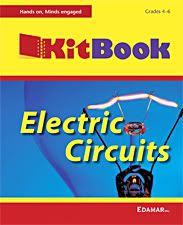
 We completed a unit study on electricity earlier in the year. As I was preparing for the unit, I kept wondering how in the world I was going to design hands-on electrical learning without having to buy lots of little pieces – and quite honestly, not really knowing what I was doing.
Enter the Electric Circuit KitBook. This was an awesome tool! Not only did it provide the hands-on experiences I was looking for, but included a teaching text, student booklet and all the required equipment!! All in a nifty, self-contained package, too.
The price seems a tad high at $39.95. I know that’s steep for most of us as one-income families. However, you really need to buy nothing else for a complete, in-depth study of electrical circuits for upper elementary and middle school students.
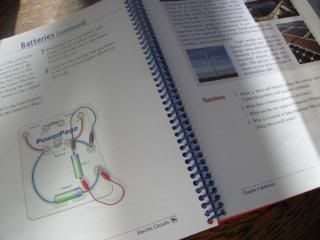 Here’s what you’ll find in the kit:
- A spiral-bound student text is attached to the experiment surface. There are eight chapters, each with child-friendly explanations about the chapter’s topic. There are several illustrations, photographs and charts, along with lots of color to keep your child’s attention.
- Each chapter includes step-by-step experiments with illustrations that are completed on the sturdy, fold-out work surface.
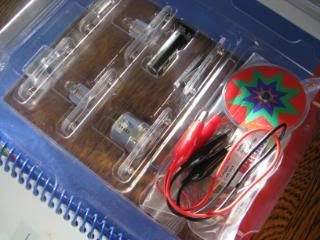
- All supplies are included with the kit including a battery, switches, safe wires, light bulbs, a buzzer, a spinning disc and several other small items. These are contained in specific compartments within the kitbook so all the pieces can be easily found for experiments and easily kept for future use.

- After experiments are completed, each chapter has a question section, a challenge and a science or history bonus paragraph or two about famous people or items relating to electricity.
- A small student workbook is included separate from the kitbook that your child can write in. It includes multiple choice, fill-in-the-blank and writing questions for each chapter, as well as a small glossary of terms.
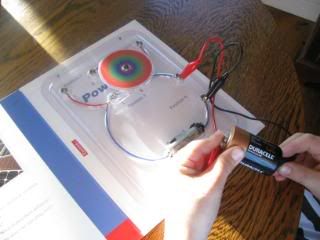
 My children learned A LOT from this KitBook! Even more importantly, though, my children had fun. They loved every minute of their time spent completing the lessons and still ask to “play” with it. They’ve designed several electric circuits that weren’t included in the book based on the knowledge they gained during the study.
There is a teacher’s edition KitBook available. Personally, I wouldn’t spend the extra money on it. The student guide had plenty of information and didn’t leave me feeling like I had missed anything.
One other plus – extra parts are available for sale individually just in case one of your parts goes bad or gets lost.
And just what will your child learn? Here are the chapter titles:
- Getting Started – What is Electricity?
- Simple Circuits
- Batteries
- Conductors and Insulators
- Switches
- Series Circuits
- Parallel Circuits
- Electromagnetism
There you have it! Enjoy your time with electricity!
-Written by Cindy, eclectically Charlotte Mason mom of 3. You can find Cindy blogging at Our Journey Westward and Shining Dawn Books.

The biggest reason Cindy chose to homeschool was because she loves experiencing life with her children and watching them grow inside and out. She's sure that’s why the Charlotte Mason method first caught her attention. It allows her to be creative in scheduling, rigorous in learning, yet opens the door for plenty of close-knit time, opportunities for her children to explore their interests and offers enough free time for them to be children. She implements many of Charlotte Mason's methods with an eclectic twist of things that work for her family! At Cindy's website, Our Journey Westward, you will find a blog packed with fun learning ideas and a shop full of creative curriculum, including the NaturExplorers studies.



Leave a Reply