Jimmie

Jimmie is mom to one creative twelve year old daughter. Jimmie's Collage is where she blogs about their Charlotte Mason styled homeschool. Her second blog, The Notebooking Fairy, features free notebooking printables and how-tos plus the eBook Notebooking Success.

Apr 052010
 

science notebook spineI like using notebooking as a form of narration in our Charlotte Mason styled homeschool. My preference is to use blank notebooking pages or to make our own, but I also enjoy History Scribe retail notebooking pages.

Why do I like History Scribe? My daughter is creative and loves to sketch. If I give her a notebooking page with graphics on it, she generally feels disappointed. After all, in her mind, the funnest part is already done. Blank pages are what she prefers because she has room to draw and to write. (And I’m in hearty agreement with blank pages. After all, the more she completes herself, the more learning she is demonstrating and reinforcing.)

History Scribe fits her perfectly.

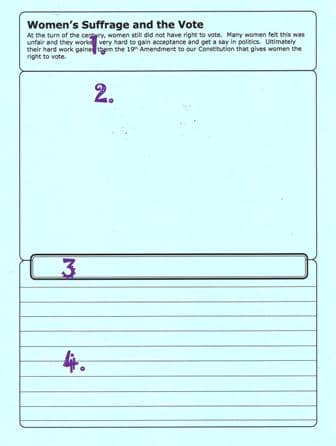
This is the anatomy of a History Scribe notebooking page:

  1. Heading — including a title and a short introductory blurb
  2. Top half – space for drawing, affixing images
  3. Another section for a second heading or caption to the image.
  4. Bottom half, lined for writing 9 lines

Biography pages are a bit different. Each has the person’s name for a heading at the top. The bottom half is lined for writing. The top half has empty space for creative expression plus an oval area and a small box called Fact File with some basic data to fill in.

If you have a highschooler, be sure to consider the History Scholar pages which have smaller lines and more detailed areas to fill in. You can see samples here.

Each set comes with some blank pages without any text at all. These are great for topics that aren’t included in the set.

So what if your child doesn’t like drawing? Actually, you can still use the blank space for affixing maps or images printed from other sources.

You may be wondering why you would want to buy a basically blank notebooking set. Three good reasons:

  1. If you plan your own unit studies, you may find the history scribe notebooking sets helpful for identifying key topics.
  2. Independent work. The top blurb gives enough introductory information for a student to get started on his own research and complete the notebooking page.
  3. If you use project based learning, you could give a student the table of contents and ask for a set number of pages to be completed as part of a unit of study. The student could choose his own preferred topics from the available pages.

Tips for using
Print the table of contents page for each set you buy. Keep that page with your planning notes so that you don’t forget what you have available.
Inject some variety.  Print notebooking pages on colored paper or print 2 per page or 4 per page for making themed minibooks.

Examples of History Scribe pages in action:

Where can you buy History Scribe notebooking pages? I buy them from Currclick where I can immediately download the files and begin printing them out. (There are frequent 50% to 75% off sales.)

If you prefer a CD instead of a PDF instant download, visit the Westvon Publishing homepage or History Scribe.

Mar 032010
 

I’m one of those homeschool moms who can never use a curriculum exactly as it is planned. I regularly tweak, skip, and add. So I admit that I’ve not used Considering God’s Creation as it is designed, but I’ve loved having it on my shelf as a resource for supplementing science and nature studies.

Considering God’s Creation is written for 2nd through 6th grades and is flexible enough for teaching a group of children in various grades. Perfect for a Charlotte Mason styled homeschooler who wants no formal science before 7th grade, this program is very gentle and provides a brief introduction to many areas of science: creation, the universe, weather, rocks, plants, animals, ecology, and human body.

The authors recommend using the 36 lessons over 2-3 years, making this $30 curriculum an incredible value. (You can buy Considering God’s Creation at Rainbow Resource.)

Considering God’s Creation is a set of three resources – a student book, a teacher’s manual, and an audio CD.

The Student Book

The student book has almost 200 perforated pages that can be reproduced within a family. These make up the notebooking component of Considering God’s Creation. Some are strict pages with coloring or matching, but many are cut and paste paper activities or minibooks.

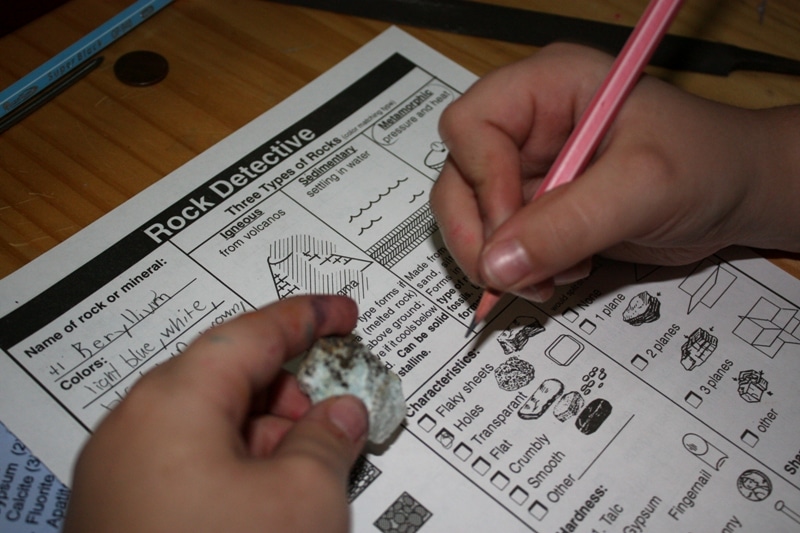
One of my favorite parts of the student book are the detective pages. These are one page worksheets that can be filled in with details; there are boxes to tick and places to draw diagrams.


Detective Pages offer a concrete framework for careful observation and documentation, so they are great for science notebooks or for nature journals. The student book wisely includes duplicates of the detective pages because you will want to use them many times in your scientific observations.

Working on Rock Detective

Detective Page Topics

  • Solar system
  • Scientist (biography)
  • Rock
  • Cloud
  • Speed
  • Flower
  • Mold
  • Tree
  • Insect
  • Animal

Twelve crossword puzzles serve as review and can be used as tests for older children.

The Teacher’s Manual

Considering God’s Creation is a very “open and go” curriculum thanks to the teacher’s manual; any needed preparation is clearly outlined at the beginning of the teacher notes. Each lesson includes Bible references to connect the science to God’s word. There are suggested experiments or activities, a fully scripted lesson (with answers to all the questions), a notebooking activity taken from the student book, evolution stumpers, and resources for further study.

The Audio CD

The audio CD has songs to help you learn the science facts. The lyrics are included in both the student and teacher’s books.

My Own Evaluation

The notebooking aspect of the program is easy to adapt to either science notebooking, nature journaling, or even lapbooking. As a downside, some of the printable papercrafts and minibooks are tiny, with lots of information crammed on very small pieces of paper. You may want to enlarge some of the reproducibles or adapt their use. For example, the minute flaps that are to be glued together could be more easily stapled.

eyes minibook eyes shutterfold inside

Another option that we used was to print the diagrams and illustrations and affix them onto blank minibooks we’d already created. (You can see an example of this method with the shutterfold about eyes pictured above.)

The style is a bit coarse; Considering God’s Creation is not as visually polished as an Evan Moor or a Scholastic book. But the Christian emphasis in the lessons and the comprehensive nature of the book make up for it.

Personally, I find the songs in the program very annoying, so the CD stayed safely in its envelope in the back of my teacher’s manual.

Pros

  1. Multi-age
  2. Christian
  3. Inexpensive
  4. Reproducible pages
  5. Easily adaptable for notebooking, journaling, or lapbooking

Overall

I think that every homeschool with elementary aged children should have this resource. If you’re a Charlotte Mason styled homeschooler, you’ll find Considering God’s Creation a perfect fit for a gentle science study for elementary years and/or as a help for nature studies.

Feb 032010
 

Winter Promise (WP) is a provider of complete curriculum packages (excepting math and often science, depending on the program). Their philosophy is primarily Charlotte Mason with an emphasis on living books, narration, timelines, and historical fiction read alouds. One main difference from other similar curriculum providers is the addition of hands-on projects, paper crafts and notebooking pages.

totem pole craft beside mapAmerican Story 1 (AS1) is the first part of WP’s two year American history plan. It is designed for grades 1-3 and covers life in America from Pre-Columbian times to Westward Expansion. The package is expensive ($379) because of the quantity of books included. The plus side is that most of these books are ones you will want to keep as you build your home library.

sprite with maskWe used this curriculum for my daughter’s third grade, and it overlapped into fourth grade. I never regretted my purchase of AS1. It was a perfect fit for my crafty, history loving daughter.  Two time periods that especially stand out in my memory are the American Revolution and the Lewis and Clark Expedition. There is also a wonderful emphasis on Native American peoples that cycles throughout the entire year.

You will like WP AS1 if

  • You want a literature based history curriculum.
  • You want to move through all of American history in 2 years.
  • You want hands-on activities and papercrafts integrated into the program and already planned out for you.
  • You enjoy using a timeline.
  • You don’t need tests, comprehension questions, or vocabulary lists.
  • You like a well organized, open and go schedule.
  • You enjoy the support of an online forum where you can interact with other curriculum users.

The guidebook is your schedule that lays out the reading assignments in a weekly format. It offers a plethora of choices, usually including several hands-on activities and a website or two. The expectation is that the mom will selectively choose which ones to try. No one is expected to do it all. We did a lot of it, but never all of it.

plains indians travoisI love how the activities are already planned out, often in the form of reproducible paper crafts. All I have to do is photocopy and my daughter is ready to cut and create. Other projects require more preparation or supplies, but none are terribly complicated. Directions are found either in a book that is part of the package or in the guidebook. slave trade 3D map2The crafts are woven into the program in a very skillful way, matching the activities with the curriculum content. My daughter made dioramas, a model travois, salt dough pendants, an earthen Hogan model, and 3D paper maps. She always looked forward to the papercrafts and projects, and I felt that they added a lot of enjoyment and excitement to the program. Best of all, I didn’t have to hunt down ideas as I had done with other curricula.

Generally each week has one to two notebooking pages assigned, always recapping something you’re studying in the lessons.

The books are wonderful. There is a delightful combination of picture books, non-fiction books, coloring books, and biographies to teach history. The read alouds are relevant historical fiction which generally match the time period you’re studying. We loved every one of the books. There was not even one dud in our estimation.

WP guidebooks do not include specific notes for the books. There are no comprehension questions, no vocabulary lists, and no tests. The guidebook is basically a schedule with suggested activities.

Navaho Notebook page (Winter Promise)I found the notebooking pages very disappointing. Although the topics chosen each week were good and the frequency seemed just right, the pages themselves are too text heavy. Generally the pages include a black and white graphic and text. There is nothing to do, write, or draw. We sometimes used these pages by reading them and highlighting key parts. Or we cut out the graphic and wrote our own text. Basically, the WP AS1 pages are not true notebooking pages, so we often resorted to creating our own. If you like the notebooking option, you may want to look for pages from another resource to complement AS1.

notebook timelineAS1 is designed to go along with a timeline, and the suggested figures are listed in the guidebook. You can use your own timeline or buy the WP notebook timeline cardstock pages. I love the format of WP’s timeline because you can put notebooking pages among the history timeline in the correct places. The pages are heavy duty cardstock, already hole punched and ready for a notebook (not included). They are actually quite pretty with fancy script headings and a list of some key events on each page. A faint map background gives the page a bit of visual interest but doesn’t distract from the timeline figures. You can use your own timeline figures, buy a package from WP, or use the Homeschool in the Woods packs.

The WP owners and guidebook writers are Christians, but AS1 is not overtly Christian. A secular homeschooler could easily use WP by simply omitting the Bible portion of two titles. I found the Bible portion too shallow, and we chose to substitute with something meatier.

If you’re interested in WP but the high price is a barrier, consider buying used.  Homeschool Classifieds and Vegsource often list WP packages (often complete or nearly complete) at reduced prices. Be patient, plan ahead, and check the ads daily.

If you’ve used WP American Story 1, please share your own pros and cons here. Or if you’re searching for information, please feel free to ask any questions that you still have.

Jan 062010
 

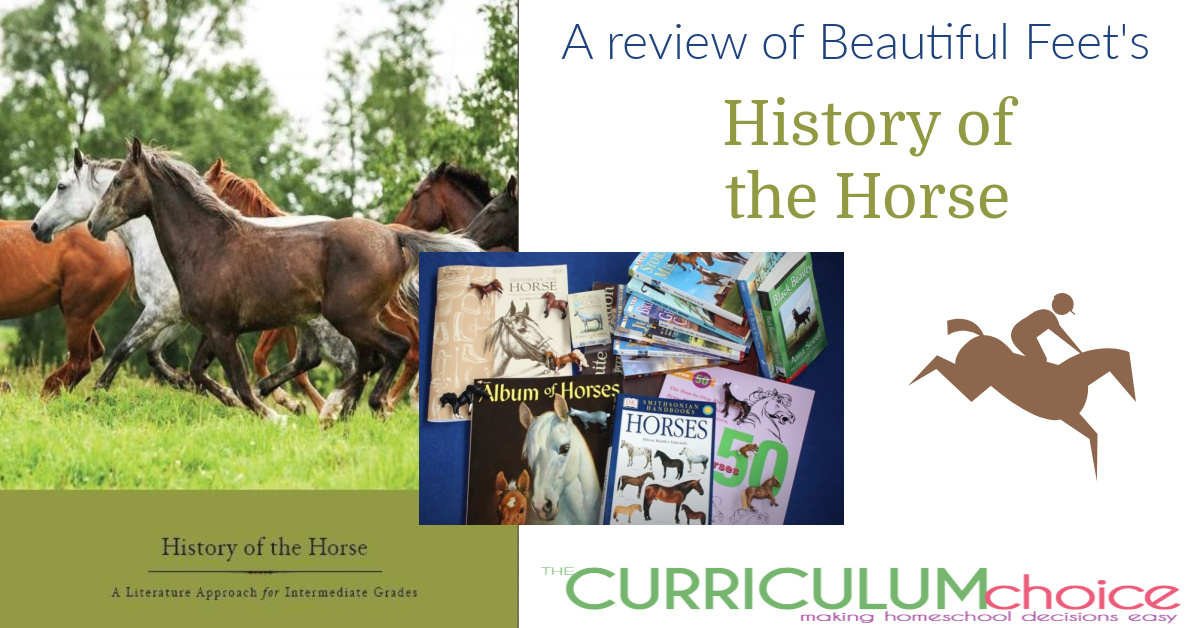
The History of Classical Music is published by Beautiful Feet Books, a long-respected homeschool curriculum provider.

The 75 lessons in this curriculum move through classical music starting with Corelli in the Baroque Period and going all the way to Stravinsky in the Modern Era. Here is a list of the many composers studied:

    violoncello

  • Corelli
  • Vivaldi
  • Bach
  • Handel
  • Haydn
  • Mozart
  • Beethoven
  • Schubert
  • Berlioz
  • Mendelssohn
  • Chopin
  • Schumann
  • Grieg
  • Tchaikovsky
  • Wagner
  • Verdi
  • Brahms
  • Dvorak
  • Strauss
  • Mahler
  • Foster
  • Sousa
  • Debussy
  • Stravinsky

A study of the instruments and structure of the orchestra is also interspersed throughout the curriculum.

Features of this curriculum:

Included in the set are a composers card game, five living books, 18 Audio CDs, 2 coloring books, a timeline, and a schedule/teacher’s guide.

Don’t be fooled by the term “coloring book.” They are full of text and information, complemented by black and white drawings.

The VOX Music Masters audio CDs are narratives of composer’s lives sprinkled with relevant musical selections throughout. A single narrator tells the story. There is no dramatic dialogue or sound effects. These are more straightforward than say a Jim Weiss or Your Story Hour audio. That is, they are not as entertaining in a humorous or exciting way. But they are well made and full of facts about the composers.  We do enjoy them; my daughter has never complained that they are boring. For younger students, you may want to use the Classical Kids CDs instead.

A timeline with beautiful images is part of the complete package. Besides the line drawings, there are even  two strips of cardstock for making the actual timeline. (Or the figures could be but onto your own pre-existing timeline.)
The composers card game is basically a matching game like Go Fish with composers on the cards. It’s a fun way to reinforce the names and works of the music masters you study.

About the Guide

In the guide, all reading assignments are scheduled clearly, lesson by lesson so that you could hand the guide over to your middle schooler (or high schooler) and let him do the study basically on his own.

Notebooking suggestions and tasks are included in the lessons. These are varied and open-ended. Examples include mapping, sketching diagrams and labeling them, writing definitions, taking notes on a certain historical topic, coloring and pasting in an image from the coloring book. (There are no printable notebooking pages, just tasks to complete in your blank notebook.)

Occasionally websites are listed for additional study. And there are short research projects integrated into the curriculum.

Most lessons include a culminating or key question that is answered in the reading assignments. You can choose how to handle it, either discussing it orally with your child or having him write the answer in his notebook.

Materials needed in addition to the set:

  • An atlas
  • A composition book (or other format for notebooking)

How to use History of Classical Music

BF History of Classical Music is truly a history of music and not of history in general. Thus I consider it insufficient for a year’s history curriculum. Instead I suggest BF History of Classical Music could be used in a Charlotte Mason homeschool in two ways:

1.  As an in-depth unit study covering the span of a few months.

BF History of Classical Music  has only 75 lessons. So if you completed two lessons each day (very doable if this is your base curriculum) you could finish it in less than forty school days (9 weeks on a five day school week; 10 weeks with school four days a week). Because of the heavy emphasis on reading and writing, BF History of Classical Music would make a good language arts curriculum.

2.  As a guide for composer studies.

The BF History of Classical Music could supply almost all you need for several years of composer study if you spent a term on each composer in the materials. Instead of doing two lessons each week as the publisher suggests, you could stretch out all the Bach assignments, for example, over the course of a 6-12 week term. By adding daily music listening to the routine, you would have a very rich composer study.

Although the curriculum states it is for 5th – 8th graders, I see no reason why high schoolers couldn’t benefit from these lessons and living books. Fifth and sixth graders may need to have some of the more challenging reading assignments read aloud to them.

Dec 092009
 

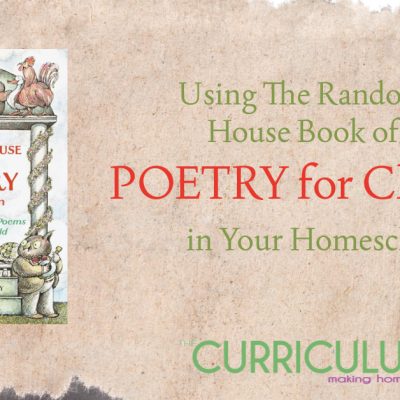
poetry bookThe Random House Book of Poetry for Children: A Treasury of 572 Poems for Today’s Child
Selected by Jack Prelutsky
Illustrated by Arnold Lobel

This large, hardback volume is a wonderful investment in your language arts curriculum and in your general reading library. With 572 poems, this single book could last you three years if you read one poem each day. In fact, that is the approach we’ve taken with this book, savoring one poem each day in a Charlotte Mason style. We’ve ended up using this volume for third, fourth, and fifth grade poetry study. And we’re still not tired of it; my daughter consistently looks forward to poetry time.

I really like The Random House Book of Poetry for Children because of that last phrase, “for children.” These poems were especially chosen with children in mind. They are funny, gentle, spooky, silly, and happy. The poems are arranged in chapters according to loosely organized themes. Here are a few examples:

poem illustration

  • Nature Is…
  • The Four Seasons
  • Dogs and Cats and Bears and Bats
  • The Ways of Living Things
  • Home! You’re Where It’s Warm Inside
  • I’m Hungry
  • Some People I Know
  • Nonsense! Nonsense!

You can see the topics are wonderfully appealing to children – foods, children, animals, unique personalities, and nature.

One of my main considerations in choosing a volume of poetry was that it be engaging. I wanted my daughter’s earliest introduction to poetry to be positive so that she would always have an appreciation for verse instead of a fear of it. Other poetry collections I looked at seemed dry and too mature for young children, but The Random House Book of Poetry for Children is suitable for the earliest of students.  You could use this from Kindergarten up to fifth grade. Most of the poems are short and nonthreatening even to poetry haters.

Jack Prelutsky understands what children like to read. He has the honor of being named the first Children’s Poet Laureate by the Poetry Foundation in 2006.  In The Random House Book of Poetry for Children, he has chosen some outstanding poems for young readers. Of course, there are many of his own poems in the volume, but there is also a wide assortment of styles and authors ranging from classic to modern. Besides the poems themselves, the illustrations by Arnold Lobel, such as the one above, are delightful! (Remember Owl at Home and Frog and Toad? Those are illustrated by Arnold Lobel.)

poetry notebooking ClickbeetleThis is how we use The Random House Book of Poetry for Children. Although we occasionally vary our pattern, usually I read the poem outloud and my daughter narrates it back orally. Once a week she copies a poem onto a notebooking page. It’s a very simple and enjoyable way to incorporate poetry into your homeschool.

We also used The Random House Book of Poetry for Children as the basis for a more in-depth poetry study which is available at Homeschool Share. It includes many figures of speech such as personification, imagery, and onomatopoeia.

Next year when my daughter moves to sixth grade, I will switch to a slightly more mature poetry collection. But I feel sure that The Random House Book of Poetry for Children will continue to be a well-loved volume on our shelf.

Nov 252009
 

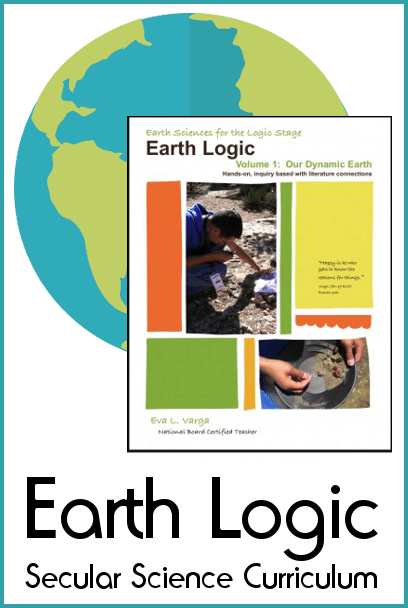
Our Dynamic Earth CurriculumFinding a good science curriculum for middle schoolers can be a challenge, and Makita has created another option for homeschoolers. Makita is a former public school science teacher, and has quite a resume, so she knows how to write effective lessons with creative experiments. Her Science Logic curriculum is a collection of secular lessons and activities for middle school students. There are three themes — Life Logic, Earth Logic, and Physics Logic. Eva gave me a free ebook copy of Our Dynamic Earth (part of the Earth Logic theme) to review.

Our Dynamic Earth is a ten week course, with two lessons for each week. It appears to be a very flexible program; there is no daily schedule or checklist. Instead, there are lesson plans and hands-on activities to demonstrate the science being learned. Each lesson begins with objectives, a list of needed materials, and an overview. Then Makita jumps right in with the science. You’ll find lots of scientific vocabulary and diagrams in the lessons. Then there is some type of activity. These vary greatly from complex backyard projects to kitchen table experiments to paper models. Some of the activities require specialized items, and Eva gives suggestions for where to find them.

Most lessons have additional websites to explore for further information. Some lessons have a list of good living books to read and extension activities. Other lessons have diagrams to label, a webquest, or flow charts. Each lesson is quite different from the other. Eva has done a good job of tailoring the activities to the information rather than following an arbitrary pattern.

As a secular curriculum, Our Dynamic Earth is based on evolutionary science.  There are two entire lessons devoted to this teaching – “Earth’s Beginnings – Timeline of the Earth” and “The Fossil Record.”  And of course, the evolutionary terminology and assumptions are evident throughout the curriculum.

Who will like this curriculum:

  1. Secular homeschoolers
  2. Hands-on homeschoolers who crave complex experiments and demonstrations
  3. People with a backyard (at least two projects require a large open space outdoors) and access to specialized materials (ammonium dichromate, ammonium nitrate, zinc dust, sand samples, rock samples, for example)
  4. People who enjoy variety
  5. People who want the facts laid out quickly and clearly so they can quickly move on to the fun experiments and their own explorations (versus living books or textbook approaches)

Each course comes in an ebook format for $14 and two different print formats for $17 and $20. Visit the Science Logic site for more details. I’m sure Makita will be happy to answer any questions you have.

Nov 112009
 

what's the big deal Why God Cares about SexFast Facts

  • Complete Title –What’s the Big Deal? Why God Cares About Sex, Book 3 in the God’s Design for Sex series
  • Authors –Stan and Brenna Jones
  • Publisher –Navpress

Although I was really pleased with my purchase of It’s So Amazing, since it is a secular book, it didn’t give the whole picture of what I wanted to teach my daughter about human sexuality.  (Read my review of It’s So Amazing here.) To supplement it with a Christian perspective, I also bought Almost 12 by Kenneth N. Taylor and What’s the Big Deal? By Stan and Brenna Jones.

I felt that Almost 12 was dry and made sexuality seem almost boring!  It was too scientific and too preachy for my taste. It felt as if an old maid, retired biology teacher was teaching a Sunday school class to a group of middle schoolers.  There was no sense of wonder or feeling.

But I was delighted to find What’s the Big Deal much more contemporary and far less technical. Instead of handing it over to my daughter, I read it outloud to her so we could discuss each chapter.

The book is laid out like a dialogue among a dad, a mom, and two children – Sam and Amy. The kids ask really good questions, and the parents answer them, thoroughly and with Biblical truth.
Here are a few questions from the book:

  • Why do people talk and joke so much about sex?
  • Do people have sex when they aren’t trying to have a baby?
  • What if all your friends are doing it?
  • How come girls start liking boys so much when they are teenagers?
  • What do they mean when they call a person gay?
  • Is HIV the only disease you can get from sex?
  • If God will forgive us, does it really matter if we break His rules?

See? There are some deep topics. When you read this book, you’ll be speaking some sentences that really need to be said but are rather hard to get express. Having the book helps you verbalize those realities! The entire book is written from a Christian worldview, so it constantly refers to God’s love and God’s commands.

Another beautiful thing in this book is the emphasis on clear communication among family members. I love how the whole structure of the book is parents talking with their children. We all want our children to feel free to discuss sex with us, but to be honest, it can be very uncomfortable for them and for us. This book really helped me say things that needed to be said but under the “cover” of a book. And once the things were out in the open, it didn’t feel so awkward to discuss them anymore. So really this book is as much for parents as it is for their children. That theme of family dialogue is reinforced with the black and white photographs in the book featuring a family talking at the dining room table or on the sofa.

As I did with It’s So Amazing, I didn’t omit anything in reading this, but I did stop and discuss some areas I felt the authors didn’t address adequately.  Because of the nature of the topic, you don’t want to have to edit on the fly. Be sure to pre-read the book and identify any trouble spots. Decide how you’ll handle them before reading. This book is designed for ages 8-11, but it’s almost impossible to assign an age range to this kind of topic. You just have to see for yourself. I was thrilled that it was just right for my ten year old daughter.

There are no illustrations or diagrams in What’s the Big Deal. It’s completely text. That’s why I feel that It’s So Amazing and  What’s the Big Deal are perfect complements to each other. One is visual and funny. The other is text based and Biblical.

Oct 282009
 

It's so amazing!Fast Facts

It was time! The questions were coming, and I was totally unprepared. I had not even one book that explained the “facts of life.” Does every parent think that this time comes far sooner than expected? I sure did!

I did my best to research online and made some book selections from Amazon. A couple of weeks later, I was armed with some top notch books to answer my daughter’s questions about human reproduction. I’ll be reviewing two of the best ones here at The Curriculum Choice.

I am a fan of It’s So Amazing! I’m so glad I bought it despite some of the negative reviews at Amazon. The comic book format is lighthearted and inviting and perfect for my highly visual learner. There’s no scary feeling; instead the emphasis is on the wonder of relationships, conception, and new life.  Sexuality is approached from the very age appropriate question, “Where do babies come from?”

Colorful drawings illustrate the book and provide factual diagrams of body parts with quite a dose of humor. For example, the sperm talk as they rush towards the waiting egg. I really like the lively tone. It helped to relieve some of the tension inherent in this delicate topic.

Harris wrote this book to reach children ages seven and up.  I handed this to my ten year old daughter to read on her own. At age seven, she would not have been ready for this book, but now at ten, it’s just right. Of course, each family situation is different, so closely preview the book before handing it over to your child. You may find it’s appropriate for your eight year old, or you may feel your ten year old is not yet ready for it. I would place it in the tween category, for children who are beginning to go through puberty and are starting to ask more questions.

bird and beeThe narrators are two mascots – a bird who is fascinated by the topic and a bee who is uncomfortably embarrassed about it. I really appreciate this honest portrayal of how a discussion of sex can make people feel. It can be uncomfortable! And laughing at the bee is a way to laugh at ourselves.

The book has a secular, “value free” perspective.  That is, there are no judgments made about a behavior being right or wrong. Things are simply stated as “some people do this; some people don’t.” The value of this kind of book is that there is plenty of room for the parent to offer the family’s value system, sharing truth that isn’t discussed in the book. I didn’t feel anything in the book was offensive to my own Christian faith, so there was nothing I edited from the book. But I did add a lot as far as Biblical perspective.  (In two weeks, I’ll review another book that I paired with It’s So Amazing, specifically to add a Christian worldview to our discussion.)

This lively book is written with a sense of humor but also with correct vocabulary. More colloquial terms (pee or poop, for example) are sometimes used to clarify meanings, but there is no profanity or vulgar talk. If you think human reproduction is not something to laugh about, you won’t enjoy this book. You’ll find it silly or possibly even irreverent. But I enjoyed the upbeat tone and colorful, accurate illustrations. I felt it gives just enough detail without being overwhelming for tweens. Be sure to click on some of the links in the Fast Facts section to see some page views.

Possible trouble spots in this book –

  1. What’s Love section includes a simple explanation of heterosexual and homosexual (“straight,”  “gay,” and “lesbian” are also used). These two lifestyles are stated objectively without condoning or condemning.
  2. Talking About It is a section on HIV and AIDS.
  3. Keeping Safe discusses sexual abuse– “okay touches and not okay touches” and includes a paragraph on masturbation.
Oct 142009
 
sprite reading OOH

Sprite reading the OOH

The Occupational Outlook Handbook (OOH) is a publication of the US Bureau of Labor Statistics.  Are you wondering how in the world a boring statistical book made it onto a homeschool review site? Keep reading.

The OOH is not boring, and it’s very helpful for middle school and high school homeschool students and their parents. My daughter is only ten but I’ve already bought a copy (from Amazon for $10) for our home library. Actually, you can access the OOH without spending a dime. For younger children, visit this version.

The primary use of the OOH is to guide students as they consider future career paths. It’s called an outlook because the BLS projects which jobs will be in greater or lesser demand in the next ten years.  But besides looking at employment growth, the OOH is an incomparable reference on careers.

What other volume could answer all of these questions:

  • How much education do I need to be a court reporter?
  • Where do most psychologists work?
  • Does a loan officer need a license or certificate?
  • What job opportunities are available to chemists?
  • Can you learn to be a computer software engineer solely through on the job training?
  • Where can I write for more information about being an aircraft mechanic?
  • What exactly does a mathematician do?
  • Will the next ten years see an increase in the need for building inspectors?
  • How many hours a week does a power plant operator typically work?
  • What’s the average salary of a graphic designer?

researching RN job

The OOH can answer these types of questions because it’s amazingly comprehensive. And thankfully, the 890 page book has a detailed index to make research easier.

So the burning question is really how can the OOH be used in homeschool?

1.  A Reference About Jobs

OOHTeens and tweens will enjoy browsing the OOH to learn about potential job fields. I promise you that your child will find jobs he didn’t even know existed!  Jobs are organized by type, and each job features a list of related occupations. This is really helpful for the child who is interested in a general field but knows little about the specific jobs within that field. There’s more to education than being a school teacher and more to medicine that being a doctor or nurse. The OOH will show all the facets of a field.

Some of your child’s more romantic notions of a particular job may be dashed as she reads about the long years of education or long working hours. But that realism is needed when preparing for a future career.

2.  Research Projects

researching and taking notesBecause of the depth of information available, the OOH can serve as the basis of a challenging research project. A student will have to read carefully to identify key facts and then summarize them in her own words. (Or if your child is like mine, she simply enjoys browsing the OOH and making notes just for fun!)

Look at this lesson for a printable notetaking page (DOC) especially for the OOH.

3.  A Guide for Mom

If your child is leaning towards a specific field, you can use the OOH to learn which academic subjects are emphasized in training for that career. Then  you can design your high school curriculum accordingly.

4.  Academic Tie-ins

To expose your child to various careers, consult the OOH as it is relevant.
Here are some examples:

  • You are studying a famous Greek mathematician. Look up what a modern mathematician does.
  • You are studying chemistry. Research a chemist’s job.
  • You just learned about the respiratory system. Find out the differences between a respiratory therapist and a respiratory nurse.
  • You are working on American geography. Read what a cartographer does.
Sep 302009
 

If you’re looking for a Bible study that your 8-12 year old can do alone, the Discover 4 Yourself Inductive Bible Studies for Kids are  a good choice. Written by Kay Arthur of Precepts Ministries, these studies are solid introductions to forming a lifelong Bible study habit.

discover 4 yourself bible studies
There are many titles in the series covering the gamut of Old Testament and New Testament books, people, and big ideas. My daughter has already completed the God, What’s Your Name? and the Joseph, God’s Superhero titles. She enjoys writing her answers and thoughts in the consumable workbooks.

Because each book has from 25-30 lessons, it generally it is a five to six week course. And each day’s lesson can be completed within 15 minutes. Since the books are not terribly expensive and they cover only a short period of time, they are easy to try out. If you like the format, then you can buy more titles. Although you can see some chronological progression, you don’t have to do them in any particular order. They are each a stand-alone Bible study.

  • How to Study Your Bible for Kids
  • God, What’s Your Name?
  • Genesis 01-02: God’s Amazing Creation
  • Genesis 03-10: Digging up the Past
  • Genesis 11-25: Abraham God’s Brave Explorer
  • Genesis 26-36: Extreme Adventures With God
  • Genesis 37-50: Joseph, God’s Superhero
  • Wrong Way Jonah
  • Daniel 01-06: You’re a Brave Man, Daniel!
  • Daniel 07-12: Fast-Forward to the Future
  • John 01-10: Jesus in the Spotlight
  • John 10-16: Jesus: Awesome Power
  • John 17-21: Jesus: To Eternity and Beyond!
  • James: Boy, Have I Got Problems
  • Revelation 1-7: Bible Prophecy for Kids
  • Revelation 8-22: A Sneak Peek into the Future

Each Bible study has a narrative theme that ties the book together. For example, in the Joseph, God’s Superhero study, the theme was creating a comic book and having it published in New York City. The theme of God, What’s Your Name ? was a secret agent mission. The daily lesson opens with the narrative and leads into the Bible study. My ten year old daughter finds the theme a bit childish and a distraction from the meat of the Bible study. In fact, she says the themes have too many characters that are hard to remember. Despite that criticism, overall she enjoys these Bible studies. Sometimes she just skips the story part and jumps right to the Bible part.

There are a few black and white line illustrations in the books, some related to the theme and others to the Bible stories. The student is meant to write his answers directly in the book. In fact, one of the things I really like about these studies is how it teaches students to study the Bible by marking up Bible passages. For example, in one lesson Genesis 22 was printed in the Observation Worksheets at the back of the book, and the instructions were to mark key words accordingly:

  • The LORD Will Provide – underline in blue
  • Love (draw a red heart around)
  • Obey (circle in orange)
  • Worship (circle in purple)

Once the passage is marked in this way, it’s easier to see the principles in the text and then answer the fill in the blank questions about the passage. These marking assignments are quite common in the Discovery 4 Yourself Bible studies.

discover 4 yourself bible studies puzzle pageSometimes there are puzzles to work such as crosswords, scrambled words, or ciphers. Other times the assignment is to sketch an illustration. Many of the questions are open ended applications to the student’s life, “When have you felt this way?” or “What does God want you to do?”

Despite their being many Bible passages printed in the book, you will still need a New American Standard or New Inductive Study Bible to complete the studies. We tried with other translations and found it most frustrating. So make sure that you’ve got one of those versions before buying a Discover 4 Yourself Bible study. Besides colored pens or pencils, there’s nothing else you need to complete these studies.