Cindy

The biggest reason Cindy chose to homeschool was because she loves experiencing life with her children and watching them grow inside and out. She's sure that’s why the Charlotte Mason method first caught her attention. It allows her to be creative in scheduling, rigorous in learning, yet opens the door for plenty of close-knit time, opportunities for her children to explore their interests and offers enough free time for them to be children. She implements many of Charlotte Mason's methods with an eclectic twist of things that work for her family! Besides writing on her blog, Our Journey Westward, you can find her NaturExplorers studies and other creative curricula at Shining Dawn Books.

Mar 162012
 

Geometry

Algebra

Measurement

Statistics

What is GAMSology?  A board game developed by a math teacher to help practice math facts for elementary, middle and high school students.

Quite simply, players draw a card and show it to the person on their left.  The player on the left solves the math equation on the card.  If correct (as determined by the person who drew the card and can see the answer), the player moves a given number of spaces on the game board.

2-4 people can play and each game takes about 10-20 minutes to play.

What I like best is that various skill cards can be purchased to go along with the game board.  In other words, you can purchase the addition/subtraction card set when your children are in elementary school, add the multiplication/division set as they get older, then buy the proportion set in middle school, and add the algebra set for high school.

In fact, if you have children working on different levels, you could actually play the game with more than one set in the same game.  Simply make sure each child gets equation cards appropriate to his or her level and the playing field is more evenly  matched!

It’s highly unusual to find games that practice higher level math skills like algebra, making this a huge positive of the game!  My 9th grader and I had a blast trying to beat each other to the end with the algebra set.  She won every time.  Hmmm.

Negatives?  Well, just a couple.  There are a few misspellings on the cards  – for example, “quoien” instead of “quotient”.  Also, our game board did not lay flat.  Neither of these issues made a difference in our game play, but they are worth mentioning.

There are other ways to use the game cards, too.


Pin It
Feb 172012
 

I’m not going to lie.  We’ve struggled with algebra.  It’s the first real struggle we’ve had since this journey of homeschooling began, but a struggle it’s been.  Not so much because my daughter nor I can do it, but because it’s one of those things that’s harder to backtrack with and find the method to the madness when you get stuck.

This year, I’ve made sure we have an arsenal of help awaiting us when necessary.  My daughter CAN tackle algebra successfully, and I CAN be her teacher!  We’re still using Saxon Math as the main curriculum because I’ve grown to dearly love the thoroughness and incremental approach.  But, three new products sit on my shelves: Saxon Teacher, Math Dictionary for Kids, and A+TutorSoft’s Algebra 1 CD Curriculum.

I’ve gotten to know Vinod, the author of the A+TutorSoft curriculum, through various conventions I’ve attended and upon hearing of my struggles with algebra, he was quick to offer me his Algebra 1 Full Curriculum CD in exchange for a review.  So, in this post about algebra, I’d like to highlight the A+TutorSoft weapon in my arsenal.

Consider the joy of having your very own tutor at the ready whenever you or your child gets stumped on an algebra concept.  That’s what you have with A+TutorSoft!  Every algebra topic you can think of is taught clearly by a teacher’s voice while examples are “written” on a computerized chalkboard.  Additionally:

  • Text of the teacher’s lesson is available for re-reading yourself.
  • You can rewind or fast forward the teacher’s lesson.
  • All concepts are introduced in a clear step-by-step fashion.
  • You get to work sample problems within the lesson to make sure you get it.
  • Immediate feedback is given whether answers are right or wrong.
  • You can print off practice pages for extra understanding on the topic.

The CD is very organized, too.  You can easily locate a particular topic and go directly to the specific tutorial(s) you need.  With A+TutorSoft, there’s been no need to pay a pricey real-life tutor!  My daughter is tackling algebra with success this year – and I couldn’t be more relieved!

Because of the multiple choice nature of the computer-based practice problems, I would not feel comfortable using A+TutorSoft as a full curriculum.  It certainly covers all necessary algebra 1 topics, but there wasn’t quite enough written accountability for me to consider using it as our sole text.  Honestly, some people may disagree with me – and that’s okay.  I encourage anyone who has used it to leave their thoughts about whether or not it should be used as a stand-alone.

When I spoke to Vinod about this stand-alone question, he responded:

Our curriculum is designed to be a full curriculum and hopefully the only resource homeschoolers will need. And that is the reason we provide printable worksheets and exams where student is required to show their work. And of course, because they are printable, a parent teacher would need to check student’s work using our “Worksheet Solution Guide” and “Exams Solutions Guide” (the parental manuals) which are also included with this MATH curriculum software.

You have automatically graded interactive quizzes for each lesson which provides instant feedback with step-by-step explanation for each problem if the student answers it incorrectly. And at the same time, if you need additional practice with problem solving, we provide printable worksheets and exams, which can be used in more traditional way. And as I mentioned, there is help (the solutions guide) for every problem on the worksheets and exams.

We explain step-by-step solutions to each worksheet and exam problem. And that’s what makes this such a great MATH curriculum product. Because of this reason and thoroughness of all the material that is covered, I would highly recommend that A+ TutorSoft MATH curriculum be used as a full curriculum. However, if parents want to supplement it, sure you can to that but we don’t believe that is really necessary.

Either way you decide, it’s truly a great resource – professionally done, full of meat and worthwhile!

Pin It
Feb 102012
 

I love art, but have no real training in it.  I believe my children need to learn art techniques, but I can’t afford $60/hour lessons at the local art studio.  What’s a homeschooling mom to do?  Well…I had the blessing of reviewing lessons 1-12 of See the Light Art Class DVD’s and found them to be full of solid instruction at a reasonable price.

Before I even begin telling you about the lessons, you ought to know the film quality is very good.  That means a lot to me considering so many DVD programs I review leave a lot to be desired in quality.  No need to worry with these!

The complete first year program consists of 36 lessons, meant to be taught once per week.  The teacher has an engaging personality, gives clear directions, and models lessons at an appropriate pace – all important aspects allowing my children to stay focused.  And, she teaches lessons incrementally, meaning each new lesson expands on a previously learned skill.

Technique and art vocabulary are key components in the lessons, as well as learning how to effectively use various art media.  Even though the lessons are simple to implement, they are in-depth, making art class a serious (and fun) venture.  Additionally, each lesson is wholeheartedly Christian, tying in Bible verses or mini-devotionals to the art topic at hand.

Students are encouraged to have their own “toolbox” of basic art supplies including #2 pencils, paper, a drawing pencil, charcoal pencils, a black Sharpie marker, colored pencils, a sharpener, a medium to large box of crayons, a large white eraser and a kneaded eraser.   Some lessons will include easily found household supplies, too, like two apples in lesson 3, for example.

Each lesson lasts approximately 15 minutes and it’s assumed your child will put to practice some of the newly learned skills afterward.  I have used the lessons with my 6th and 9th graders, but even my five year old enjoyed taking part most of the time.

You can purchase all 36 DVD lessons in a bundle for $99.  (Yes, that seems high, but it’s an entire year of art instruction.)  You can also purchase DVDs of four lessons each for $14.99 or get an online subscription which “unlocks” four lessons at a time for only $10 per month.

My children aren’t the most artistically gifted kids you’ll ever meet, but the lessons have really improved their skills.  If you’re skeptical, try the first three lessons for free!

Pin It
Jan 252012
 

My five-year-old son received My 1St Science Kit – The Science of Color from his grandma and grandpa for Christmas.  We were both excited but I had no idea it would be “the” source of motivation for school every single day for a week!

What was so motivating?  The goodies my son found in the box.  Hands down. Giant, plastic test tubes, pipettes, little plastic cups, a mixing tray, a (tiny) magnifying glass, color tints and growing crystals made him feel like a real scientist!

The kit includes enough materials for 10 experiments relating to color.  Most experiments allow your child to observe the effects of mixing primary colors, while a few involve water-absorbing crystals.  All the experiments are very elementary, but we’re talking about using them with children who are under 2nd grade, so they should be elementary.  After so many engaging experiments about color mixing, my son has a very good grasp on primary and secondary colors.

Could I ditch the fun test tubes and do most of the experiments with materials found at home?  Yes.  But, I’m telling you, something about the kit turned my son from a mildly-interested-science-experiment-kid into Eli, Super Scientist Extraordinaire!  Plus, the supplies can be used over and over again as long as you have some extra food coloring on hand.

Pin It
Jan 162012
 

As we find ourselves cooped up more often during the winter, we (unfortunately) tend to watch a bit more TV.  I’ve tried to make sure at least some of what we watch is super-productive and the Just the Facts: Understanding Government DVD set fits the bill.

Each of  the three DVDs takes a detailed look at one of the three branches of the United States government system – The Executive Branch, The Legislative Branch and the Judicial Branch.  Running approximately 50 minutes each, I can best describe the format to be much like you might find on the History Channel.  A narrator talks as some photos or footage is shown, while expert interviews pop in to explain more or offer commentary.

The content of the programs is easily understandable for children 5th grade and older, but is quite suitable for adults, too.  Undoubtedly, some children will find the DVDs to be boring simply because they are documentary-like rather than cartoon-like.  However, the information presented is extremely valuable and worthwhile.

Each DVD sets out to give a bit of history about why the Founding Fathers chose to create such a government as ours and how each entity is supposed to uphold the Constitution and protect our rights.  The duties, obligations and limitations of each branch are covered in-depth, as well as such things as where they meet, who helps them in their duties and how individuals are chosen for various positions.  After watching the entire set, my children have a very solid understanding of each branch of government!

As the teacher, I like the extras as much as the programs.  Each DVD offers a Teacher’s Guide and Bonus Material which turn the TV time into way more than just vegging out.

The Teacher’s Guideswhich can be viewed from the menu on your TV or inserted into your computer and printed out as a PDF file – offer:

  • Learning Objectives – the things your child should know and be able to discuss by the end of the program, and can also be used as test questions if you desire.
  • Vocabulary Lists – important terms and definitions.
  • Web Resources -  just a few pertinent websites for further study.
  • Expert Bios – a bit more about the experts who have been interviewed during the programs.

The Bonus Material includes:

  • Another brief, but informative video tied to each DVDs theme.  For instance, the bonus track on the Executive Branch DVD is on the topic of the Presidents of the United States.  A brief biography, some trivia and pictures or photos of each president are covered.
  • An on-screen multiple-choice quiz based on the material from the program.  One question at a time is placed on the screen along with multiple choice answers.  A narrator reads each question and possible answer to your child, then a check mark comes on the screen to show the correct answer.  I wish the check mark allowed for a little more thinking time, but you can easily pause the DVD if you like.

Besides some of the text being a little jiggly on my o-l-d TV, I thought the quality of the DVDs was very professional.  They have been a wonderful help as my children have been part of government classes at co-op this year.

*Through 2/29/12, The Cerebellum Corporation is offering you 30% off any of their Social Studies or Standard Deviant DVDs using the coupon code HOME30 upon checkout!  (The DVDs are already 20% off and your coupon code will take an additional amount off to give you a total of 30% off the regular price.)

Pin It
Dec 122011
 

My husband and I have been thrilled to introduce the Learn Our History DVD’s to our children.  We both have a passion for teaching fundamental truths about the history of the United States in our homeschool.  Believe it or not, much of what we read/hear/watch is either extremely watered-down or downright misleading.  Not so with this series of DVD’s from Learn Our History!

In each of the videos, you will travel back in time with the TimeCycle Academya small group of children who get to the heart of history by actually visiting various historical periods.  Through meeting important historical figures, hearing primary source speeches or conversations, and mingling with the people of the time period, a wonderful (and easily understandable) picture is painted for your own children.

From the Revolutionary War to 9/11 and the War on Terror, many of the United States’ important stories are told through animated, 30 minute (approximately) DVD’s.  All my children – from 5-14 – have enjoyed watching.  While the animation may be a bit immature for the 14 year old, the information gleaned has not been immature at all!  In fact, even I now have a clearer picture of some of the historical events!

Learn Our History currently has 7 videos in the series.  Seven more are in the works for 2012, with a vision for more than 70 in the future.  Co-founder, Mike Huckabee, believes the series teaches historical facts without bias and promotes a strong sense of patriotism in our children.  I agree.

Navigation of the website is a tad difficult and purchasing prices are not clearly marked.  Your first video – in which you receive a physical DVD and online streaming – is only $9.95 + $3.95 shipping.  Once you purchase the first video, you will be offered a new video monthly, via email, for $11.95 + $3.95 shipping.  You will be automatically billed and the video shipped if you don’t respond with a “no thank you” phone call.  While I think the prices are very fair and worth the money, the monthly mailing subscription is not my cup of tea.

(In their FAQ’s, it states that you can call their customer service line to talk about other options for purchasing.  When I decide to purchase more, I’ll be making this phone call.)

Even though I received 3 of these videos for free in exchange for my (honest) review, I DO plan to purchase more!  They have truly been a great addition to our history lessons.


Nov 302011
 

This review is Part 2.  If you haven’t already read my review of Primary Arts of Language: Reading, please do so before continuing with this post.

Primary Arts of Language: Writing by Jill Pike of Excellence in Writing is the companion program to Primary Arts of Language: ReadingWhile the reading program focuses on early phonics and reading skills, the writing program focuses on printing, beginning story writing, copy work and spelling.  Using the two programs combined gives you a complete and thorough language arts curriculum for the K-2nd grade student.

Primary Arts of Language: Writing is divided into three parts.

  • Part 1 introduces your child to printing using correct letter formation and story summaries.  Handwriting is taught in a variety of ways, most importantly through modeling by the parent.  (A DVD-ROM comes with the program which teaches you precisely how to teach your child.)  Letter stories are introduced to your child at the same time they are learning to write the letters to reinforce sounds the letters make.  After handwriting practice, your child gets to listen to simple stories and learn the fundamentals of comprehension through sequencing, and understanding characters, settings, plots and more.
  • Part 2 builds on handwriting fundamentals through copy work and begins spelling lessons using the very popular All About Spelling , Level 1.  (You can read my previous review of All About Spelling here or read Lynn’s review here.)  During copy work times, you will also discuss such things as punctuation and capitals.
  • Part 3 assumes that handwriting is now automatic, spelling is going well and story charting (characters, setting, etc.) is no problem.  If this is the case, your child will move into beginning composition.  These 16 final lessons are meant to ease your child into the basic units of the Institute for Excellence in Writing’s Teaching Writing: Structure and Style methods.  Your child will learn to take notes, summarize from the notes, create a story sequence and write creative stories.

You can certainly choose to move more slowly than the material suggests!  I am using Primary Arts of Language: Reading with my K4 at a slow pace.  My little guy is only ready for some of the handwriting lessons, so that’s all I plan to complete this year.  I’ll probably wait to use the remaining parts of the book until first grade, because I know he won’t be ready for copy work and composition until at least then.

Besides the daily lesson plans, the teacher’s guide also includes a scope and sequence of writing skills covered, several printable posters, charts and templates, and additional tips for teaching writing.  You also receive a DVD-ROM with video instruction on how to teach the lessons, audio seminars from writing teachers and the all-important printable student pages.

Just as the reading program, Primary Arts of Language: Writing is a fantastic program!  The only warning I might give…the reading and writing programs are meant to be used together.  My feeling is that the reading program can be started much earlier than the writing program.  I would be very weary about starting the writing program with a child younger than 1st grade, while the reading program can easily be started as early as K4.

-Cindy West is an eclectically Charlotte Mason mom of a high schooler, middle schooler and K4.  You can find her blogging at Our Journey Westward and find her NaturExplorers studies and other creative curricula at Shining Dawn Books.

Nov 162011
 

Have you ever wished for a reading comprehension program that encourages higher order thinking skills?  Questions that require deep thinking, inference and opinion?  Questions based on “living” literature selections rather than dry paragraphs?  All of this in assignments that can be completed in a lesson or two?  Not to mention, reading comprehension available for children as old as 9th grade?

I’ve had the pleasure of reviewing levels 4 and 5 of the Jacob’s Ladder Reading Comprehension Program, which covers all the bases above!

Each of the books consists of 20 lessons divided into three chapters.

  • Chapter 1 focuses on Short Stories – like The Celebrated Jumping Frog of Calaveras County, The Gift of the Magi and The Tell-Tale Heart.
  • Chapter 2 focuses on Poetry – like Stopping by Woods on a Snowy Evening, Ulysses, and Not They Who Soar.
  • Chapter 3 focuses on Biographies – like Emily Dickinson, Marie Curie and Harriet Tubman.

For each lesson, your child must read the 1-7 page literature selection then work “up the ladder” to complete questions or activities. The reason the program is titled “Jacob’s Ladder” is because nine different activities are suggested as follow-up to the reading.  The activities are written on a pictoral ladder.  The lower the question or activity is on the ladder, the lower the thinking skill; the higher the question or activity is on the ladder, the higher the thinking skill.  You may choose to assign as few or as many of the activities as you like.

The thinking skills are divided into six types of skill content.

  • Ladder A focuses on prediction skills.  These activities will include sequencing, cause and effect, and consequences and implications.
  • Ladder B focuses on deductive reasoning skills.  Activities include recalling details, classification and generalization.
  • Ladder C focuses on literary analysis skills.  Activities include identifying literary elements, making inferences and determining themes or central ideas.
  • Ladder D focuses on the skill of creating new materials based on information in the reading.  Activities include paraphrasing, summarizing and creating own materials.
  • Ladder E focuses on the skill of emotional development.  Activities include understanding emotion, expressing emotion and using emotion.
  • Ladder F focuses on the skill of metacognition.  Activities include planning and goal setting, monitoring and assessing, and reflecting.

The nine activities offered for each reading lesson include a mixture of the various skills.  As I mentioned before, you can choose to assign as few or as many of the activities as you like.  You may also decide to allow your child to choose one or more of the activities herself.  Depending on how many activities you require, the lessons can last as long as 30-45 minutes one day or 30-45 minutes/day for a week or more. Several of the lesson ideas lend themselves to co-operative learning, too, if you’d like to allow your children to work together occasionally.

The books are published by Prufrock Press, a publisher of materials for gifted children.  While these books are certainly appropriate for gifted children, they will serve homeschoolers well, too!  Anyone who has a good reader that needs to take comprehension to the next level will love Jacob’s Ladder.  While the books are on the expensive side at $39.95 each, they provide wonderfully in-depth reading lessons that are sure grow to your child’s higher order thinking skills.

-Written by Cindy, an eclectically Charlotte Mason mom of 3 living in Central KY.  You can find her blogging at Our Journey Westward and find her NaturExplorers studies and other creative homeschooling helps at Shining Dawn Books.

-Cindy received the Jacob’s Ladder books as compensation for her honest review. 

Nov 042011
 

Grocery Cart Math by Jaye Hansen has been a fun addition to my son’s math schedule.  Many of you know that our family typically spends only three days per week in the math textbook.  The other two days of math are spent doing “other things” like games, logic, problem solving, math projects and more.  (You can read more about how to incorporate the “other things” in my book, Loving Living Math.)

Grocery Cart Math is one of my new tools for “other things” to add to math time.  The best part is…we don’t even have to be at home to complete math on these days because the math is completed at the grocery! How many people can say they tackled real math and grocery shopping at the same time?  I can – and you can, too!

Written for the 3rd-6th grader, the 32 lessons in Grocery Cart Math are reproducible worksheets that your child takes into the store (along with a clipboard, pencil and sometimes a calculator) to complete.  Basic math and real-life skills like nutritional analysis, counting money, comparing prices, figuring sales tax, measurement and more are covered. Sometimes, additional activities will be completed at home, like creating a comparison graph, for instance.  Discussion questions for mom or dad continue to bring home the practical side of the lessons with questions like, “Why do stores have sales?”

Real-life math application is of utmost importance and this book does an excellent job tying the two together!  As side notes:  I always take some time before entering the store to make sure my son understands his task.  I also make sure he stays within my sight at all times.  Additionally, our trip to the grocery can sometimes be extended a bit from the normal get-in-and-go mode, so I make sure to plan extra shopping time.  I also try to leave the 4 year old at home if at all possible!  (wink)

-Cindy West is an eclectically Charlotte Mason mom of 3 from Central KY.  You can find her blogging at Our Journey Westward and find her NaturExplorers curriculum at Shining Dawn Books.

(Cindy received a review copy of Grocery Cart Math for free upon her request.  As always, the review reflects only her honest opinions.)

Oct 242011
 

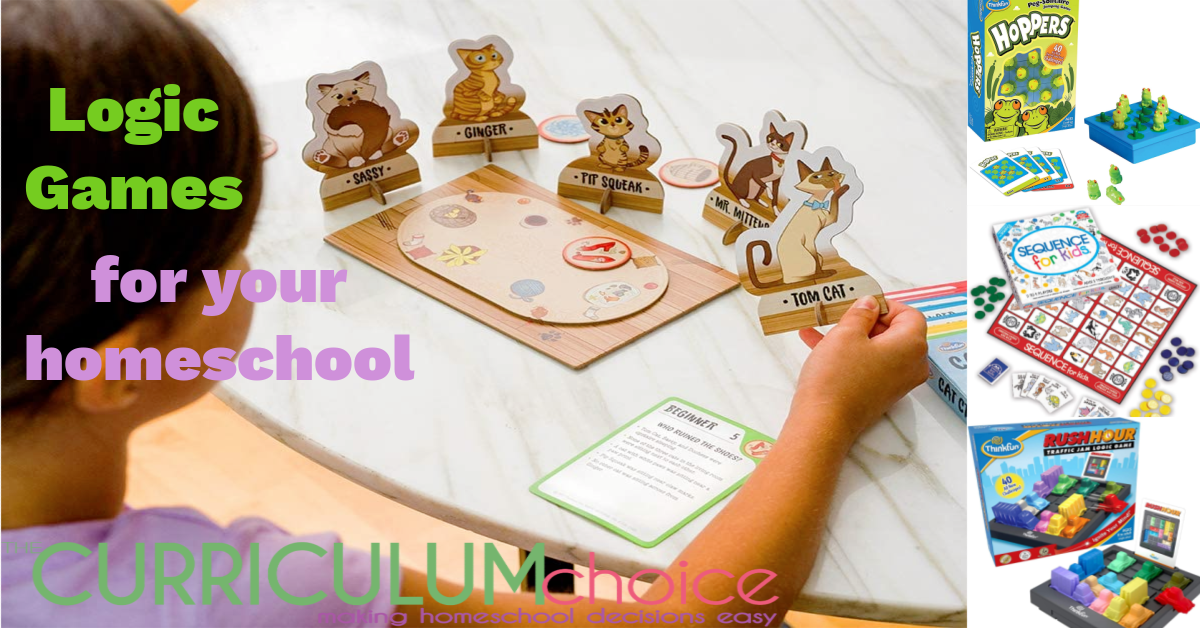
Remember my love for logic? Well, here I am again talking about incorporating more logic into your homeschool – this time through games!

I’m teaching a logic and critical thinking class at co-op this year and needed some activities that were both fun and challenging.  I hit the jackpot with Foxmind Games!

  • Each of the games below can be played by one person or a group of kids – it doesn’t matter.
  • They can be used with younger/beginning logic kids all the way up to adults.  Seriously.  Each game includes cards of varying skills.  The earlier cards are easier and require less critical thinking ability.  Each card as you go through the deck builds in logical intensity.
  • All the games use manipulatives, making them very hands-on and good for tactile learners.  But, they don’t have too many pieces to try to keep up with.
  • They are colorful and inviting.
  • All directions are concise and easy-to-implement.

ZooLogic requires you to arrange animals on a grid so that all the animals are peaceful.  In other words, no animal can be placed next to its rival or beside its favorite food.  A simple, illustrated chart supplies you with a quick-reference about who and what can/can’t be placed next to each animal.

My four-year-old is able to complete the earlier puzzles and loves the colorful animal pieces.  He had no trouble at all catching on to the rules.  Conversely, my middle school logic class gets a kick out of the game, too.  Obviously, they work more towards the middle and end of the spiral bound deck of 60 cards, but they can’t get enough.

Meta-Forms includes a simple 3×3 grid as the playing board, with nine attribute blocks as the playing pieces.  At first, the directions make the game seem as if the puzzles are nothing more than merely looking at a clue and placing an attribute block on the appropriate square.  Very quickly, though, the clues get harder and there is nothing extremely easy about placing nine shapes on the board.

My middle and high school logic classes have already spent many moments pondering the clues and working (then reworking) the pieces to try to find the correct configurations.  Each of the 80 puzzles (also in a spiral bound deck) in supposed to take only 5 minutes.  Tell that to my high school students.

Equilibro offers a spiral-bound deck of 50 cards on which 2-dimensional figures are pictured.  At the bottom of each card, you are given specific 3-diensional shapes you must pull out from the supplied set of blocks.  Using the photograph, you are to build a 3-dimentional structure with the blocks.

Again, the directions sound easy enough, right?  Again, the puzzles are only supposed to take 5 minutes each, right?  Again, tell that to my high school students!  The earlier puzzles are easy enough for 1st graders, but they quickly become more complicated and require much more critical thinking.  (Don’t worry, answer keys are provided for each of the games! )

What’s super-cool about Equilibro?  You can purchase other guides in their Brain Builder series which will utilize the same blocks from Equilibro, but focus on different structural concepts!

I’m new to Foxmind Games, but I’m in love!

-Written by Cindy, eclectically Charlotte Mason mom of three – 9th grade, 6th grade and K4 – living in Central KY.  You can find Cindy blogging at Our Journey Westward and find her NaturExplorers studies and other creative curricula at Shining Dawn Books.

Cindy was provided review copies of these games upon her request.  Her opinions are always her own.