Nov 302009
 

We completed a unit study on electricity earlier in the year.  As I was preparing for the unit, I kept wondering how in the world I was going to design hands-on electrical learning without having to buy lots of little pieces – and quite honestly, not really knowing what I was doing.

Enter the Electric Circuit KitBook.  This was an awesome tool!  Not only did it provide the hands-on experiences I was looking for, but included a teaching text, student booklet and all the required equipment!!  All in a nifty, self-contained package, too.

The price seems a tad high at $39.95.  I know that’s steep for most of us as one-income families.  However, you really need to buy nothing else for a complete, in-depth study of electrical circuits for upper elementary and middle school students.

Here’s what you’ll find in the kit:

  • A spiral-bound student text is attached to the experiment surface.  There are eight chapters, each with child-friendly explanations about the chapter’s topic.  There are several illustrations, photographs and charts, along with lots of color to keep your child’s attention.
  • Each chapter includes step-by-step experiments with illustrations that are completed on the sturdy, fold-out work surface.
  • All supplies are included with the kit including a battery, switches, safe wires, light bulbs, a buzzer, a spinning disc and several other small items.  These are contained in specific compartments within the kitbook so all the pieces can be easily found for experiments and easily kept for future use.
  • After experiments are completed, each chapter has a question section, a challenge and a science or history bonus paragraph or two about famous people or items relating to electricity.
  • A small student workbook is included separate from the kitbook that your child can write in.  It includes multiple choice, fill-in-the-blank and writing questions for each chapter, as well as a small glossary of terms.

My children learned A LOT from this KitBook!  Even more importantly, though, my children had fun.  They loved every minute of their time spent completing the lessons and still ask to “play” with it.  They’ve designed several electric circuits that weren’t included in the book based on the knowledge they gained during the study.

There is a teacher’s edition KitBook available.  Personally, I wouldn’t spend the extra money on it.  The student guide had plenty of information and didn’t leave me feeling like I had missed anything.

One other plus – extra parts are available for sale individually just in case one of your parts goes bad or gets lost.

And just what will your child learn?  Here are the chapter titles:

  1. Getting Started – What is Electricity?
  2. Simple Circuits
  3. Batteries
  4. Conductors and Insulators
  5. Switches
  6. Series Circuits
  7. Parallel Circuits
  8. Electromagnetism

There you have it!  Enjoy your time with electricity!

-Written by Cindy, eclectically Charlotte Mason mom of 3.  You can find Cindy blogging at Our Journey Westward and Shining Dawn Books.

Nov 272009
 

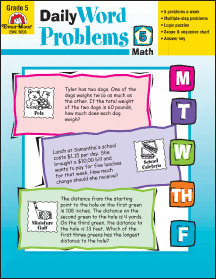
teacher-parent-store_2075_306356511The one area that our family tended to not work heavily on was word problems for math. It always seemed to be put in the back of the line with adding, subtracting and multiplying up at top priority. That was until I came across Evan Moor “Daily Word Problems” for Math.

Reading of course needs to be in place in order to really tackle the concept of word problems but once that is firmly established, this curriculum really helps.

Broken up into 5 problems a week with one and two step problems. This curriculum has really helped my oldest son learn how to read and understand math through words. At first he didn’t understand how sentences could turn into a math problem and was very intimidated by this concept.

Now, with the help of Evan Moor he doesn’t feel overwhelmed like he did with other curriculum that gave problems after problems each day. This only tackles a problem a day allowing him to master it, feel confident and then move on.

This book series will help sharpen your child’s problem solving skills, one problem at a time every day for 36 weeks. Each week’s problems are on the same theme. For instance one week is on the presidents and this gives them one problem a day for five days with that same theme.

This book series is in grades 1-6. Includes a scope and sequence chart and an answer key.

You can learn more about Evan Moor by going to their website @ www.evan-moor.com.

Written by Lynn Pitts, mom of 3, from Big Sky Country Montana. You can read more about her life at Learning by Living.
Nov 262009
 

This seems like a topic that has been covered elsewhere but I had a reader ask me about my thoughts and experiences with Sonlight and Tapestry of Grace. I will try to do my best at representing our family’s experience with both programs. I originally wrote this entry for my Harmony Art Mom blog in the spring of 2009.

First off, I love both approaches to homeschooling. Some of my fondest years of homeschooling were those years that we used Sonlight. The boys were young and eager to read and to be read to and Sonlight’s choices were a perfect fit for our family’s tastes. I really enjoyed having my days all planned out for me and believe it or not….I did not do much tweaking to Sonlight’s well presented plans. (In fact, if you use my Harmony Fine Arts plans, you will see a striking resemblance to Sonlight’s format.)

I can't bear to part with our favorite Sonlight books.

I can't bear to part with our favorite Sonlight books.

We used Sonlight’s Core Levels 2, 3, 4, and 6. We also used Levels 2, 3, 4, 5, and 6 for science. Somewhere during those years, I found The Well-Trained Mind book and decided that I really liked the idea of a four year cycle of history and I began investigating this idea some more.

We made the decision to switch to a curriculum that followed the four year cycle of history and included the Story of the World books. After much deliberation, we decided on using Tapestry of Grace. We picked up where Core 6 left off and that was with Tapestry of Grace year 3. My boys were in 6th and 7th grades at that time.

There really were two big adjustments coming from Sonlight to Tapestry of Grace.

Choices in Books and a Little More Planning

First of all, the TOG plans are so flexible that you really need to sit down with access to your home library, your local public library, and the internet to coordinate which books you will use to teach each concept. I take each unit’s plans and go through and decide on which books I would like to use to present each week’s concepts. There is definitely a learning curve when it comes to knowing how many books you need to use each week. Within each week, the books are not broken down by pages like in the Sonlight plans. You are given the title of the book and you are left on your own to cover it at a pace that you choose.

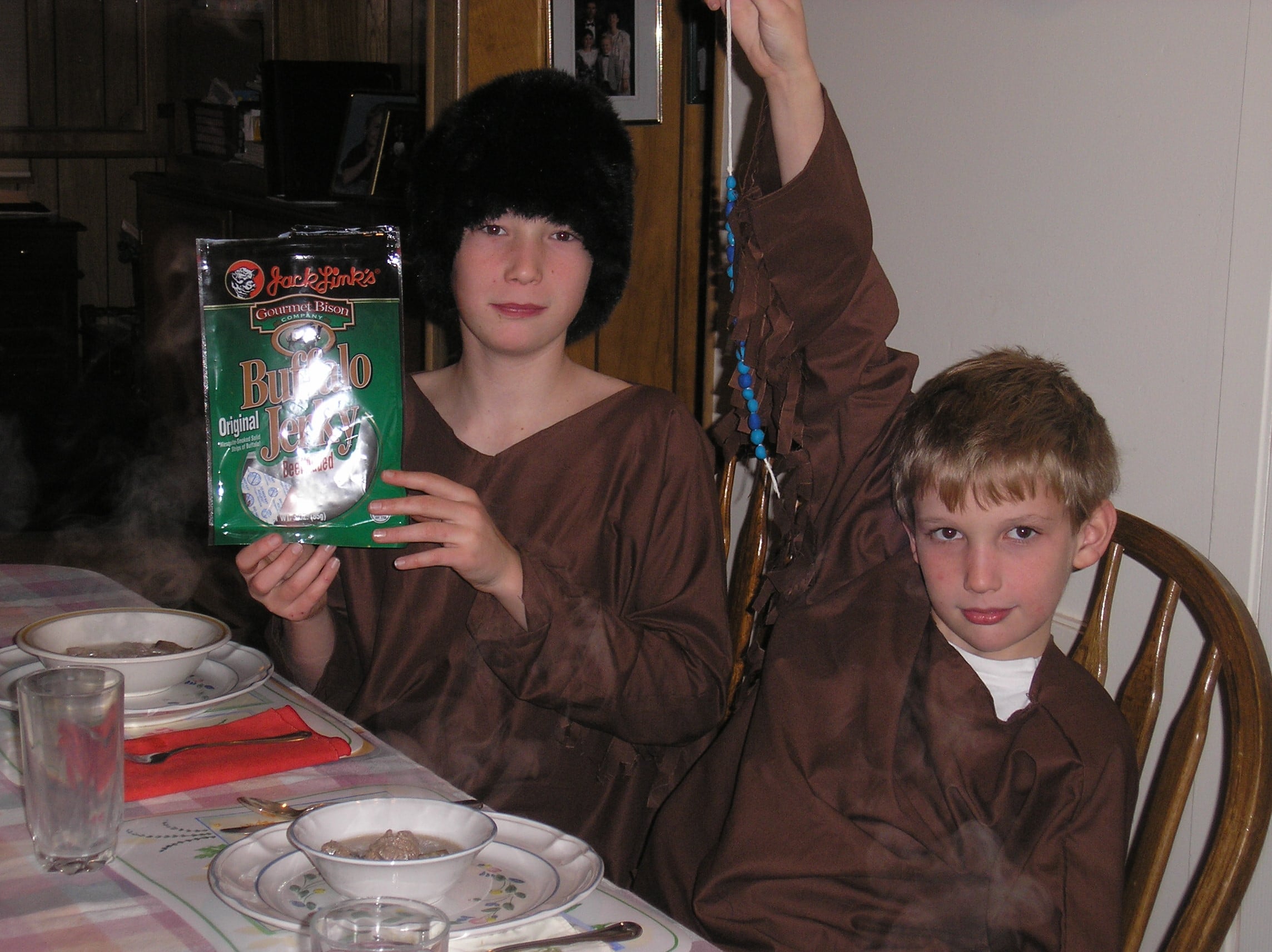
Unit Celebration Year 3-Lewis and Clark Dinner

Unit Celebration Year 3-Lewis and Clark Dinner

With Tapestry of Grace, I would say that it takes two hours of initial planning per unit (nine weeks) to decide on books and to decide on activities. It also takes an additional 45 minutes or so per week to make sure you have the books you need and if your children are older, to go over the schedule with them to put in their planners. I use the library for many of our books so that means a trip to the library at least every three weeks to check out and return books. We would be doing that library trip anyway so I don’t count that into the planning time.

If you are a box checker, TOG will seem overwhelming unless you understand right up front that you will *not* do everything put down in the plans.

The way that TOG can be a huge time saver in a larger family is the ability to offer history, literature, writing, art appreciation, hands-on activities, geography, and more to everyone from one set of plans. You can keep all your children together in all these subjects and choose from the different levels of books as you go along. The subjects are taught topically and you can use your own resources as well if you want to substitute.

The thorough Teacher’s Notes have been a great help to me as the boys have moved up to the rhetoric level. The notes are very well done and the research has been done and gathered for me.

The advantage of Tapestry of Grace over Sonlight is that you are teaching things topically and you can substitute your own books or books from your public library if you want to. The plans are not put down in such a way that if you don’t have access to a certain book that you are stuck for the week. Another advantage to using Tapestry of Grace is the fact that you can move up and down the levels within each week, using what is appropriate for your particular child. One week your child may read the upper grammar level literature and the next you can offer the dialectic level book if you think they would benefit from it instead. The opposite is also true and you can have your rhetoric level student move down and read the dialectic selection some weeks if the load is too heavy and you need to offer something a little lighter. We do that sometimes if the ideas and concepts are new to our boys.

Tapestry of Grace Unit Display Year 2

Tapestry of Grace Unit Display Year 2

More Meaningful Discussions

The second *huge* difference for us moving from Sonlight to Tapestry of Grace has been the increased expectations as far as the boys’ manner of learning. TOG has helped me to make the boys more independent learners. Many times the Sonlight discussions felt like question and answer time but with TOG we have deeper, more meaningful discussions. I think it is the way the material is not spoon-fed to them. Here is a link to some information on TOG’s website that will explain it better than I can.
Teacher’s Notes

Those are my general thoughts about our experiences with both Sonlight and Tapestry of Grace. I would highly recommend going over to Tapestry of Grace’s website and downloading the free complete samples that they offer. You will get a little taste of how the plans are scheduled out and how they differ from Sonlight. Remember there is a learning curve and know that after the first few weeks of using the plans you will be more skilled at knowing how they work together.
Tapestry of Grace-Free Sample

Just so you know, I am not an affiliate for Tapestry of Grace. The thoughts here are my own personal opinions and were drawn from our own experiences. As the years have gone by, our homeschool style has changed quite a bit and I am much better equipped to adapt TOG to our Charlotte Mason/Classical/Project based style of learning. It takes some effort but now that my children are much older, I have the time.

Written by Barb-Harmony Art mom.  She also blogs at http://harmonyartmom.blogspot.com and her business is found at http://www.harmonyfinearts.com. I would love for you to join us for the Outdoor Hour Challenges: http://handbookofnaturestudy.blogspot.com.

Nov 252009
 

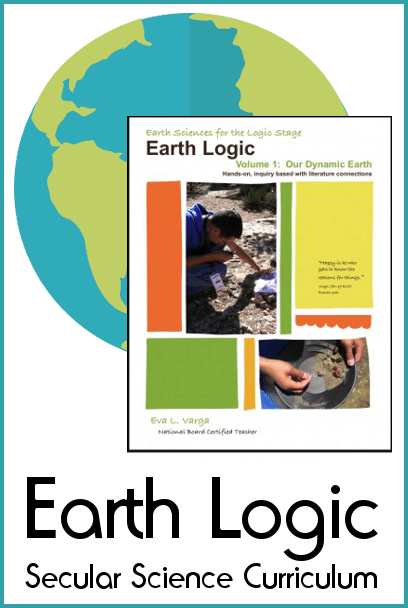
Our Dynamic Earth CurriculumFinding a good science curriculum for middle schoolers can be a challenge, and Makita has created another option for homeschoolers. Makita is a former public school science teacher, and has quite a resume, so she knows how to write effective lessons with creative experiments. Her Science Logic curriculum is a collection of secular lessons and activities for middle school students. There are three themes — Life Logic, Earth Logic, and Physics Logic. Eva gave me a free ebook copy of Our Dynamic Earth (part of the Earth Logic theme) to review.

Our Dynamic Earth is a ten week course, with two lessons for each week. It appears to be a very flexible program; there is no daily schedule or checklist. Instead, there are lesson plans and hands-on activities to demonstrate the science being learned. Each lesson begins with objectives, a list of needed materials, and an overview. Then Makita jumps right in with the science. You’ll find lots of scientific vocabulary and diagrams in the lessons. Then there is some type of activity. These vary greatly from complex backyard projects to kitchen table experiments to paper models. Some of the activities require specialized items, and Eva gives suggestions for where to find them.

Most lessons have additional websites to explore for further information. Some lessons have a list of good living books to read and extension activities. Other lessons have diagrams to label, a webquest, or flow charts. Each lesson is quite different from the other. Eva has done a good job of tailoring the activities to the information rather than following an arbitrary pattern.

As a secular curriculum, Our Dynamic Earth is based on evolutionary science.  There are two entire lessons devoted to this teaching – “Earth’s Beginnings – Timeline of the Earth” and “The Fossil Record.”  And of course, the evolutionary terminology and assumptions are evident throughout the curriculum.

Who will like this curriculum:

  1. Secular homeschoolers
  2. Hands-on homeschoolers who crave complex experiments and demonstrations
  3. People with a backyard (at least two projects require a large open space outdoors) and access to specialized materials (ammonium dichromate, ammonium nitrate, zinc dust, sand samples, rock samples, for example)
  4. People who enjoy variety
  5. People who want the facts laid out quickly and clearly so they can quickly move on to the fun experiments and their own explorations (versus living books or textbook approaches)

Each course comes in an ebook format for $14 and two different print formats for $17 and $20. Visit the Science Logic site for more details. I’m sure Makita will be happy to answer any questions you have.

Nov 232009
 

giveaway

Home Educating Family

Finally, a magazine for the thinking family.

Now through Nov. 30th, Home Educating Family magazine is giving away 50, 1 year subscriptions to the readers of Curriculum Choice.  That’s something you can mark off of your Christmas wish list!  Also, you will be entered into a chance to win a copy of The Welled Planned Day planner.  This planner looks spectacular!

The Home-Educating Family is the gateway for your family to be a part of the most meaningful discussions taking place in the homeschooling community today.

Teaching your children at home in the 21st century is starkly different than it was over thirty years ago when the homeschooling movement began. Families now have more options, support and resources than every before! The mission of HEF is to keep you abreast of all that is crucial and all that is available to you as a family so that your family can have the very best home-educating experience possible.

HEF is committed to addressing those topics that influence us most deeply, such as changing educational programs, parenting, marriage and gender, and the family’s important roles in the church and the government. At the same time, we give you immensely practical advice on implementing the newest and best ideas in homeschooling!

HEF is for families who want their children to be able to think and thoughtfully engage the culture. Homeschoolers have the advantage of avoiding some of the worse elements of our world, but we also have the responsibility of changing our world. HEF hopes to give you the encouragement, inspiration, and information to do just that!

To enter into the contest give away click here.

 Posted by at 11:26 am
Nov 192009
 
050947: The Well-Educated Mind: A Guide to the Classical Education You  Never Had The Well-Educated Mind: A Guide to the Classical Education You Never Had

By Susan Wise Bauer

I have a small confession to make. One of the reasons I homeschool is pretty selfish. I want to homeschool because it gives me the opportunity to learn so many things that I didn’t learn in my own years of formal education. Although I have always loved to read, I didn’t study many of the classics. I love history now, but learned very little about history in my school days. Foreign language? Let’s not even go there.

Trying to give my children a classical education without having one myself is both exciting and scary. So far, I’ve done a lot of learning alongside my kids. But that’s going to be harder to do as my children get older. That’s one of the reasons that a few years ago I purchased a copy of The Well-Educated Mind by Susan Wise Bauer. The sub-title is A Guide to the Classical Education You Never Had. That’s exactly what I need.

The book begins with an apology for reading and how the practice of reading helps you to train your mind. Bauer urges a set-time for reading. She then details how to read a book and keep a journal, as well as writing short chapter summaries. These recommendations are very detailed and specific.

The bulk of the book is devoted to what to read. Literature is divided up into 5 categories: the novel, the autobiography, the tales of historians, drama, and poetry. In each section, Bauer details how to read each type of literature. This is followed by lists of recommended works that include summaries of each book.  Each list is in chronological order by the approximate date written, since the “discussion’ should be read from beginning to end.

My husband and I are reading through the classics using The Well-Educated Mind as our guide. As I’ve looked back over the book, I have noticed that we haven’t been going through all the steps as detailed. However, just using Bauer’s list to select reading has been invaluable to us. I do intend to begin studying the books more thoroughly. I highly recommend this book as a resource for an adult or high school student who wants to learn how to read and analyze the Great books.

Written by Kristen, a relaxed classical homeschool mom of 4. Kristen blogs at A Day in the Life.

Nov 182009
 

HeroTales by Dave and Neta Jackson

Homeschooling moms are great multi-taskers and always on the lookout for items that also multi-task. Hero Tales by Dave and Neta Jackson, the authors of Trailblazer Books, is part church history, part devotional, and part character study. This book can be used with various age groups and double as a family devotional. The book is geared for children aged six to twelve, however, with guidance you can engage a younger child. An older child could benefit by using this as an outline for further in depth study into one or more of the featured Christians in the book. However, the text would be too simple for a child above the age of 12 to read on his own. If you have have a vast array of age groups this book is best used as a family devotional.

Hero Tales, compiles the lives of Christian heroes from William Tyndale to Harriet Tubman to Dwight L. Moody. The stories are inspirational and teach valuable character traits which glorify God. Each hero is presented by a brief biography and followed by three true stories each focusing on a particular character trait. At the end of each true story there is a verse linking the trait to the Bible and three study and discussion questions.   Martin Luther

For example the book includes Martin Luther as one of the heroes featured. Martin Luther’s life is briefly outlined for background. Following the short biography, the child will focus on vision, courage and joy in each of the stories on Martin Luther.

These heroes will inspire and teach Godly character. Along the way, your child will begin to learn an overview of church history. You can read this book daily or you can take the time to focus on each hero or a character trait you want to instill in your child. I am using this book with my 11, 9, and 4 year old. I will be assigning my 11 year old to choose a person from the book to write a biography. My 9 year old will focus on writing a few short paragraphs on a character trait that he can begin to implement in his life. My 4 year old, will begin to memorize short verses on the character traits studied. As a family, we will use the questions to open up lines of communication and instill values.

I recommend this book to anyone who wants to bring church history, devotional time, and character study to their elementary aged children.

Written by Richele, classical and Charlotte Mason inspired, homeschooling mom, to four reflections of God’s love.  She blogs at www.underthegoldenappletree.blogspot.com.

Nov 172009
 

I knew my son needed to learn how to read, but I’d never taught anyone. I debated the decision to homeschool. I worried and fretted. Then I resolved to trust the process. I’d been taught the basics of teaching phonics through a program called, Writing Road to Reading.

We used it. It worked!

Then we got to the spelling rules and the notebook work. I had a general idea of what to do, but really wanted more examples. That’s when I discovered Spell to Write and Read by Wanda Sanseri.

Spell to Write and Read

Mrs. Sanseri started her program by writing helpful tutorials to go along with Writing Road to Reading. Soon it became it’s own separate manual.

I purchased an older version called, Teaching Reading at Home, but from what I can tell the new version is similar. There are specific tutorials for teaching letter formation, step by step instructions for working through the program, and sample notebook pages.

By the time I invested in this curriculum, my son had already learned the 70 phonograms, but I still found it helpful. What we did use daily was the second part of the curriculum, The W.I.S.E. Guide to Spelling.

The W.I.S.E. Guide breaks down the spelling lists and gives lots of ideas for using each week’s words. I found that especially helpful.

Spell to Write and Read is a total language program. It teaches reading, writing, and spelling all at the same time. Children learn to write the letters as they learn their sounds. Then they compile their own spelling book that reinforces what they already learned. It is an investment that can be used for multiple grade levels. The spelling portion can be used all the way through high school.

There are a lot of recommended resources, but all that is really needed are the two books mentioned above and some form of the phonogram cards. Mine were cut out of our Writing Road to Reading book and covered with contact paper. Two of the phonograms are different, but my son didn’t even notice.

This year I added two Learning Logs from Wanda Sanseri’s site, Back Home Industries. A composition book can be used instead. I splurged a bit, because it’s time to teach my two little girls to read.

I’m looking forward to it this time around. The fear is gone. It’s been replaced by the wonder and simplicity of laying a solid foundation of learning.

Nov 162009
 

Our family completes artist study once per month during the school year.  We focus on one artist during that month – learning about their life, observing their art and completing art projects of our own.

One super book that has helped us during this art study time is The Usborne Introduction to Art by Rosie Dickins and Mari Griffith.  Even more than being a specific help during artist study, it’s been an awesome, well, introduction to art!

In a 144 page, hard-cover, fully-colored book, you (oh, and your children!) are introduced to all sorts of art and artist related topics such as:

  • how to look at paintings critically
  • noticing art themes – like prayer, war, Biblical scenes and more
  • recognizing scenes
  • watching for illusions
  • artist’s materials and how they’re used
  • sections on Ancient/Medieval art, The Renaissance, Baroque/Rococo, Revolution art and the Modern World of art

Each and every page of this book is brightly colored with authentic artwork, photographs and “just enough” reading material for the typical upper elementary and middle school student.  As with most artist study books, there are a few nudes here and there.  If you’d rather your children not view these, you will need to preview the pages.

As with many Usborne books, this book is internet-linked, which means every few pages offers you a quick-link resource where you can go to find more about a certain topic on a safe internet site.   There’s also a neat section in the back with an art timeline going from ancient times all the way to 1995.  (The very first notation on the timeline mentions cave paintings dating to about 35,000BC.  This is the only questionable reference I found.)  You can also find a brief biography of each artist highlighted in the book – that’s about 140 artists – and a glossary of art terms.

The Introduction to Art has been a wonderful addition to our library!

There’s one more fun book I’d like to mention, just because we’re talking about art and Usborne.  :)

The Art Sticker Book goes along with Introduction to Art very well.  It’s sort of an introduction in and of itself.  On each two page spread, there is information about a certain topic like:

  • fashion
  • children
  • nature
  • self-portraits
  • and 11 more!

In the back of the book, your children find full-color, authentic artists painting stickers to place in the correct picture frames on the information pages.  My kids have had a ball with this book!

Along with these books, don’t forget about the Dover Art Cards as great art resources.   What have you used to spice up art/artist study time?

-Written by Cindy, eclectically Charlotte Mason mom of 3.  You can find Cindy blogging at Our Journey Westward and Shining Dawn Books.

Nov 132009
 

A little over a year ago, I was in eastern Washington at a teacher store and I came across a few books called “Build-a-Skill Instant Books”. I thumbed through them and thought these would be great for both of my boys to use. What I loved about them at first glance was it reminded me a lot of lapbooking.

Grades 2-3 Language Arts Books

Grades 2-3 Language Arts Books


If you’ve done lapbooking before you might be familiar with the concept of cutting out templates or booklets and filling them in with information and pasting them into a folder, binder or scrapbook.

Grades K-1 Series of Books

Grades K-1 Series of Books


I decided to purchase all of them since I live in Montana and have never seen them locally. They come in two sets of grade levels. K-1 and 2-3. The ones we are working on are all pertaining to Language Arts and are very hands on in approach. They do have Math books to use but we have not used those.

Grades K-1 come in several different areas of study for Language Arts including:

  • Word Families-short vowels
  • Word Families-long vowels
  • Consonant Blends and Digraphs
  • Color, Shape and Number Words
  • Short and Long Vowels
  • R-Controlled Vowels-Vowel Digraphs
  • Sight Words, Part 1
  • Sight Words, Part 2
  • Beginning-Ending Consonant Sounds
  • Synonyms and Antonyms

Math includes:

  • Time and Money
  • Math Facts to 20

Grades 2-3 areas of study include:

Language Arts:

  • Synonyms-Antonyms
  • Homophones
  • Contractions
  • Irregular Vowels
  • Compound Words
  • Prefixes-Suffixes
  • Plurals
  • Parts of Speech
  • Verb Forms

Math includes:

  • Multiplication and Division
  • Time-Money
  • Fractions
Short Vowel Word Family Booklets

Short Vowel Word Family Booklets

We’ve worked on several of these books in both grade levels and my boys have learned alot.  Each book has several styled books to cut and fill out. Some to color if you choose or copy them onto colored paper. We have taken the books they’ve done and placed them like lapbooking or added them to existing lapbooks they were working on that related to the Build-a-Skill books.

Learning Sight Words Booklets

Learning Sight Words Booklets

They include different booklets to cut out to learn different concepts. For an example on the sight words that you can see to the left here there is many ways to teach the sight words through these books that will help reinforce the spelling of each word. Such as writing them out with your “I Can Read” and “I Can Write” flip books and then taking those same words and seeing them in sentences while filling out different booklets and coloring pictures.
Even though these come in the grade levels specified I noticed some concepts were a bit advanced for the grade they recommended so we waited to introduce the concepts. They are easy to use and fun to put together.
 
 
Once you purchase the books you will need to photocopy the pages for your child to cut out and put together so there will be an additional cost for that.
 
 
The books are inexpensive to purchase at around $4.99 each and can be copied over again for more than one child.
 
 
If you are looking for a hands on way of teaching Language Arts and Math that is fun and engaging then these might be something to explore. We love all of the books this series has to offer and will continue to use them until all of these concepts are mastered with all of our children.
 
 
You can find some of these books as an instant download @ www.currclick.com or you can visit their website @ www.creativeteaching.com
 
 
Written by Lynn Pitts, mom of 3, from Big Sky Country Montana. You can read more about her life at Learning by Living